
Pietro Beccari – LVMH Fashion Group New CEO. Story by Eleonora de Gray, Editor-in-Chief of RUNWAY MAGAZINE. Photo Courtesy: LVMH / Louis Vuitton / Givenchy.
LVMH has announced, with the calm confidence of a system speaking to itself, that Pietro Beccari—currently CEO of Louis Vuitton—will now preside over the entire LVMH Fashion Group, while naturally keeping control of the maison that already dominates the group’s symbolic, financial, and narrative center of gravity. A strategic reorganization, we are told. One might also call it an exercise in concentration.
He succeeds Sidney Toledano, a figure so structurally embedded in the LVMH ecosystem that his departures have always been temporary, his exits provisional. At 74, Toledano is now really leaving operational duties—after more than three decades shaping Dior, then supervising the fashion division, while remaining omnipresent through Delphine Arnault and ANDAM. This handover is presented as a generational transition. In reality, it is closer to a controlled inheritance.
Beccari’s professional résumé is, on paper, exemplary. Dior, then Louis Vuitton. Global desirability engineered with method. Brand positioning sharpened to the point of inevitability. Storytelling treated not as a narrative craft, but as a logistics system aligning product, campaign, celebrity, and repetition. No one disputes the efficiency.
What is more interesting is what kind of efficiency is now being elevated to group doctrine.
Under Beccari’s watch at Louis Vuitton, storytelling has increasingly replaced substance, not as metaphor but as practice. When the chequerboard pattern—once a recognisable visual code—lost its trademark protection, the response was not creative reinvention but textual insistence: the phrase “Marque L. Vuitton déposée” printed, repeatedly, across garments as if legality itself were a design language. A brand declaring ownership because symbolism alone no longer sufficed. The subtext was clear: when identity weakens, redundancy becomes a strategy.
Then there is the question of materials and ethics, awkwardly persistent distractions in an era that likes to describe itself as “responsible.” Crocodile bags and rare animal products continued to pass through the creative and commercial pipeline without visible discomfort. Not because these choices are new—luxury has always eaten contradiction for breakfast—but because they were defended through silence masquerading as tradition. Ethics, here, were not debated. They were archived.
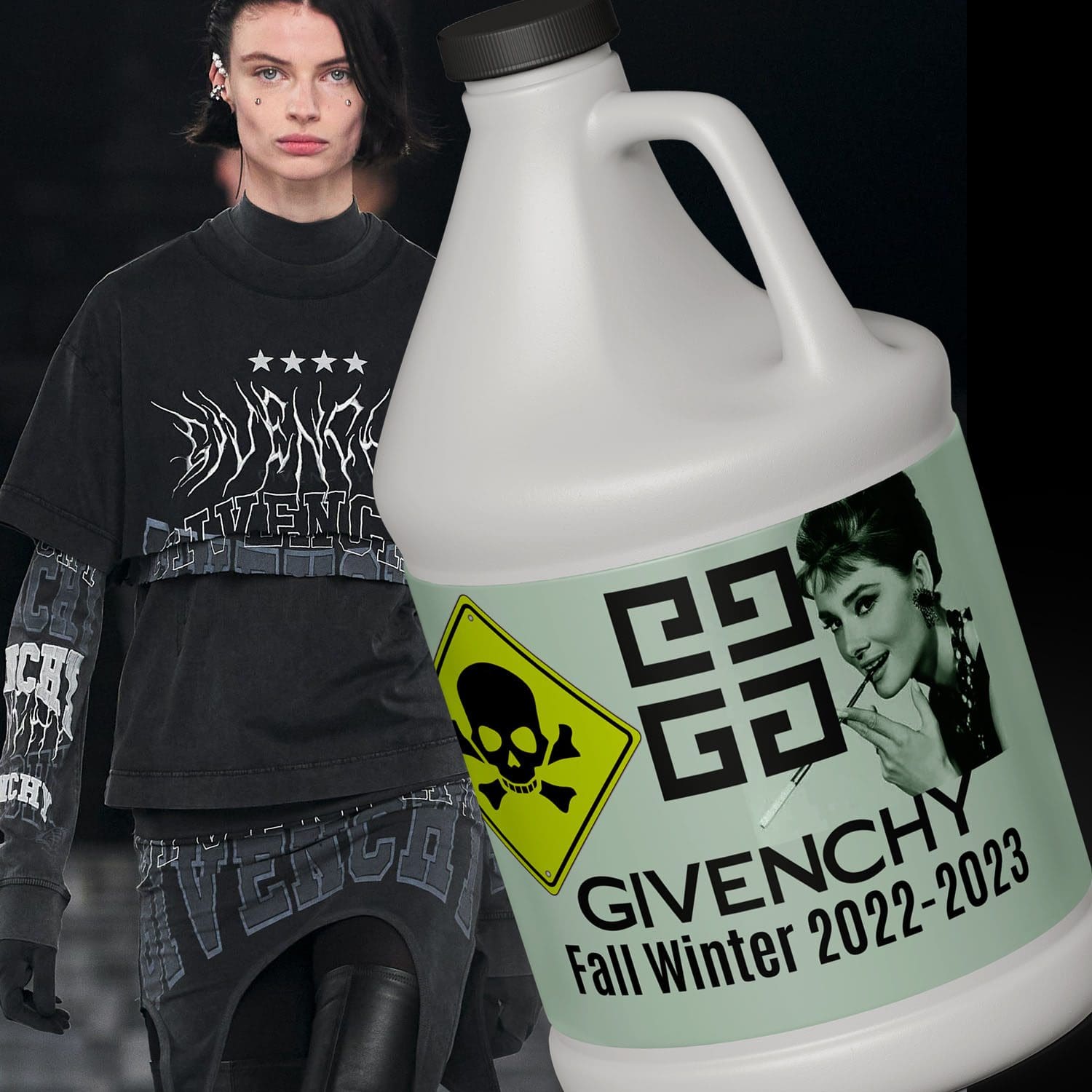
At Givenchy, the imprint was different but no less decisive. The Pietro Beccari era marked a systematic erosion of the house’s identity: visual dissonance, conceptual confusion, and what can only be described as ideological noise polluting design coherence. The resulting accumulation felt less like evolution than contamination—creative waste rather than transformation.
Placed in this context, Beccari’s promotion raises a delicate question that LVMH, predictably, does not ask aloud:
Is the future of the group’s fashion division about nurturing plural identities—or about scaling a single, dominant operational logic across multiple houses until distinction becomes inefficient?
Because supervising Celine and Givenchy requires more than maximizing visibility and desirability metrics. It demands restraint, cultural literacy, and an understanding that not all brands benefit from the same accelerants. Some maisons collapse under excessive optimization the way ecosystems fail under monoculture.
There is also the quieter issue of selective representation. Beccari’s strategies have often leaned toward prioritizing specific cultural or demographic narratives—not as inclusion in the broader human sense, but as targeted market exploitation. “Audience focus,” in corporate language. One could also use the term segmented favoritism: visibility granted strategically, unevenly, and always convertible into short-term attention. This is not diversity as dialogue; it is diversity as deployment.
LVMH frames this appointment as a move to “strengthen strategic coherence” during a global luxury slowdown and a moment of creative recomposition. Coherence, however, is not neutrality. It is a value choice. And in that choice lies risk.
Pietro Beccari’s method operates differently: speed, saturation, narrative override, and the confident assumption that desirability can always be manufactured faster than meaning.
The question is not whether this works financially. The question is whether, at group level, this logic produces a fashion division—or merely a scalable branding machine with interchangeable skins.
LVMH has bet that the man who mastered Louis Vuitton’s expansion can now choreograph the entire fashion ecosystem. Perhaps he can. But if every house begins to speak the same visual language, repeat the same slogans, and rely on the same shortcuts when identity frays, the group may discover that coherence, when over-applied, looks suspiciously like fatigue.
History will decide whether this appointment marks a strategic evolution—or the moment when fashion leadership falls to dust. Either way, LVMH has made its choice very clear.
The only uncertainty left is whether the houses now under Beccari’s supervision are meant to express themselves—or simply to perform with crocodiles on.
