
Balenciaga – A Legacy of Hourglass. Story by Balenciaga with Introduction of Eleonora de Gray, Editor-in-Chief of RUNWAY MAGAZINE. Photo Courtesy: Balenciaga.
Introduction
Editorial Note by Eleonora de Gray
Fashion houses love to mythologize their geometry, yet rarely do they surrender the compass to a true philosopher. In an era obsessed with transient novelty, tracing Cristóbal Balenciaga’s sacred curve demands something deeper than marketing: it requires archaeology. From Ambrogio Lorenzetti’s fourteenth-century allegory of Temperance in Siena to the architectural suspension born in the maritime air of Getaria, the Hourglass has never merely been a silhouette. It has always been an instrument of measure—an defiance of gravity where the body breathes inside sculpted volume without the violent cage of corsetry.
Leave it to an enigmatic maison to deliver an unsigned dissertation when launching a handbag. Yet beneath this anonymous corporate modesty lies a brilliant historical treatise penned by fashion philosopher Benjamin Simmenauer—one that properly situates Cristóbal Balenciaga not among mere tailors, but alongside Renaissance cartographers and maritime navigators.
Cristóbal understood that true cut is about space, suspension, and restraint. For years, contemporary fashion mistook that restraint for harsh armor. Enter Pierpaolo Piccioli. With ClairObscur, Piccioli proves once again why he remains the premier humanist of modern couture. In the new Hourglass Avenue, he preserves the sacred Basque curve while liberating it from cold rigidity—allowing supple box leather to dent, drape, and soften under human touch. Pierpaolo does not simply inherit Balenciaga’s legacy; he gives its legendary spine a pulse.
During his time at Balenciaga, Pierpaolo Piccioli performs what can only be described as an act of pure poetic grace. Where modern luxury spent a decade encasing Cristóbal’s line in rigid resin, Piccioli introduces Italian warmth and emotional fluidity. He strips away the stiff shell to let the leather crease, live, and remember. In Piccioli’s hands, Balenciaga’s architecture ceases to be an unyielding museum relic; it becomes an intimate dialogue with time itself.
RUNWAY MAGAZINE presents the house’s chronicle on the evolution of this masterwork. The official historical exploration of the Hourglass, published in full.
Story by Balenciaga House
Philosopher of fashion Benjamin Simmenauer traces the House’s iconic Hourglass silhouette from runway to accessory for the launch of Pierpaolo Piccioli’s Hourglass Avenue Bag.
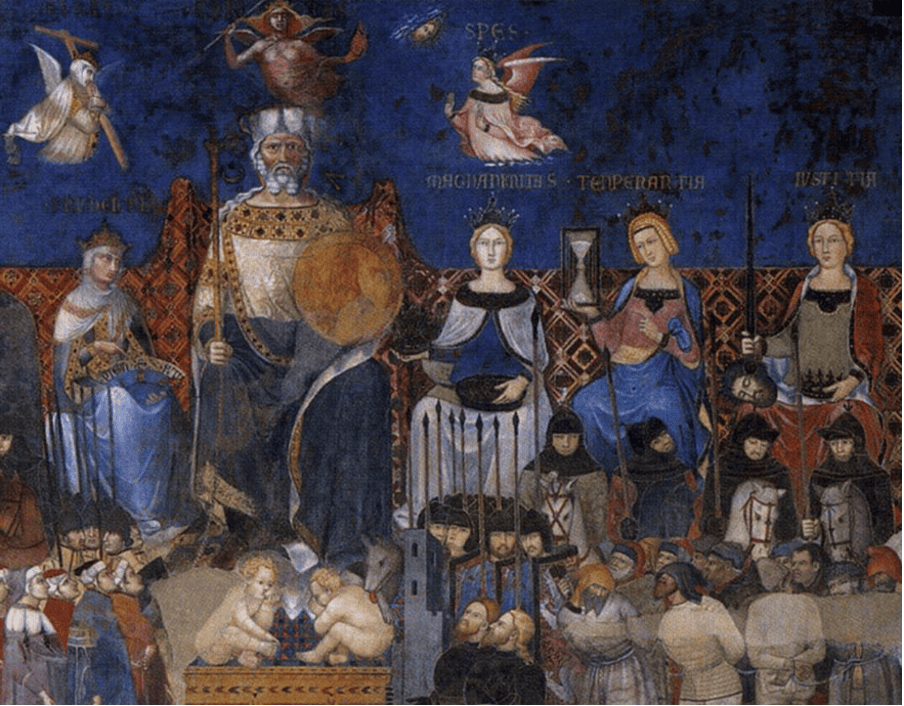
The hourglass appears first in Ambrogio Lorenzetti’s Allegory of Good Government, a fresco painted in 1338 on the walls of Siena’s town hall, where the virtues that make a city governable sit in a row. The figure holding an hourglass is Temperance, the virtue of measure. Within a few years it was standard equipment on ships: unlike a water clock, it kept its measure while everything around it moved.
Cristóbal Balenciaga was born in 1895 in Getaria, a fishing port on the Basque coast whose other famous native, Juan Sebastián Elcano, brought Magellan’s last ship home in 1522. The fleet had left Spain with 18 hourglasses in its inventory. Cristóbal’s father, José Balenciaga Basurto, was a mariner: skipper of the Guipuzcoana, a shallow-draft state boat on customs duty that ferried Queen María Cristina and her children during their summers in San Sebastián.
The sea never left Balenciaga’s work. The vareuse, the fisherman’s smock, became a house garment in its own right; a fishing net became a dress; the headdress of the single-seam gazar wedding gown that closed the 1967 collection, stiffened and closed over the head like a hood, was a memory of the oilskin hats worn in Getaria.
The hourglass silhouette, whose first sketch entered the house in 1939, may have the same source. In fashion, hourglass means a narrow waist between wide hips, a shape Western dress has been building since the 16th century with farthingales, busks, whalebone and padding, and almost never with the body alone.
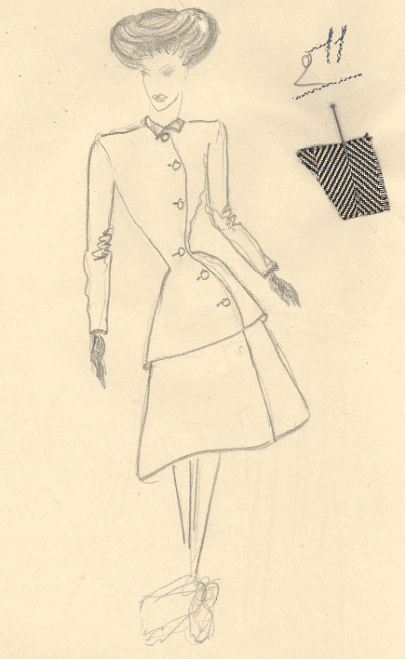
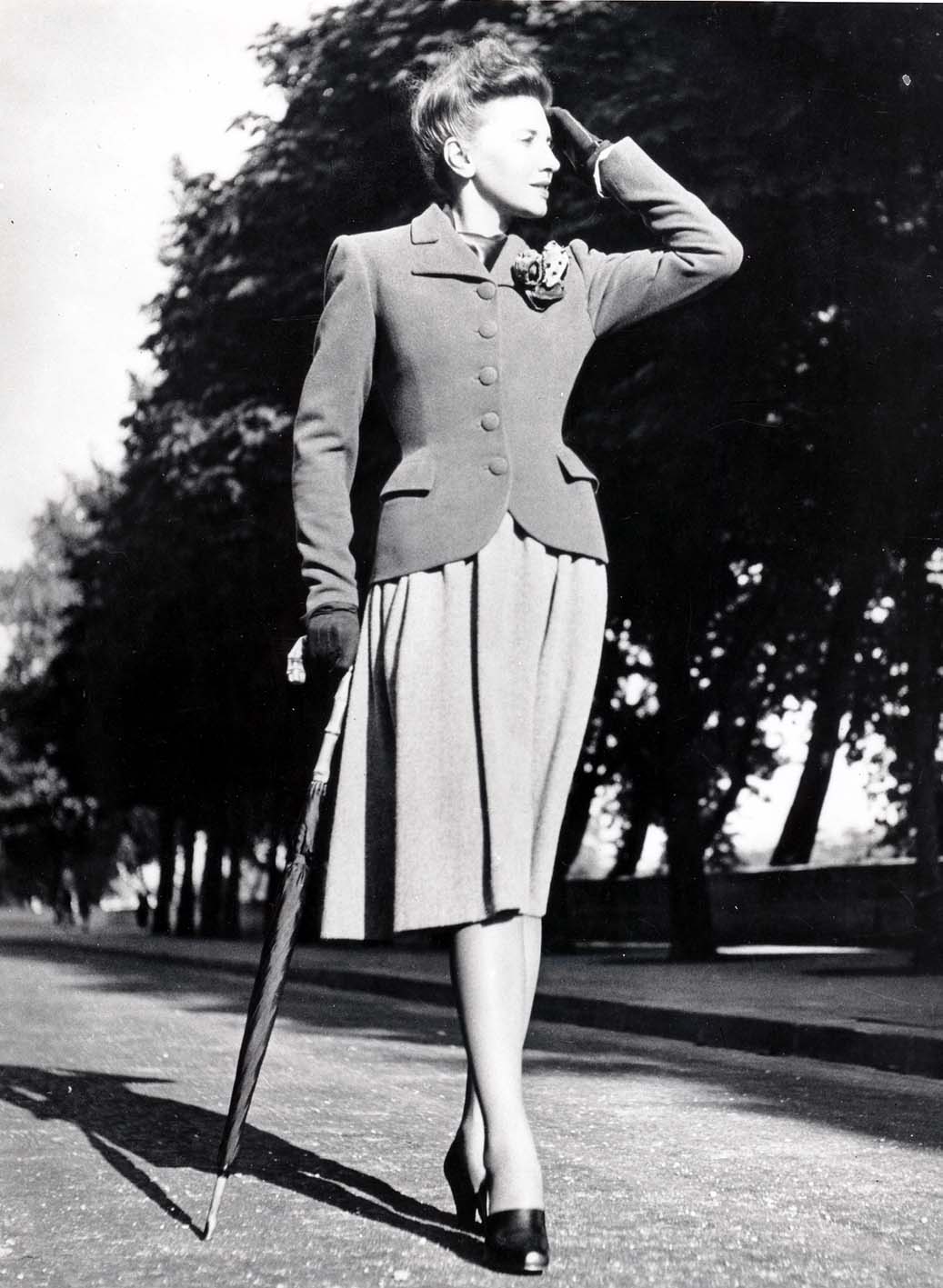
The single-garment version is already in the same collections, on a smaller and far less spectacular piece. A house photograph of a winter 1939 tailleur shows a jacket with a rolled collar and flap pockets that draws in at the waist and comes out again over the hip. The curve is shallow, the waist only lightly marked: a first attempt, a less pronounced version of what the house would later make its signature. The line proper arrives with the tailored suits and peplumed jackets of summer 1943, and by 1945 the flare has become a full basque. From there the shape is fixed and repeated season after season.
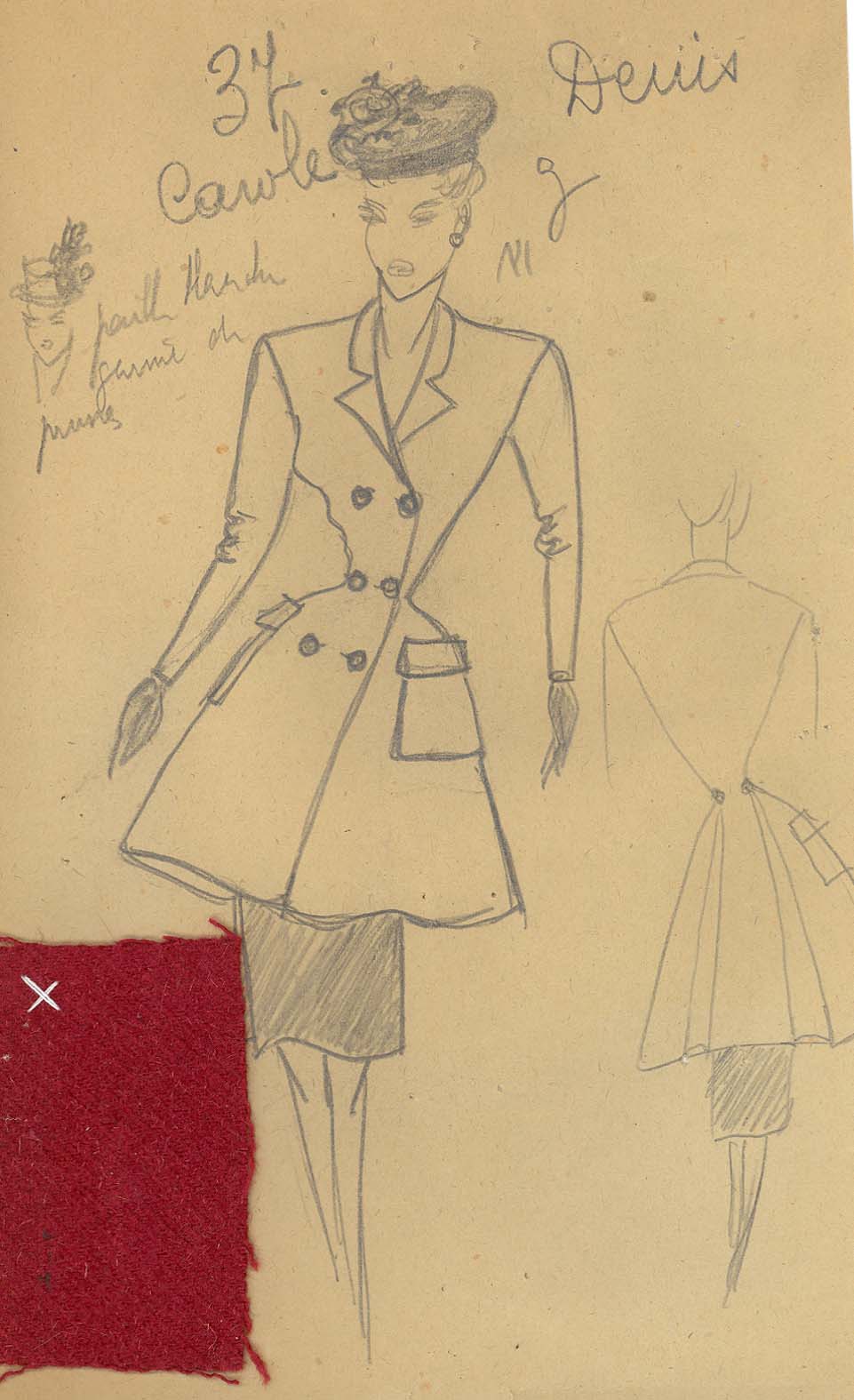
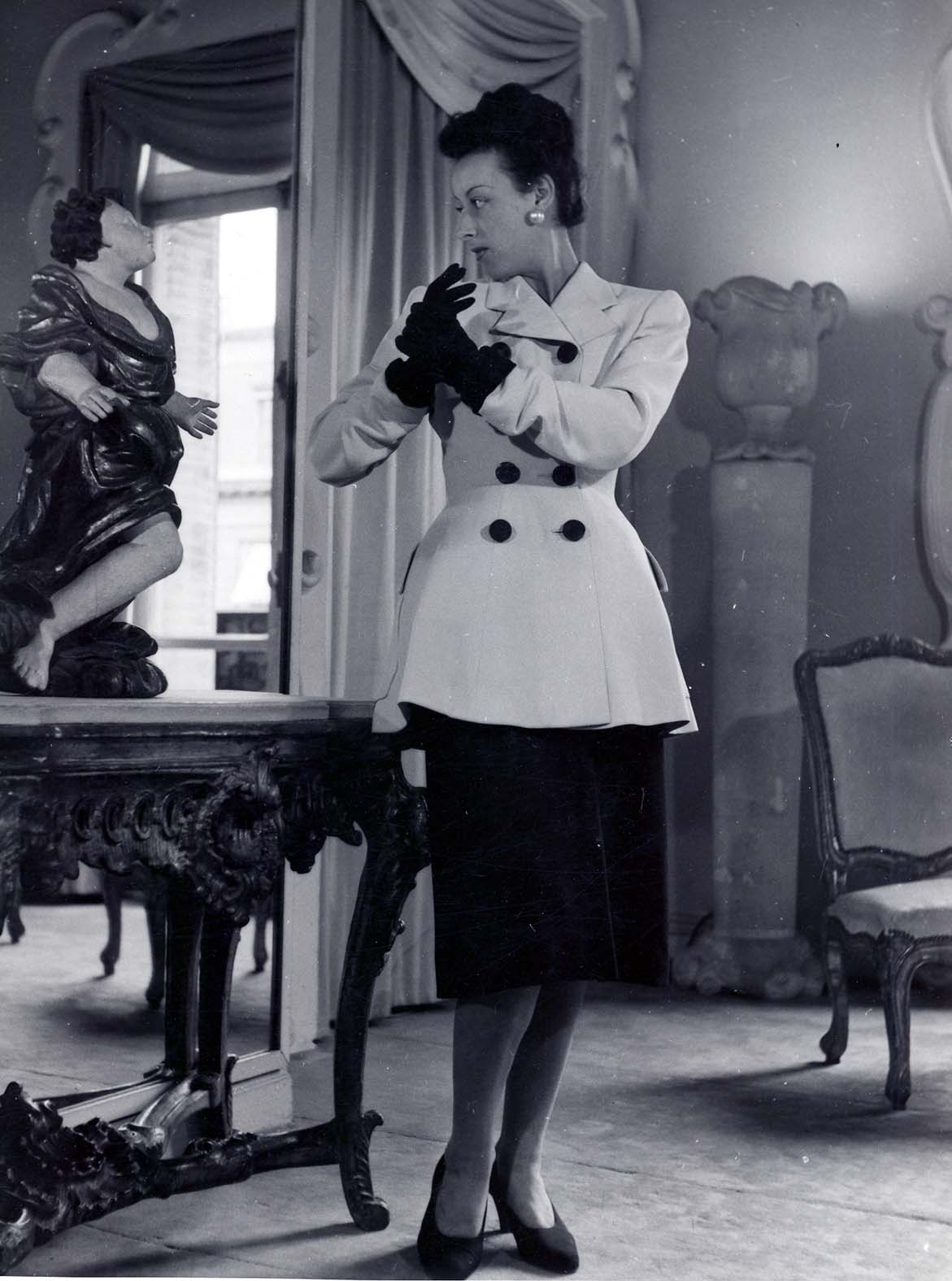
Balenciaga worked like a laboratory: toiles covered with geometric tracings and measurements, one parameter altered at a time, each line derived from the last by gradient rather than rupture. Most of those lines push the waist away (the tonneau of 1946, the tunic of 1955, the sack of 1957). The hourglass is the experiment that keeps it.
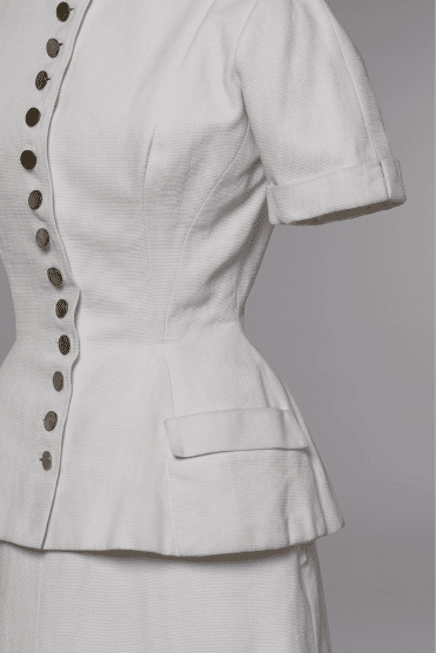
On a white piqué suit from the spring collection of 1950 the mechanism is legible on the surface: long curved panel seams run from the armholes down through the waist and on into the basque, with no horizontal join anywhere. The same seams that draw the cloth in are the ones that let it out again over the hip, where the flare is cut rather than gathered. No corsetry: the hip is built out with internal padding, the seams are hidden, and the body keeps room to move inside the curve. The hip has stopped being a skirt and become tailoring. That tailored hip is what the house keeps, listing the jacket among its icons beside the cocoon coat.
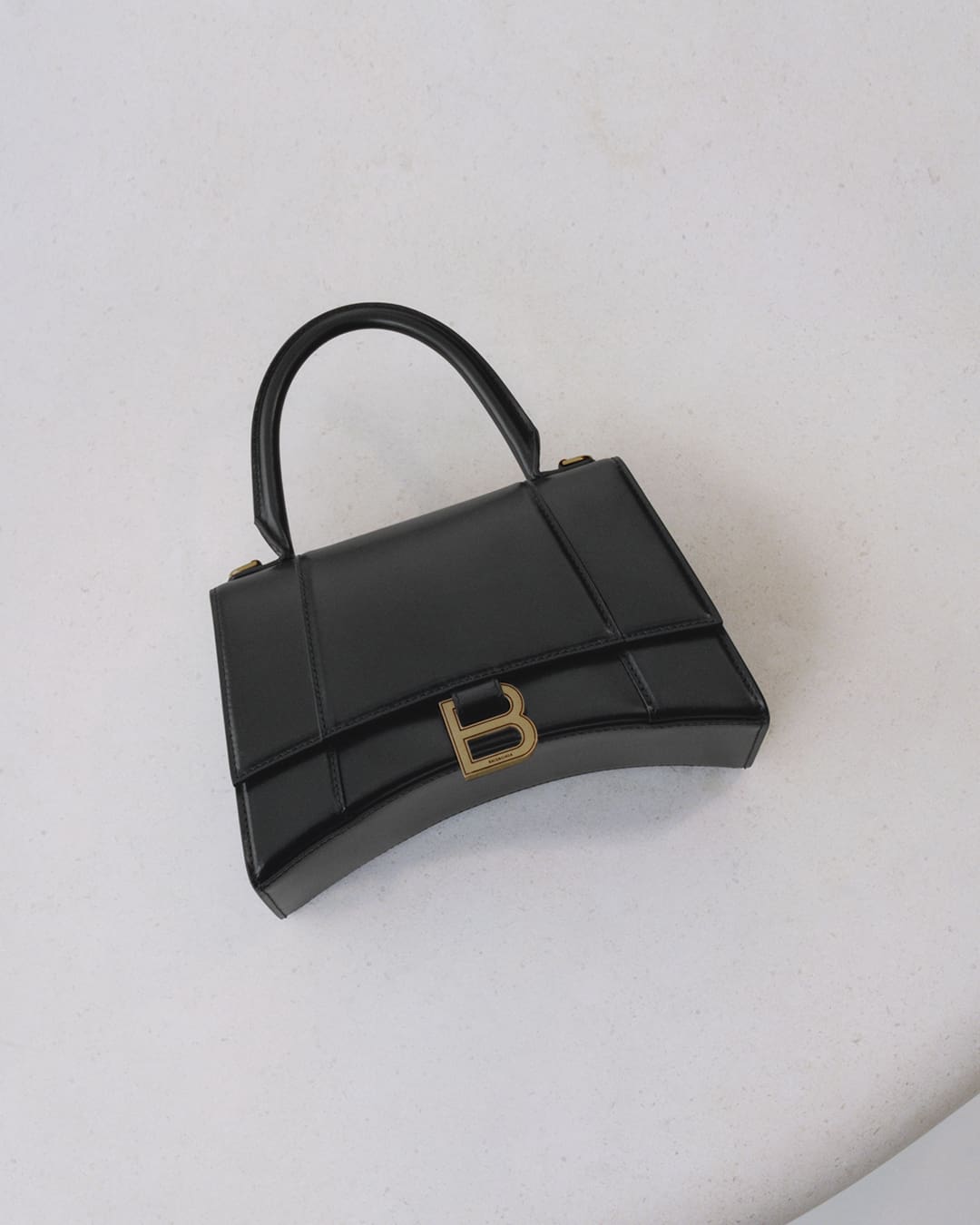
In the winter of 2019, Balenciaga introduces the Hourglass bag. It is the translation of a shape from one design category into another: the jacket’s profile, drawn in at the middle and flaring at the base, rebuilt as leather goods. The format is a small top-handle bag with a flap. It also has one property no structured bag is meant to have: a bowed base, on which it rocks rather than stands. A structured bag on a table is supposed to sit. This one rests on a curve, steady but lifted at both ends: Cristóbal’s “allure en suspension” transferred to a portable item. Many stars have carried it, making the Hourglass one of the most recognizable objects the house makes.
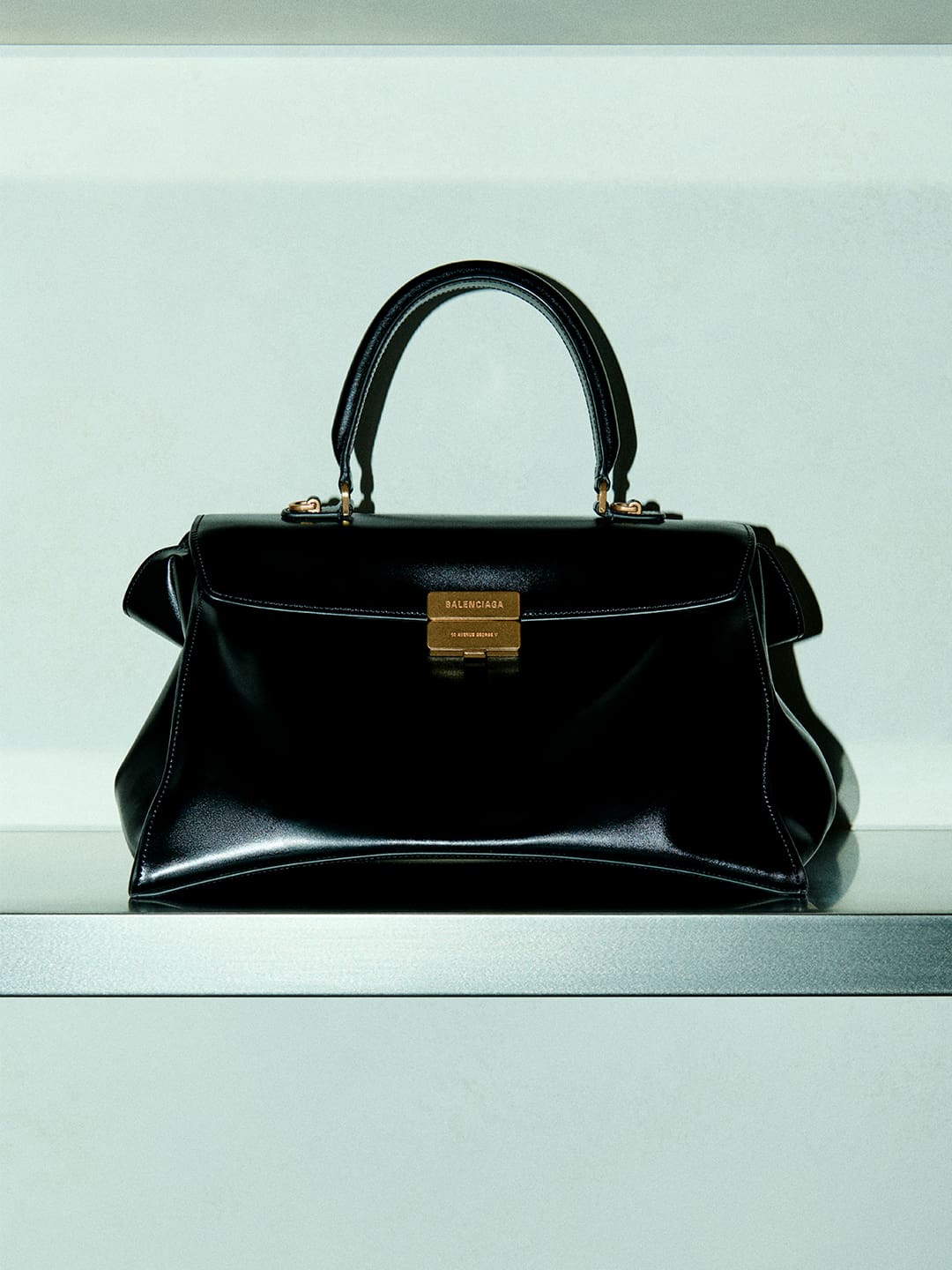
Shown with the Winter 26 collection, ClairObscur, Pierpaolo Piccioli’s Hourglass Avenue keeps the curve and changes what holds it. The body is reworked in box leather, supple and structured at once, its sheen printing every crease the bag picks up in use. For 10 years the hourglass at Balenciaga had been rigid: darts and padding in 2016, foam and resin after that, a box in leather in 2019. The Avenue lets all of that go slack. The sides fall in, the body dents where a hand has held it, the leather keeps the marks; only the base stays drawn, bowing up at the centre and pointing at the corners. While Cristóbal hid his seams so the body could move inside the curve, Pierpaolo removes the shell and lets the curve move too.
An hourglass measures time. This one takes a record of it.
