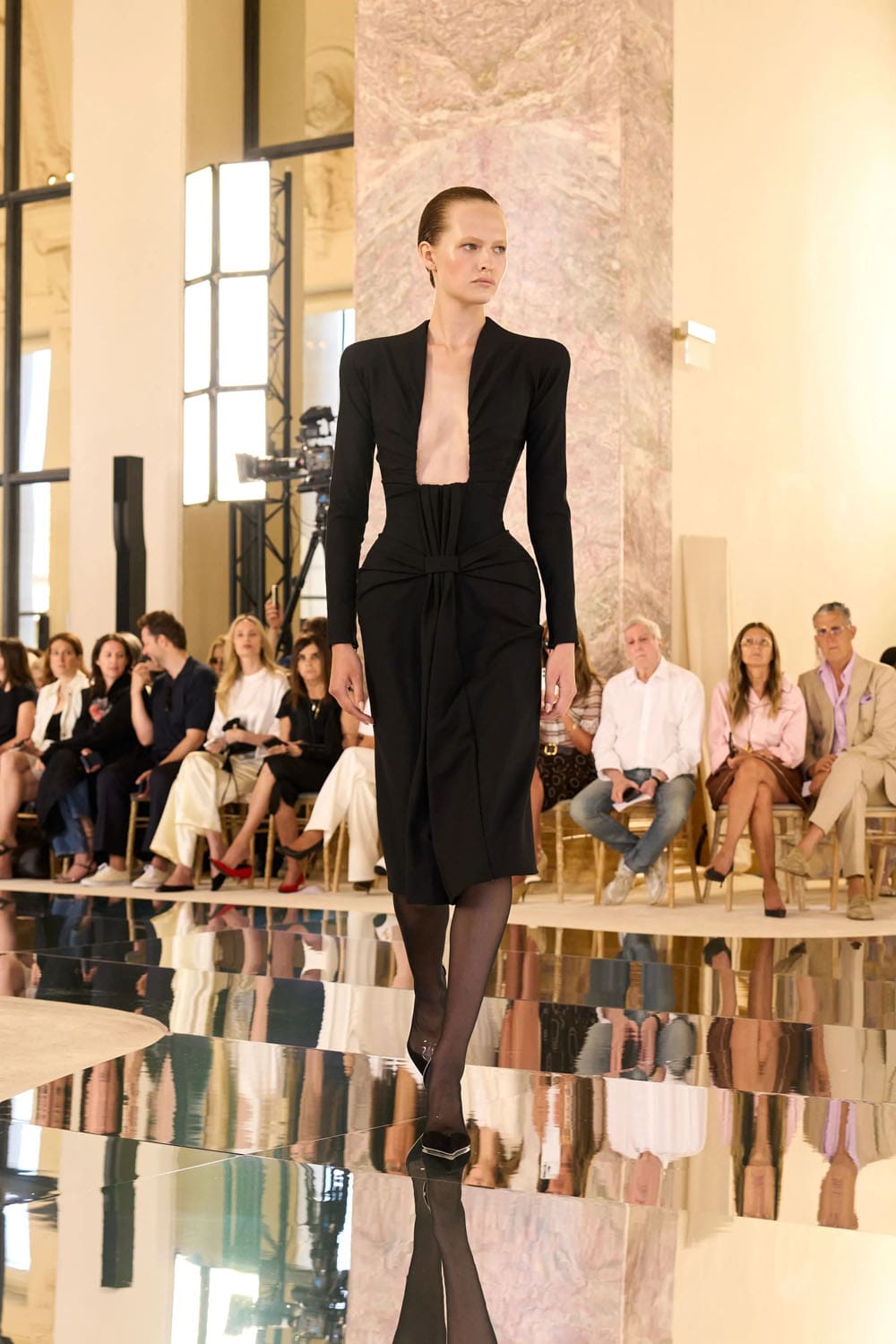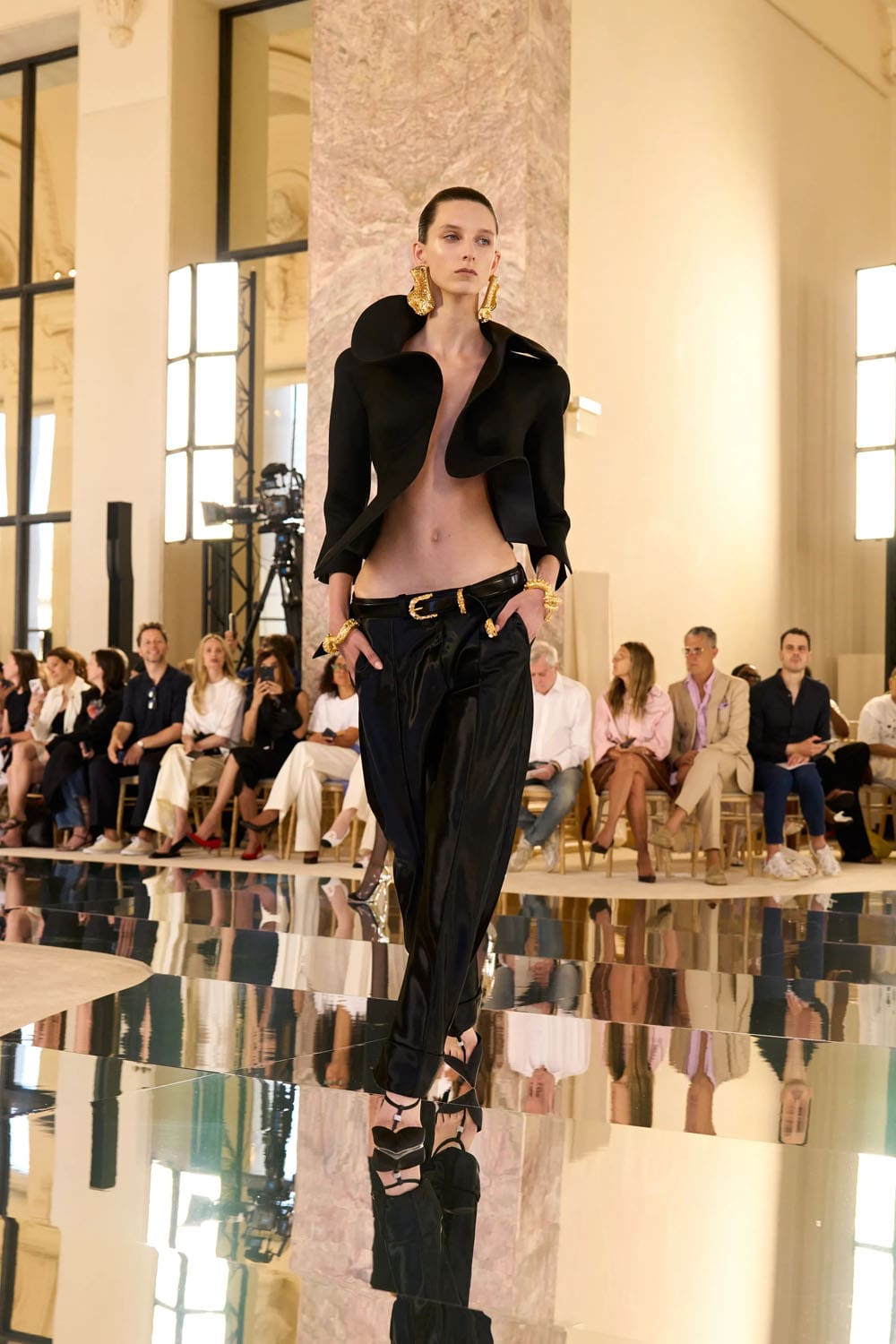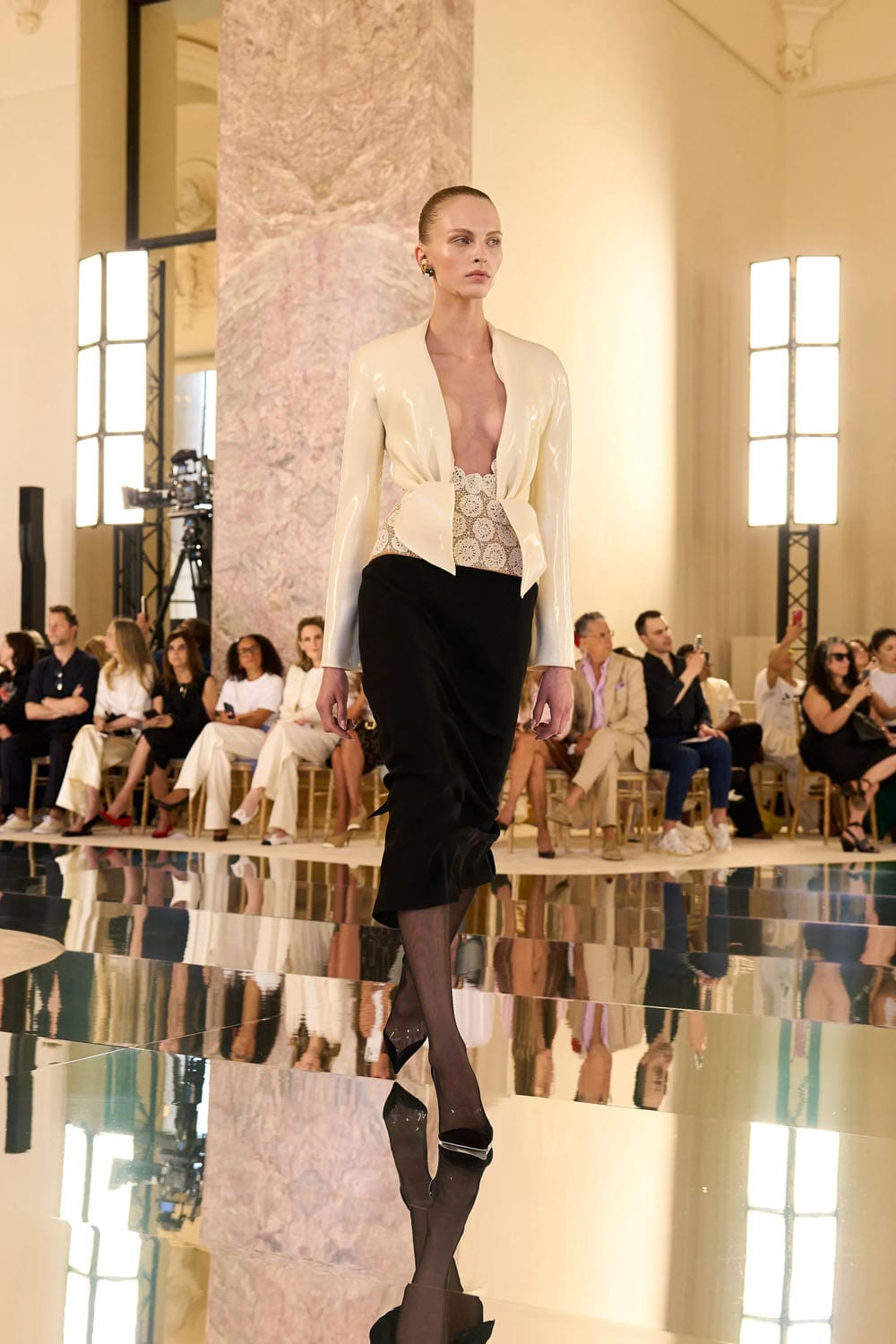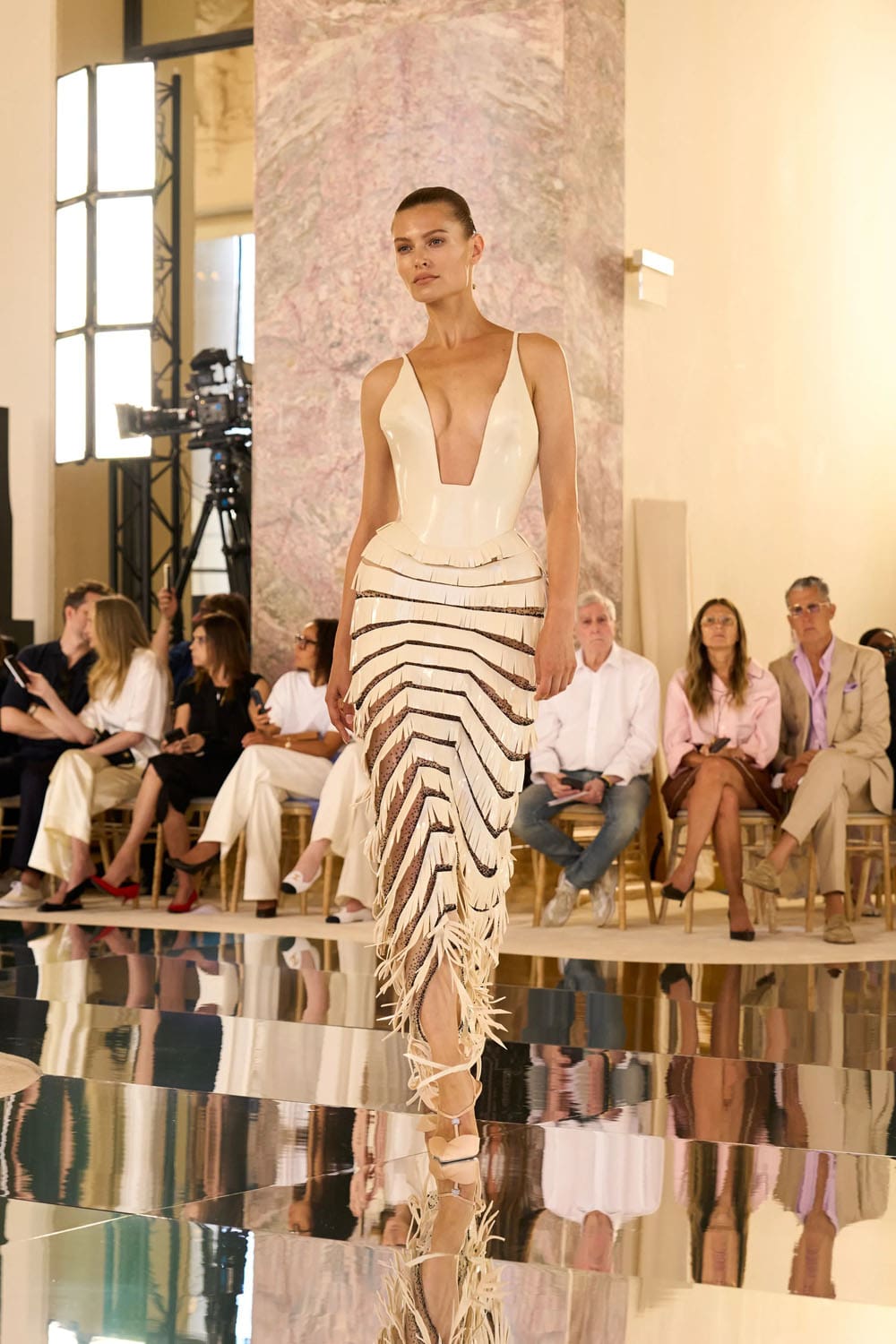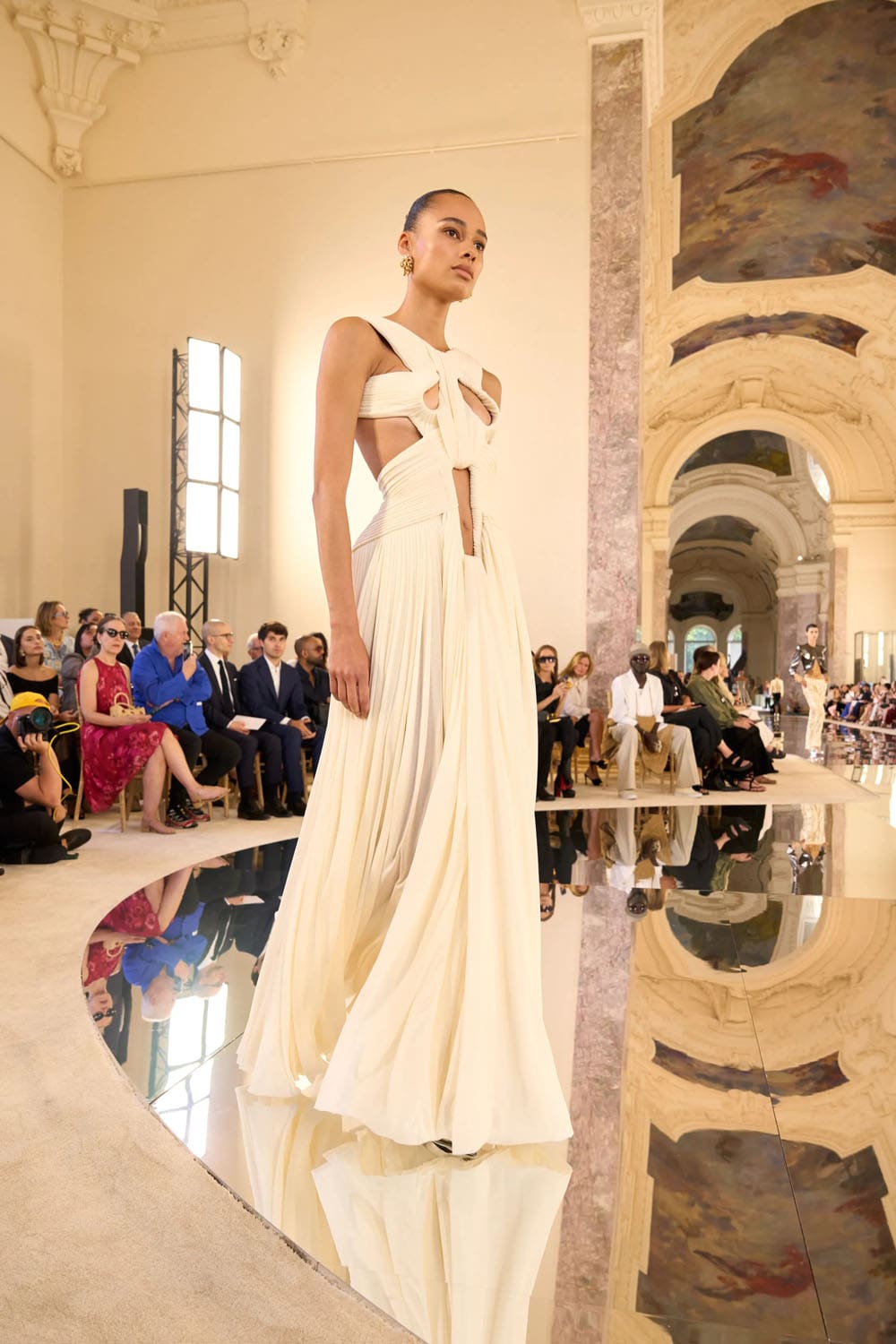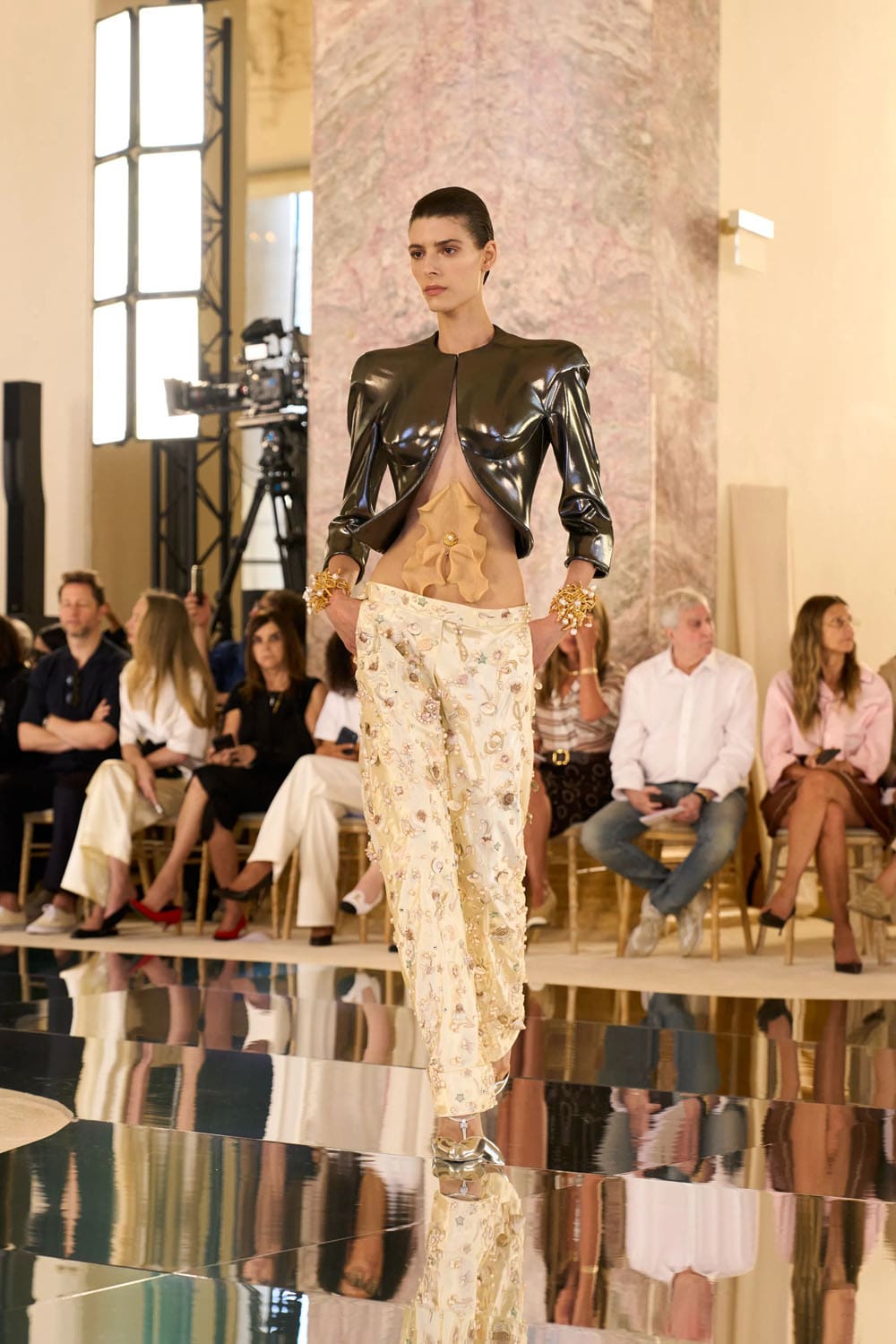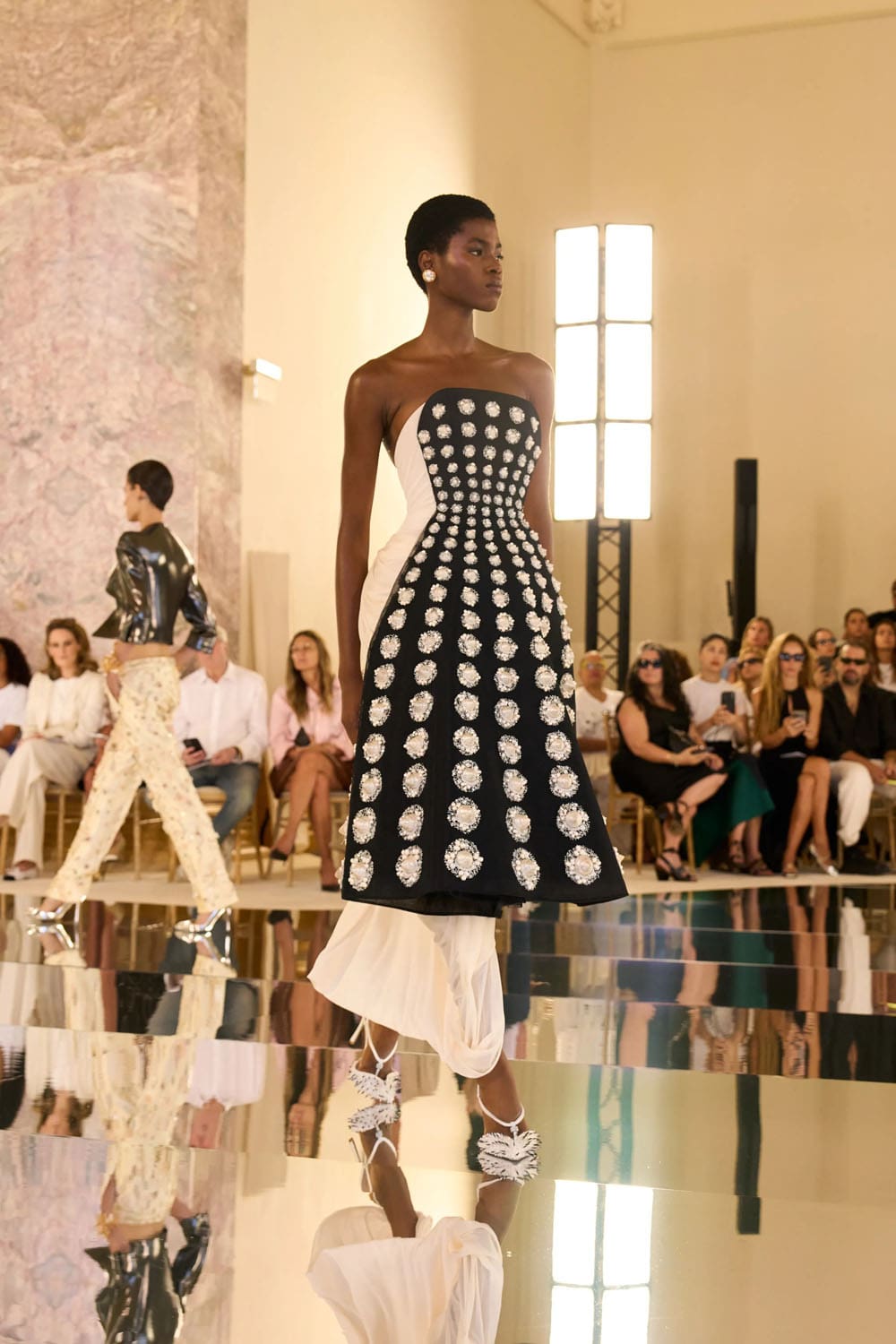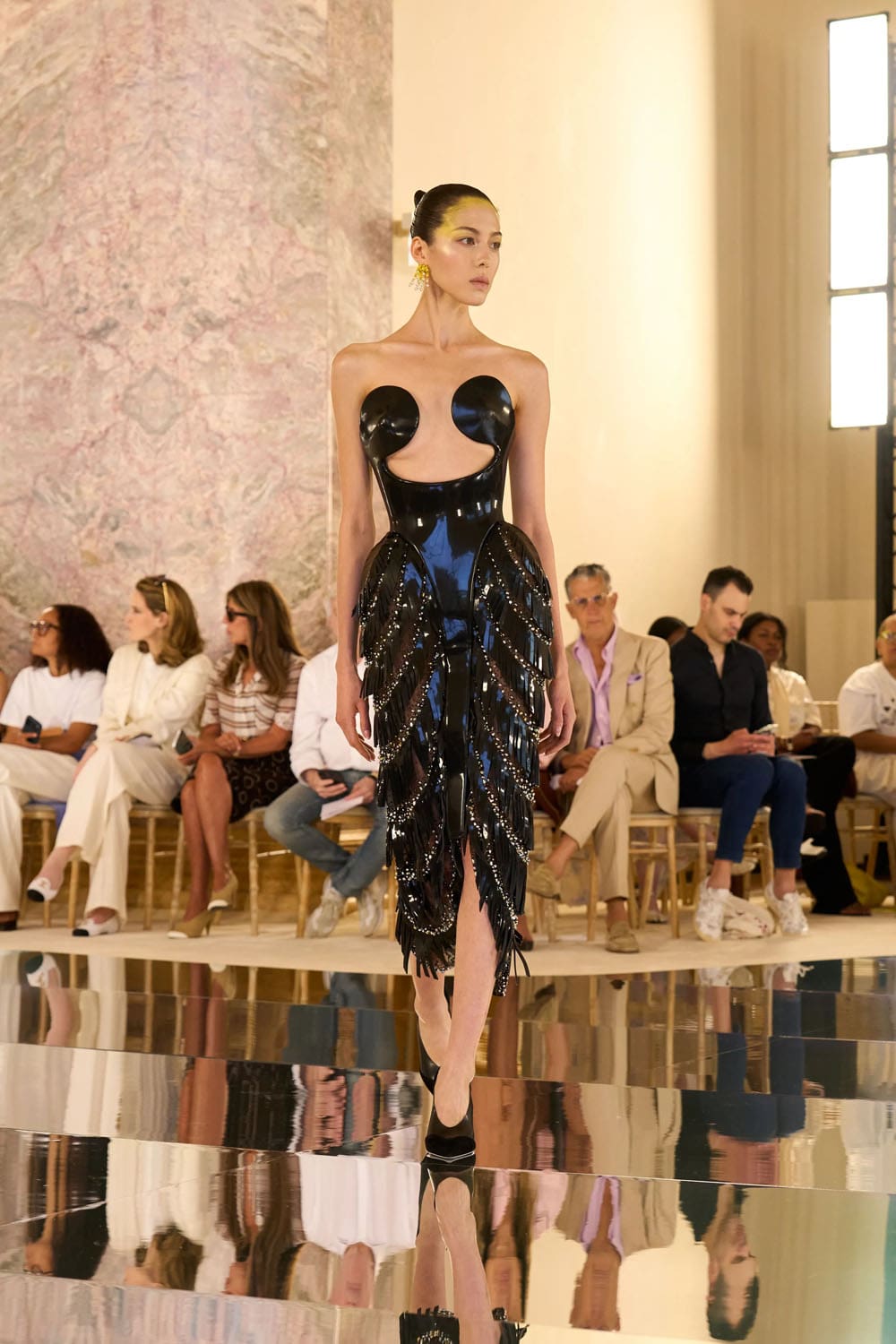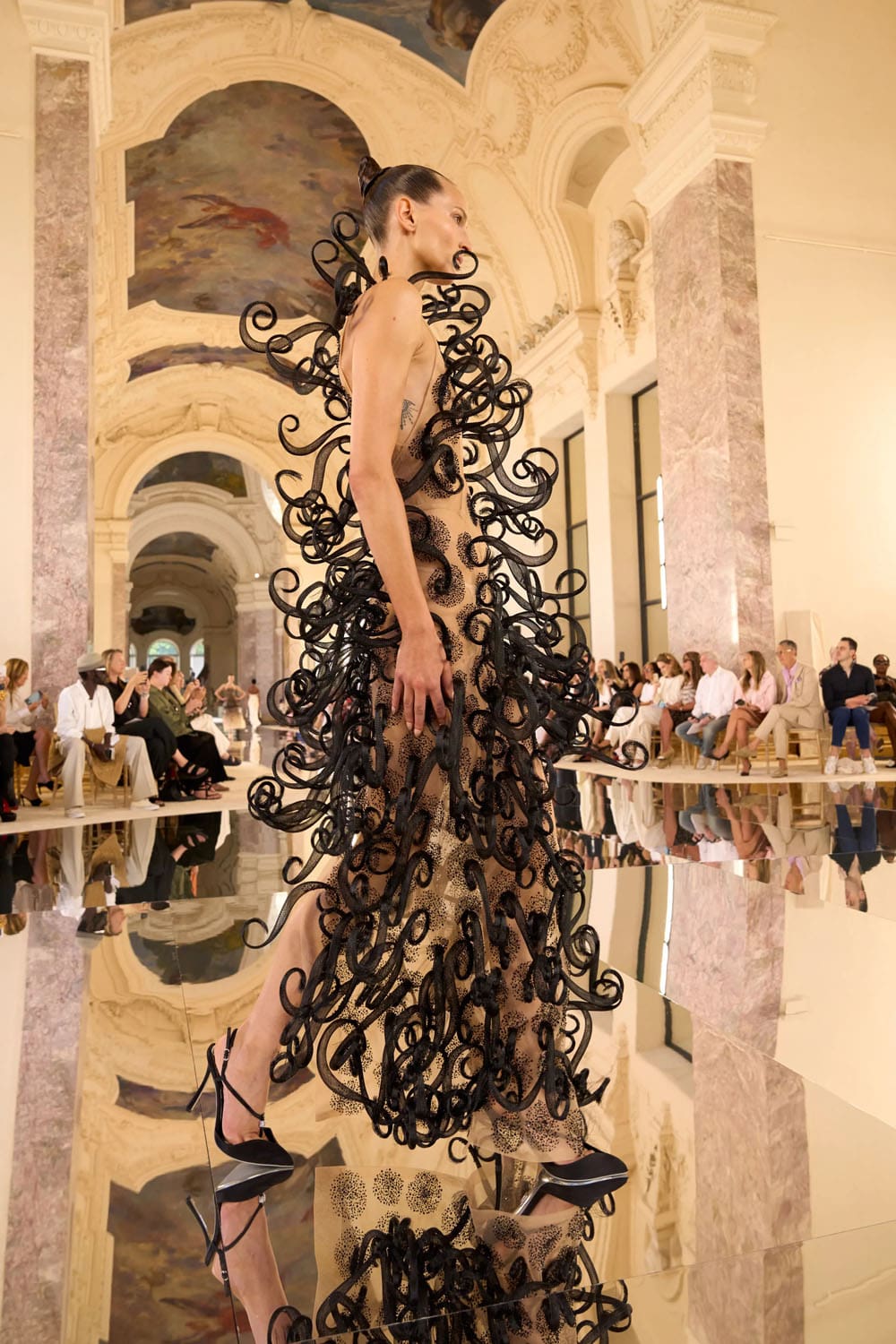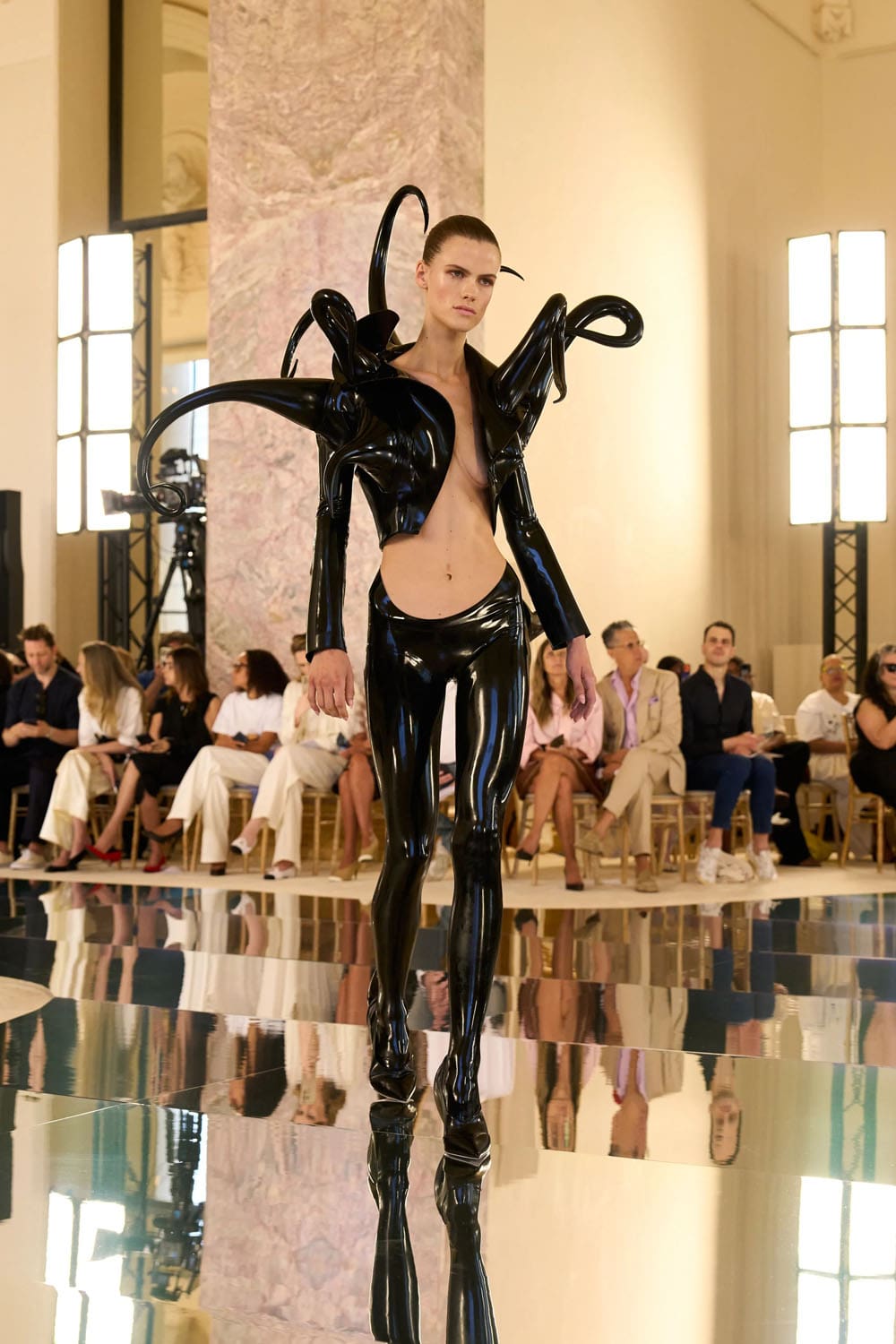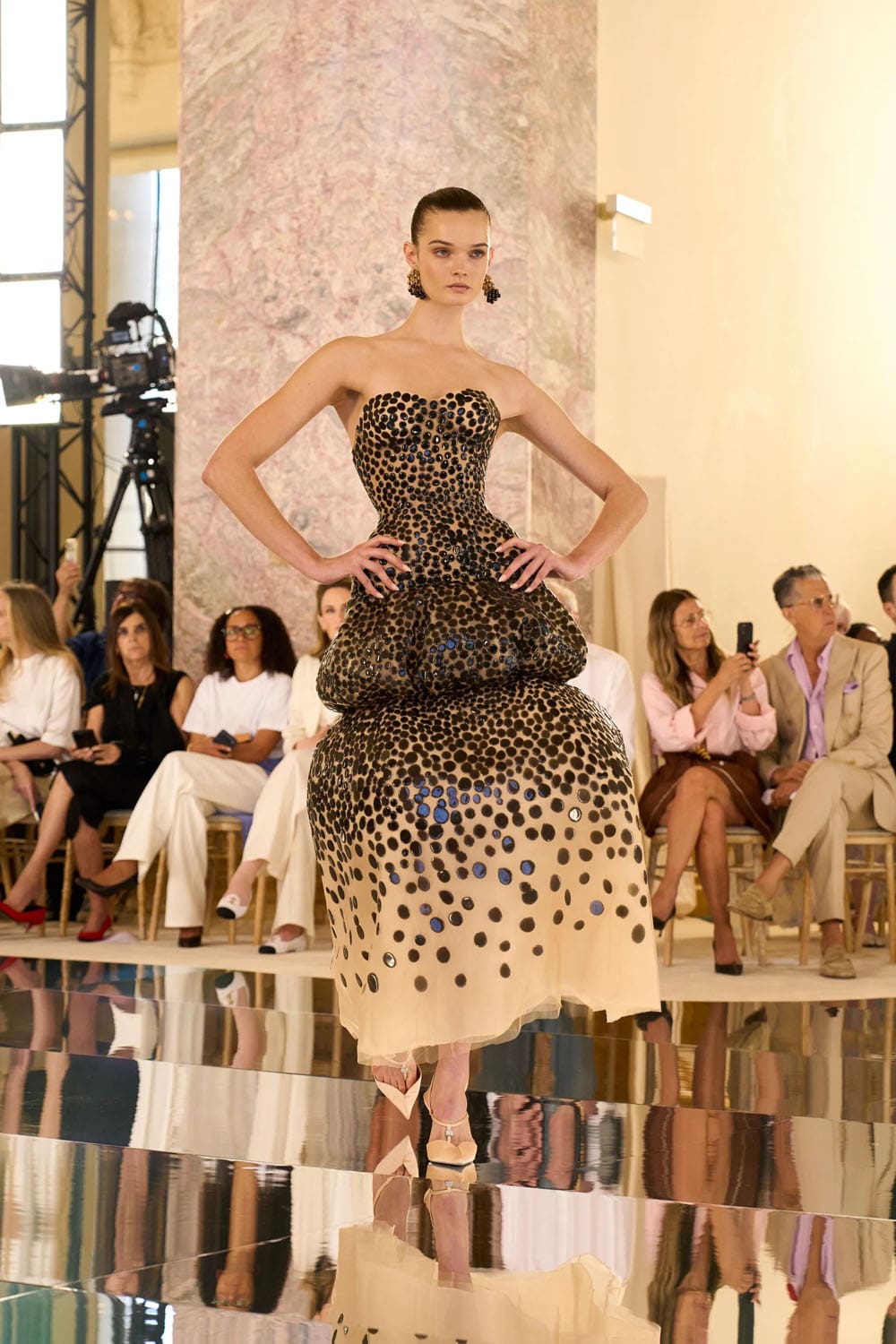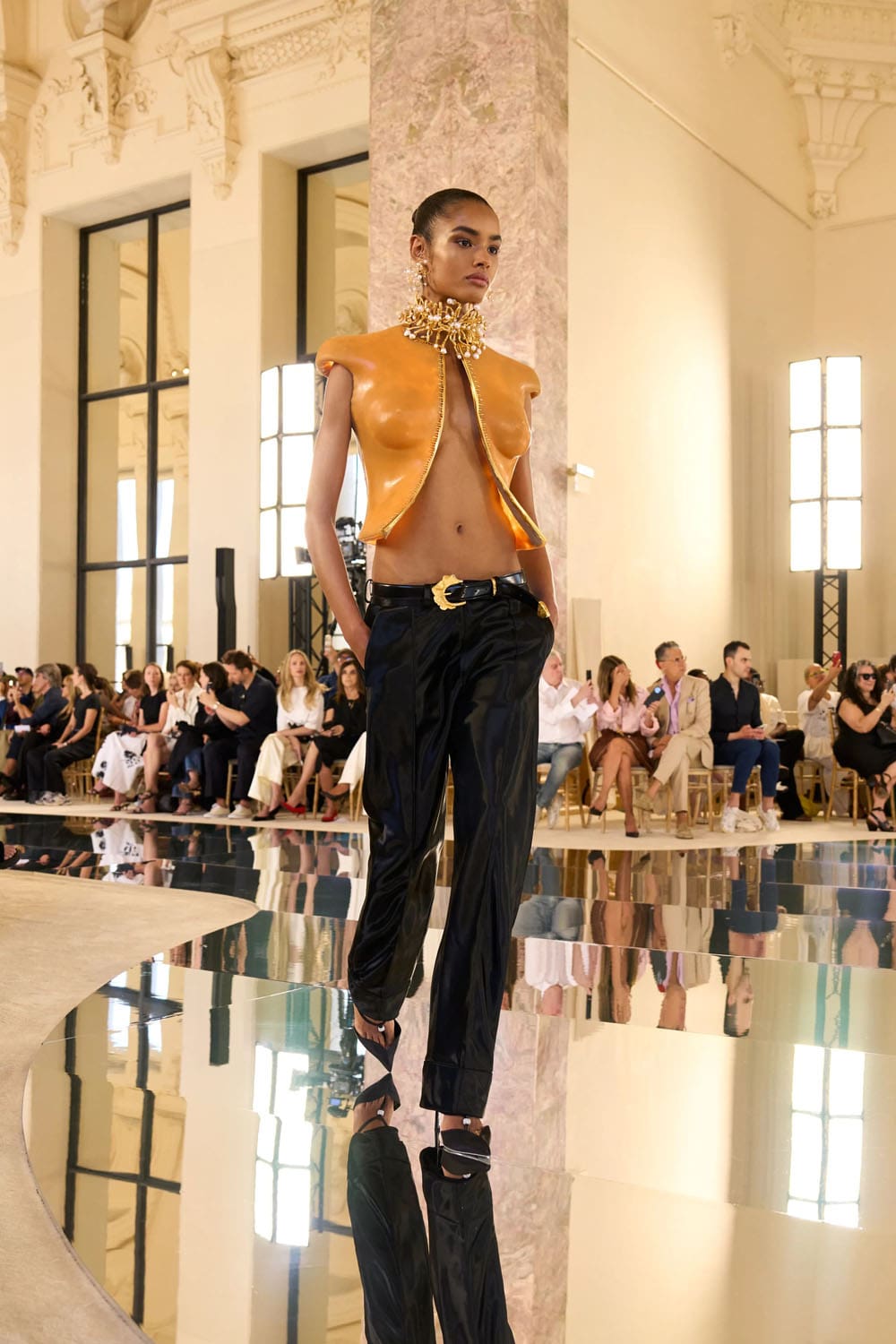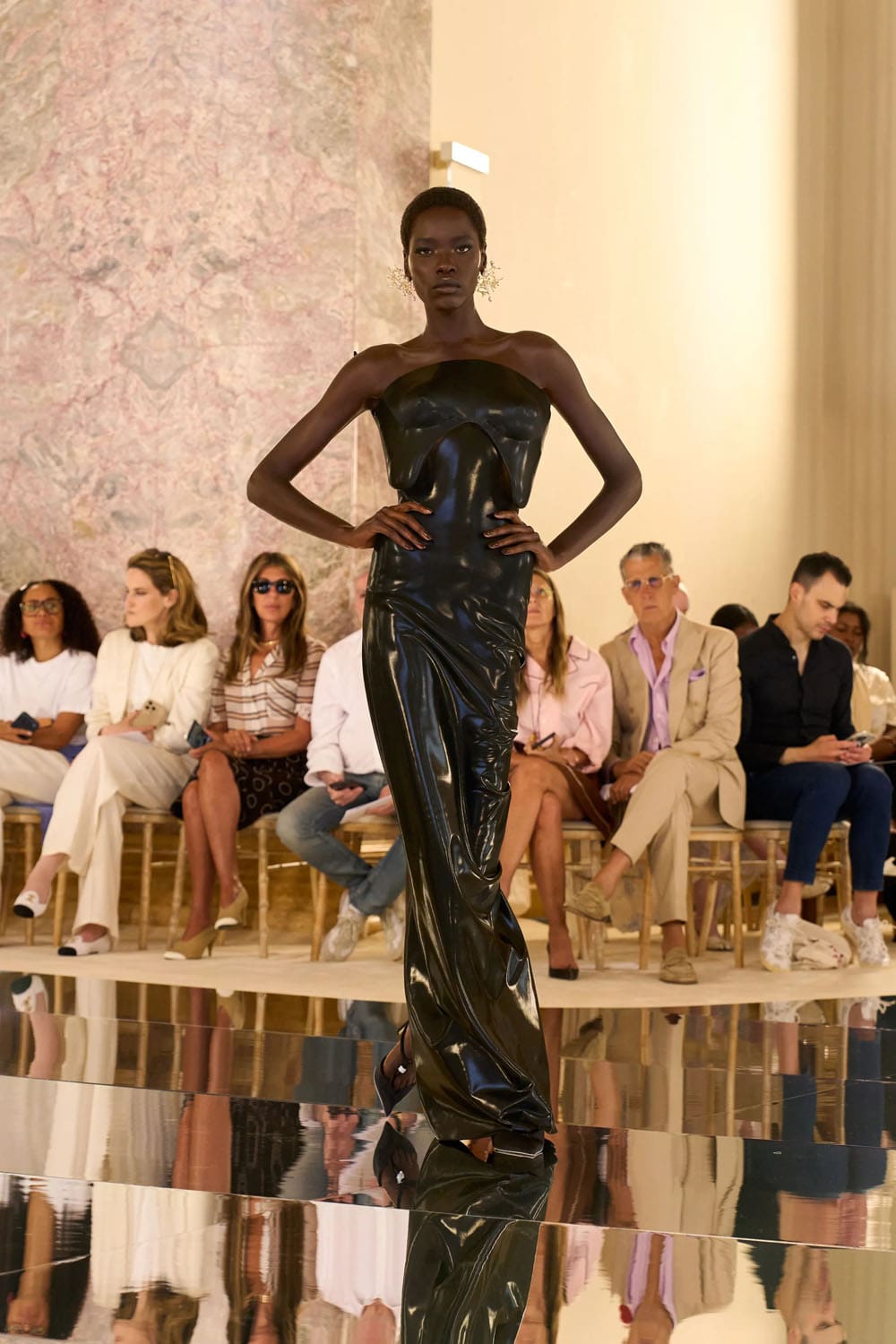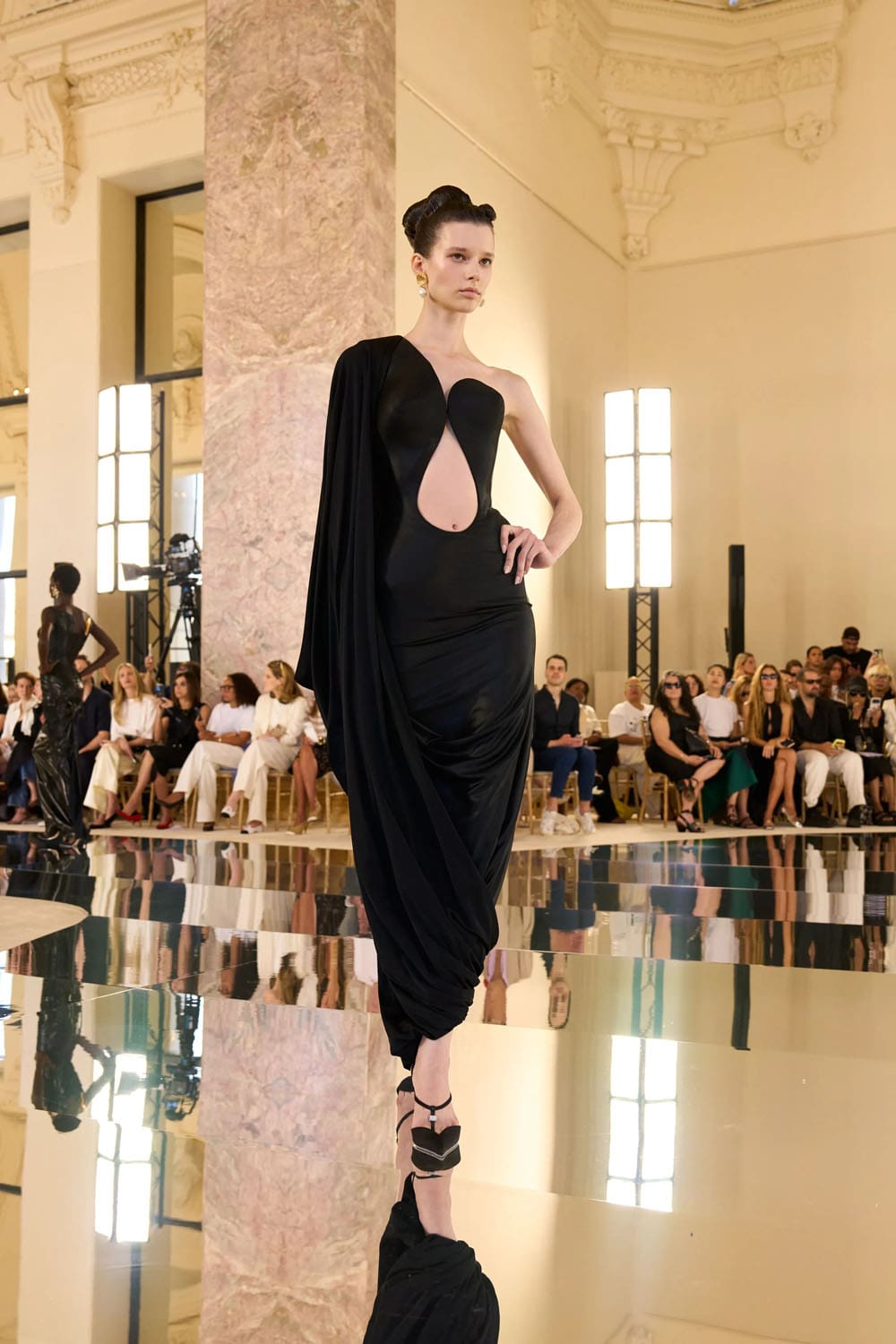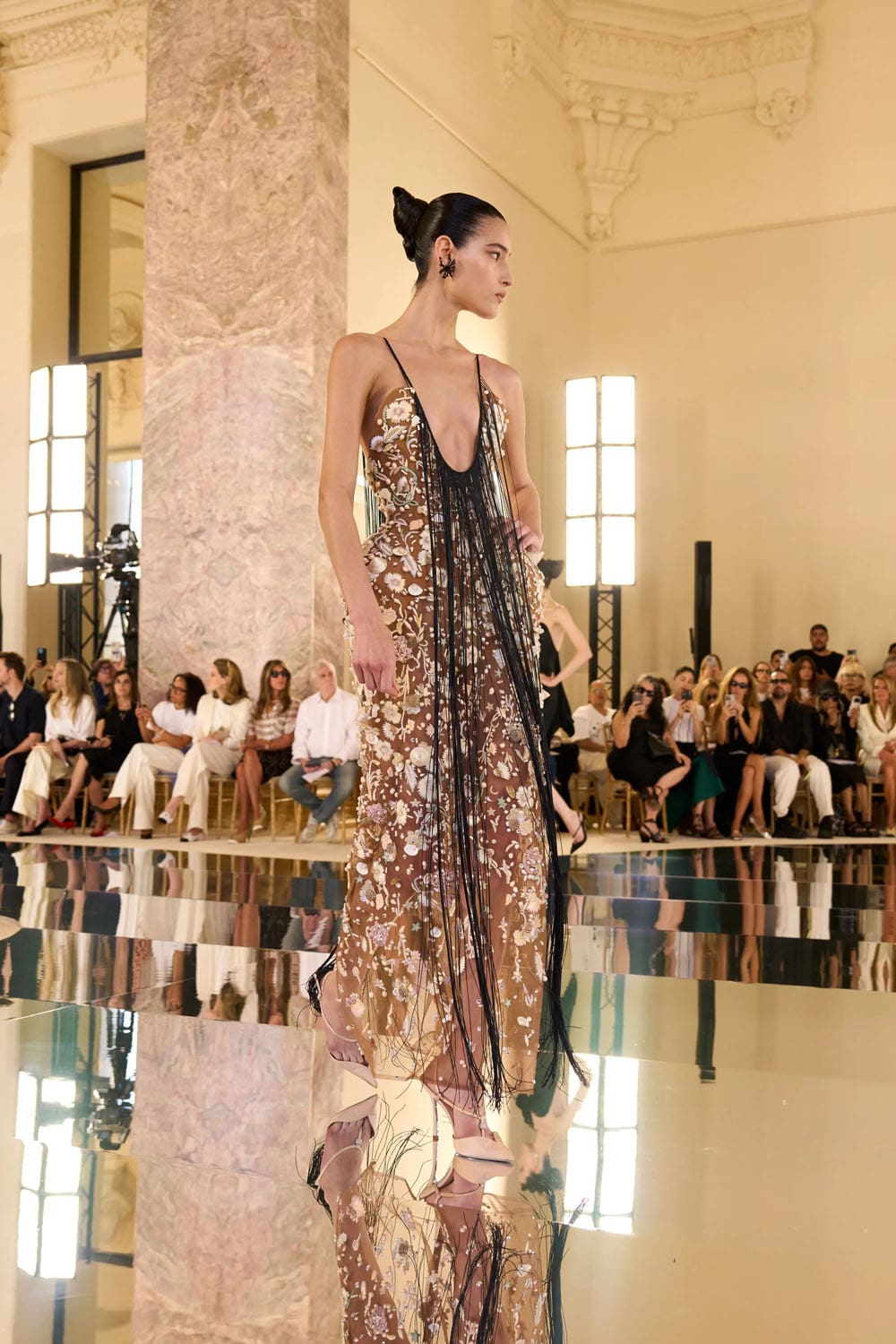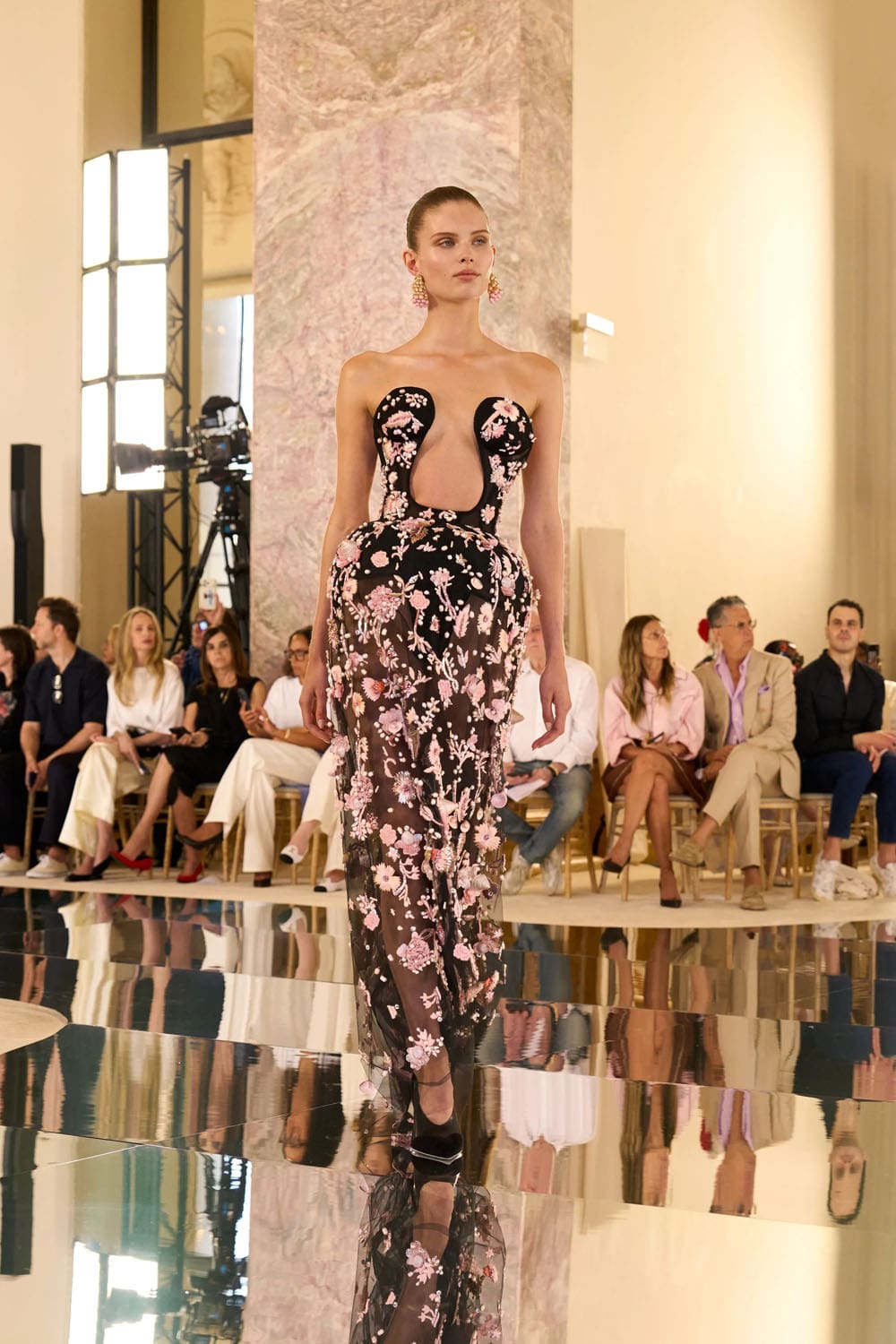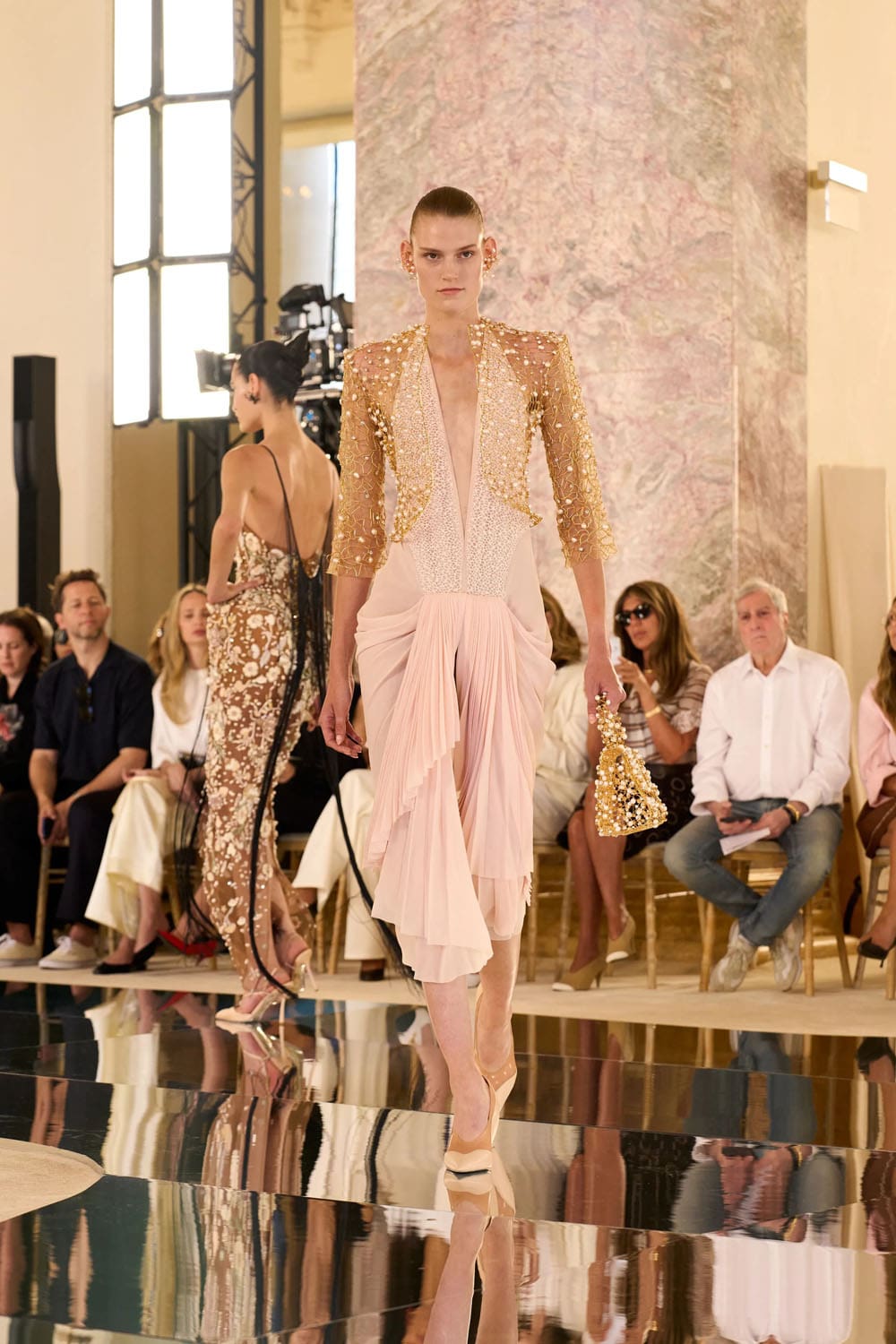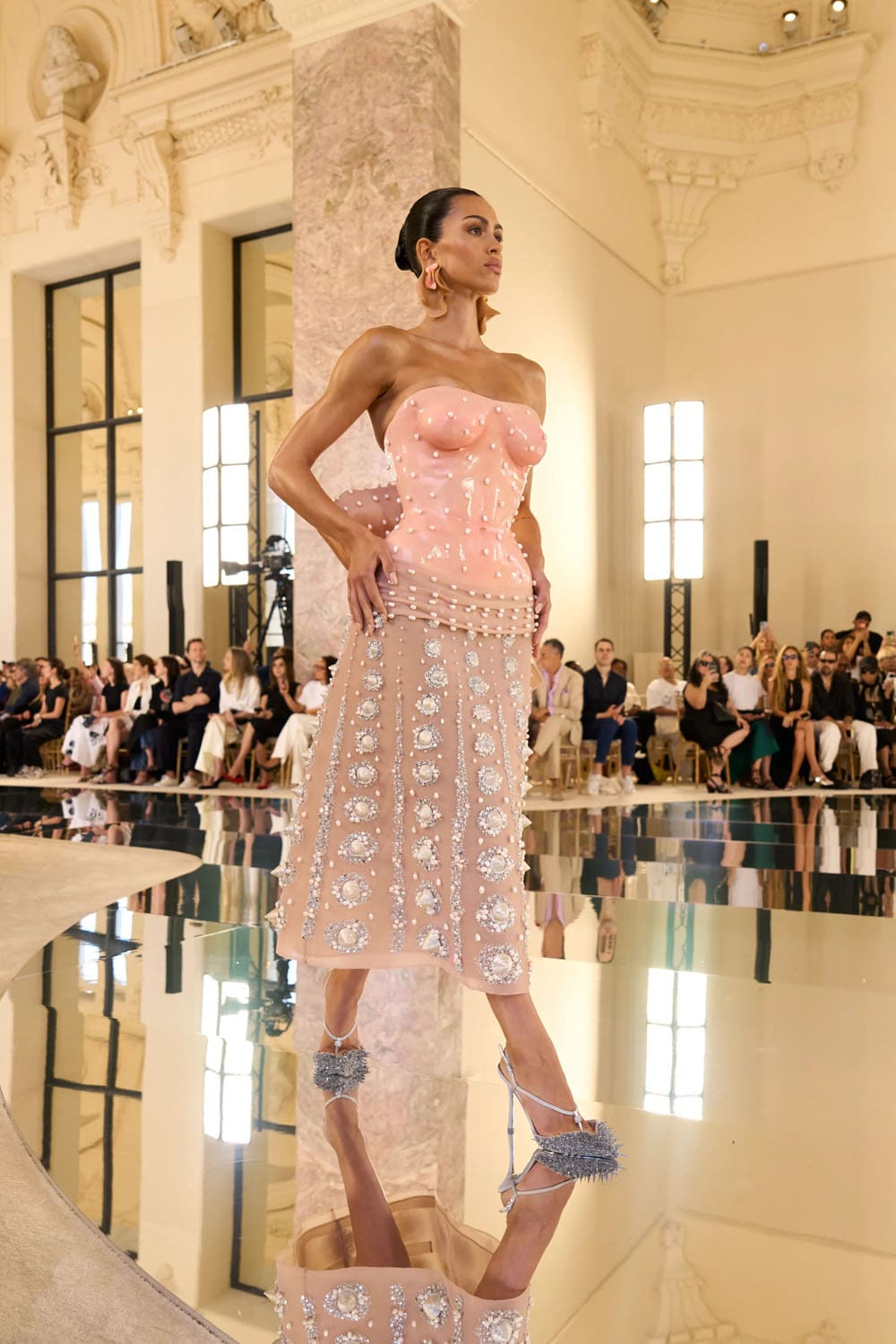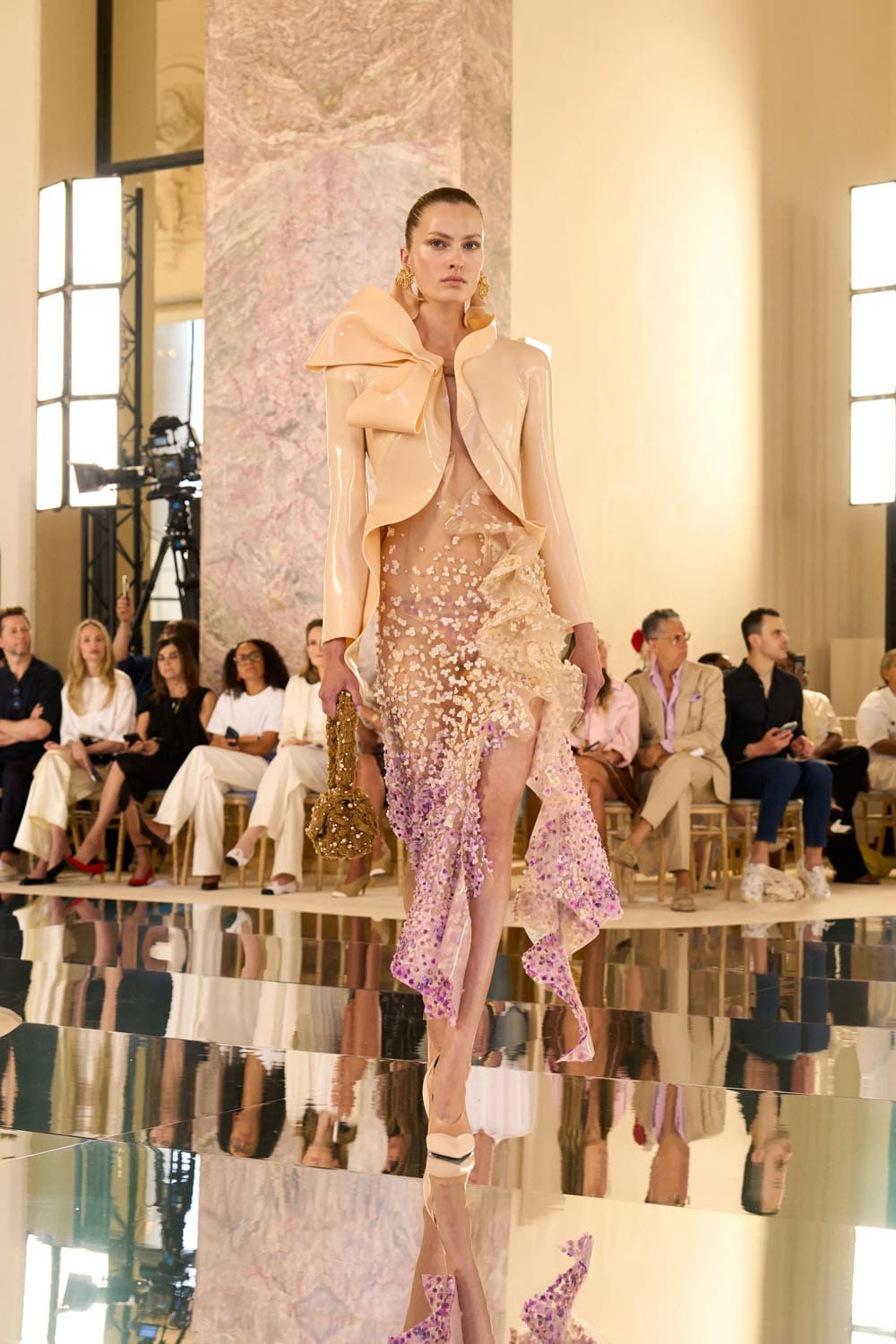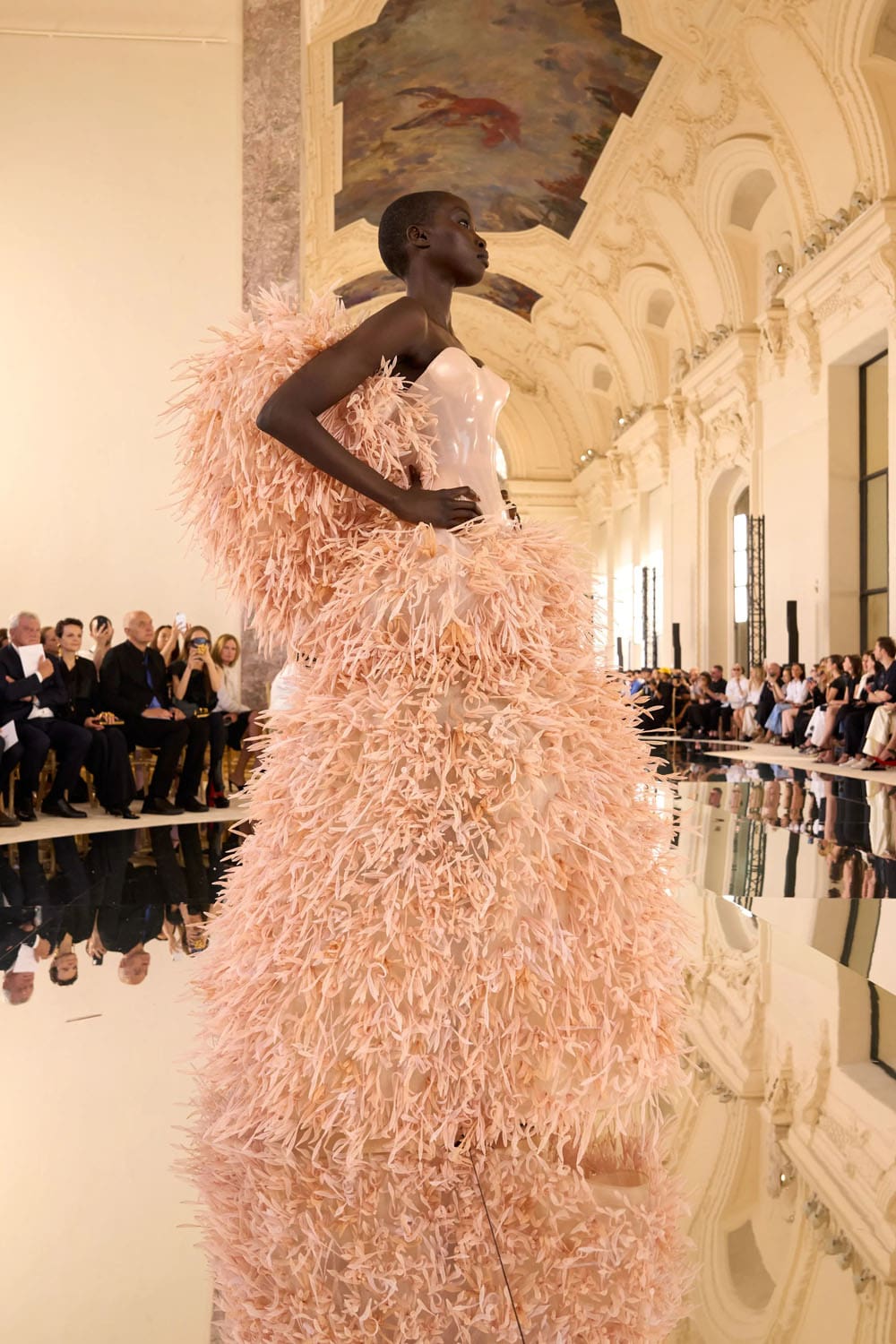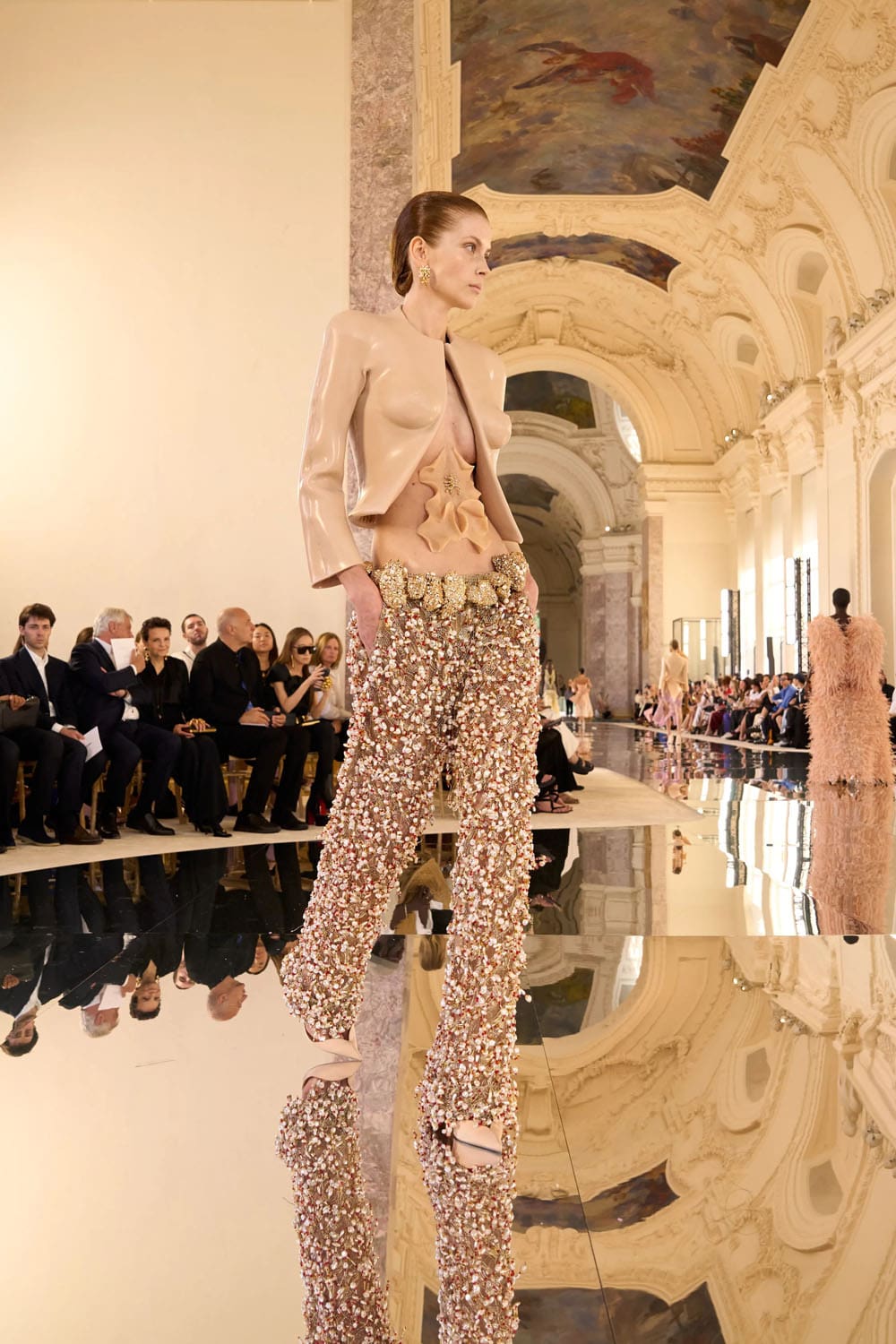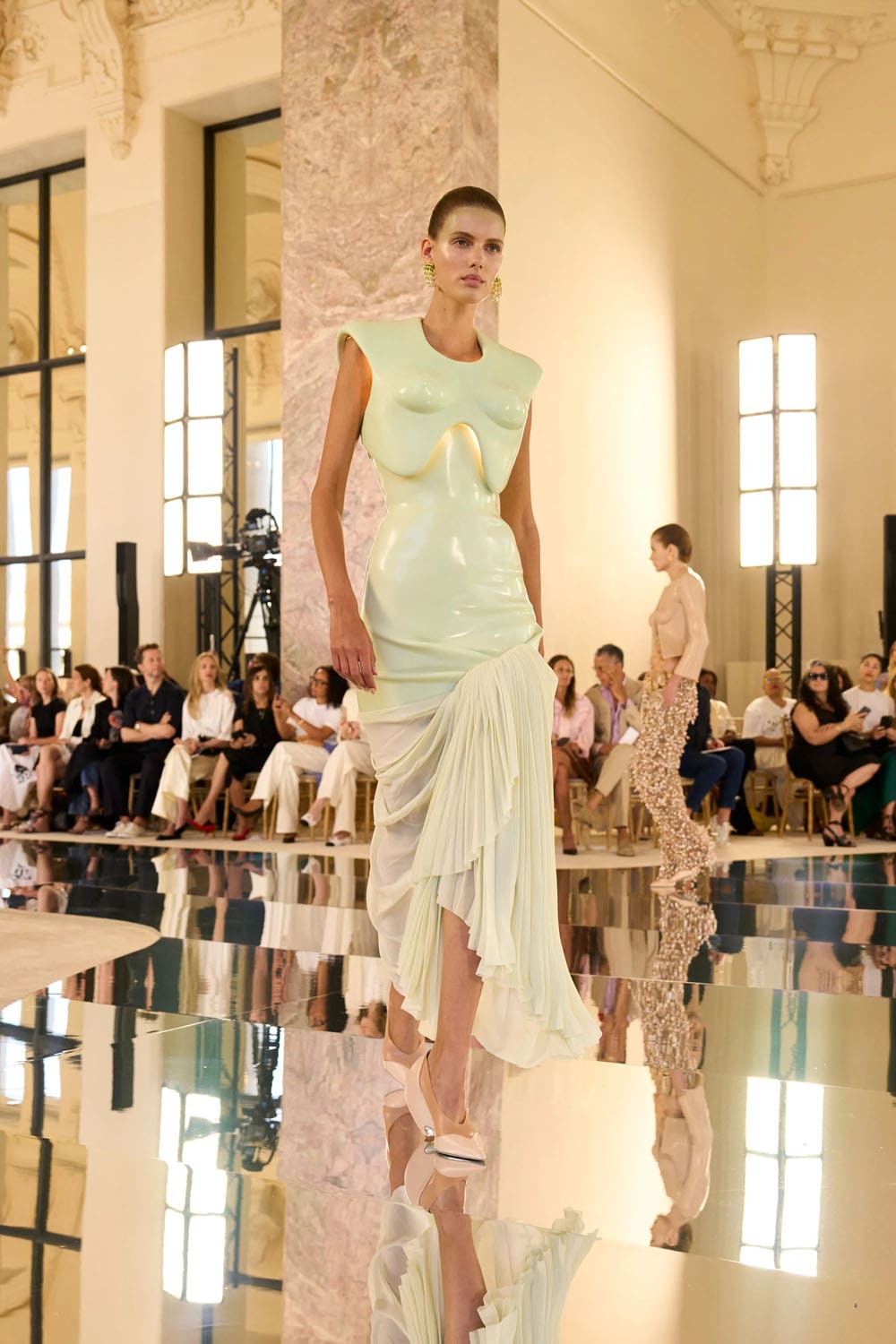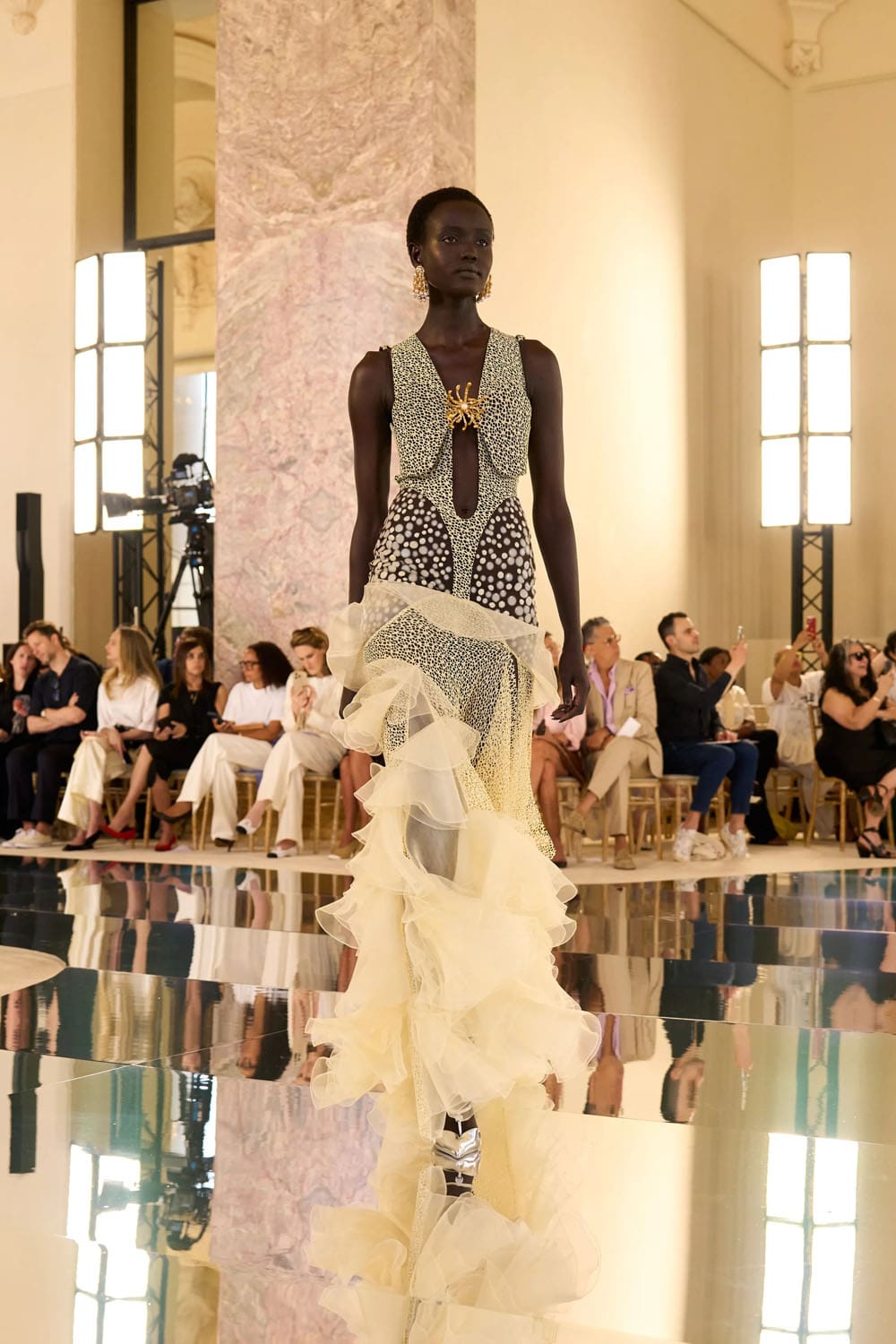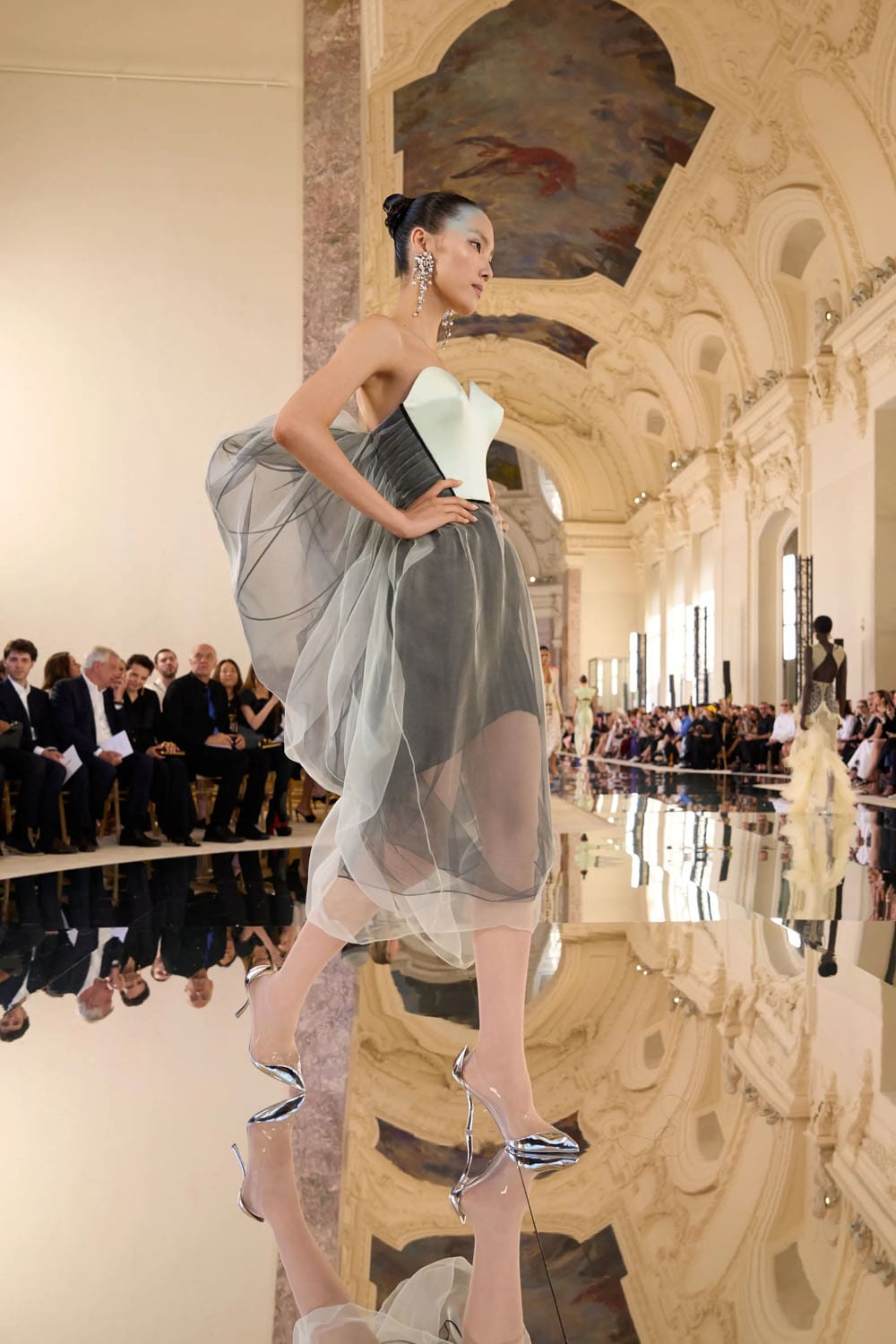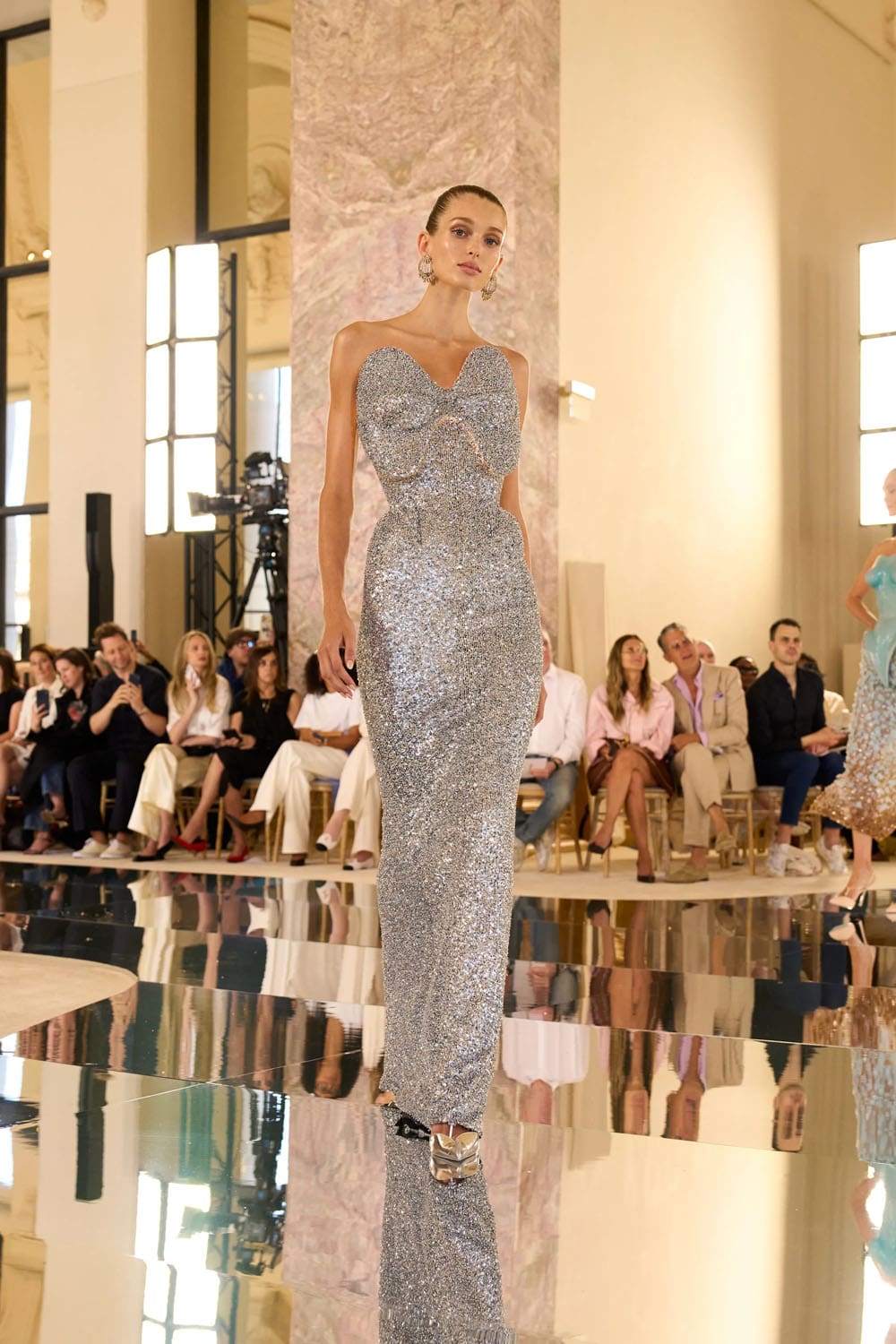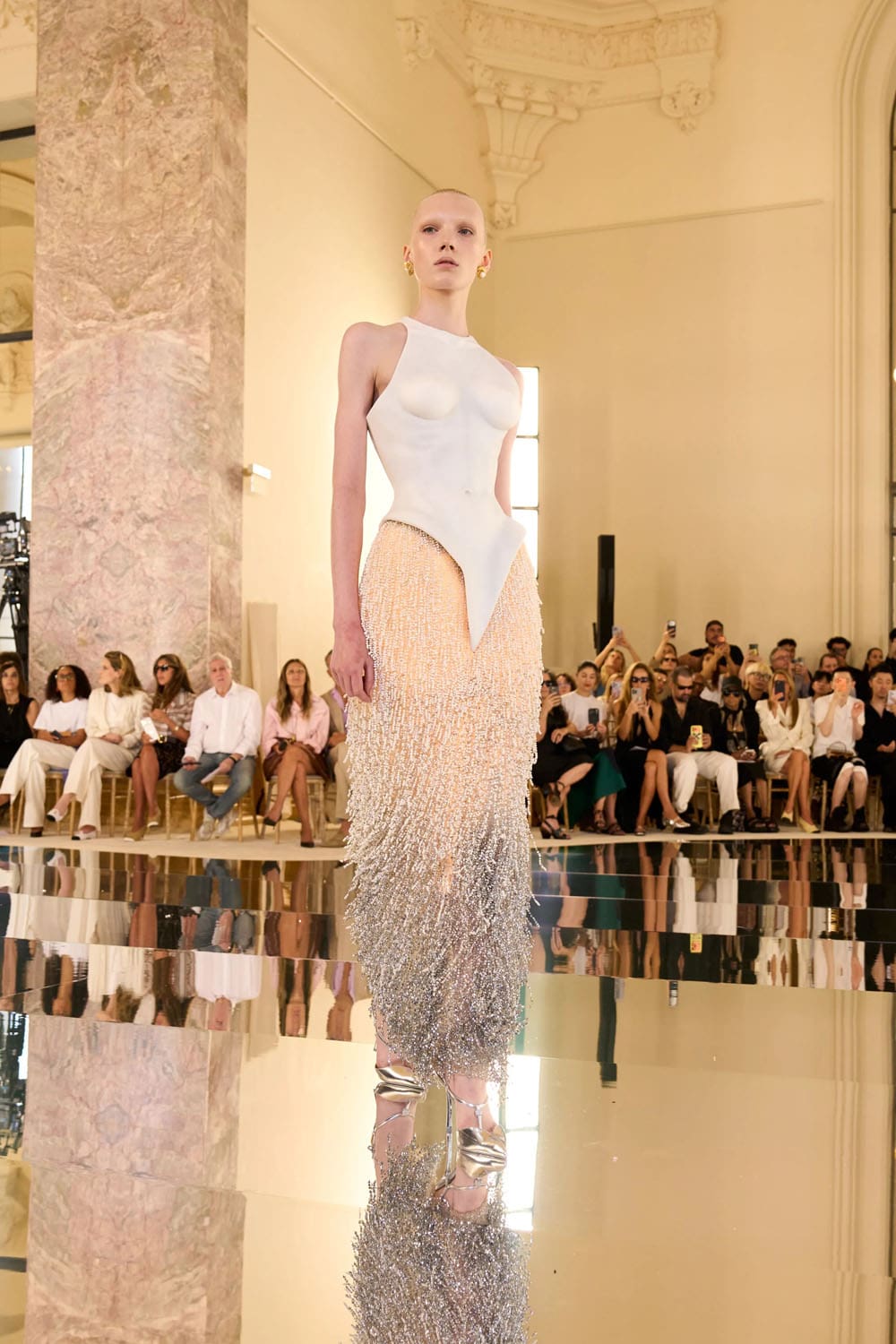
Schiaparelli Haute Couture Fall Winter 2026-2027 by Daniel Roseberry. Story by Eleonora de Gray, Editor-in-Chief of RUNWAY MAGAZINE. Photo Courtesy: Schiaparelli.
When Daniel Roseberry Fell Into the Gaultier Void
Here we go again, fashion darlings. Grab your snorkel and your sense of historical awareness, because Daniel Roseberry is inviting us to leap hand-in-hand with him into “the abyss” for Schiaparelli Haute Couture Fall Winter 2026-2027. His words, not ours. Personally? We prefer to stay firmly on dry land, where the air is clear and the references are painfully obvious.
In a beautifully poetic, somewhat dramatic press release, Daniel confesses that he threw out his usual formulas—like taking a transcendent trip to see Gaudí’s work in Barcelona—because he felt stifled. Instead, he decided to surrender completely to l’appel du vide (the call of the void). But looking at the runway, it seems the void he plummeted into looks remarkably like the archives of Jean Paul Gaultier.
Daniel, darling, please stop picking from our “Polo” (JPG), otherwise, we’ll only be hearing the echo of looking for you: “Marco!”
A Tale of Two Torsos: The Silicone Mimicry
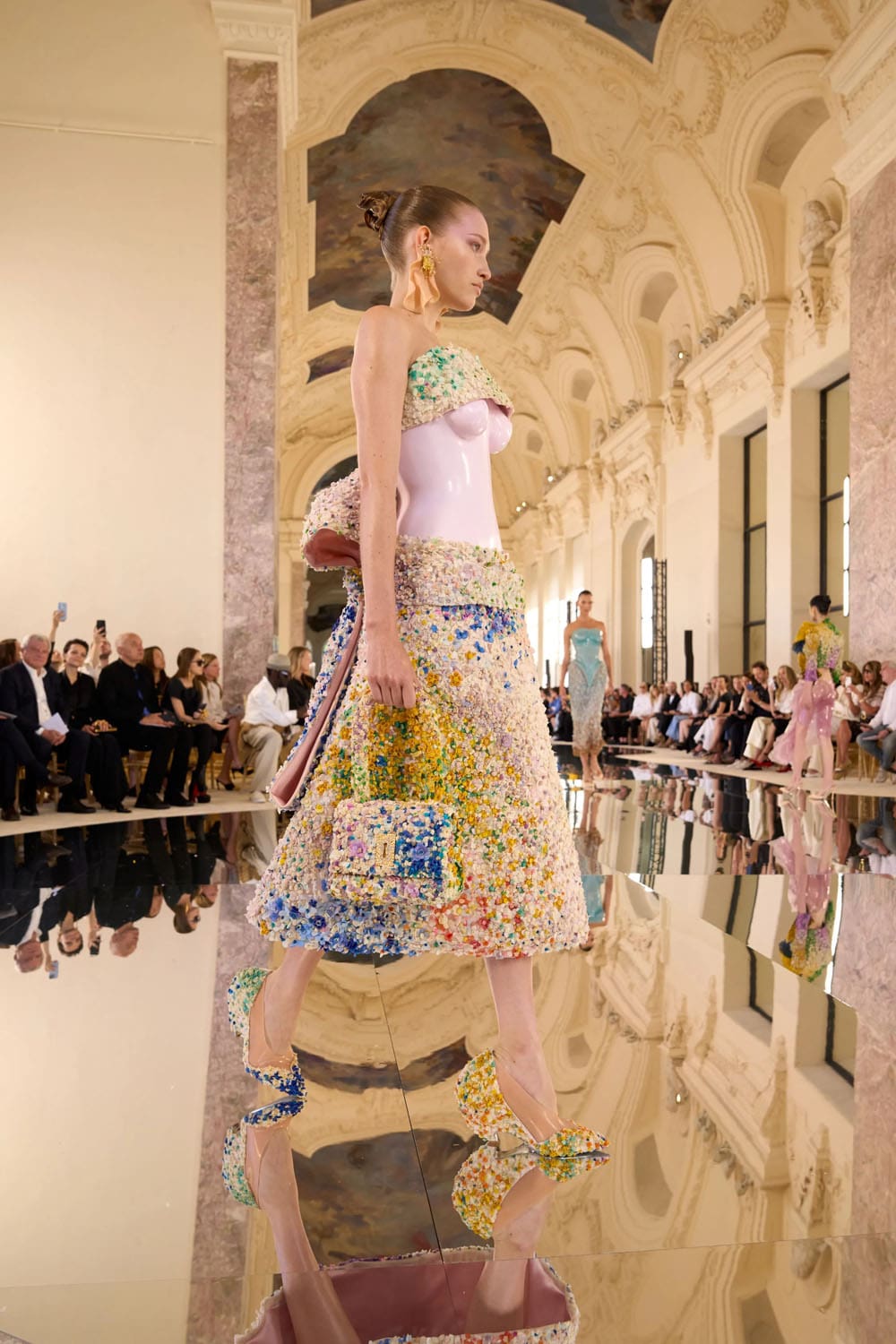
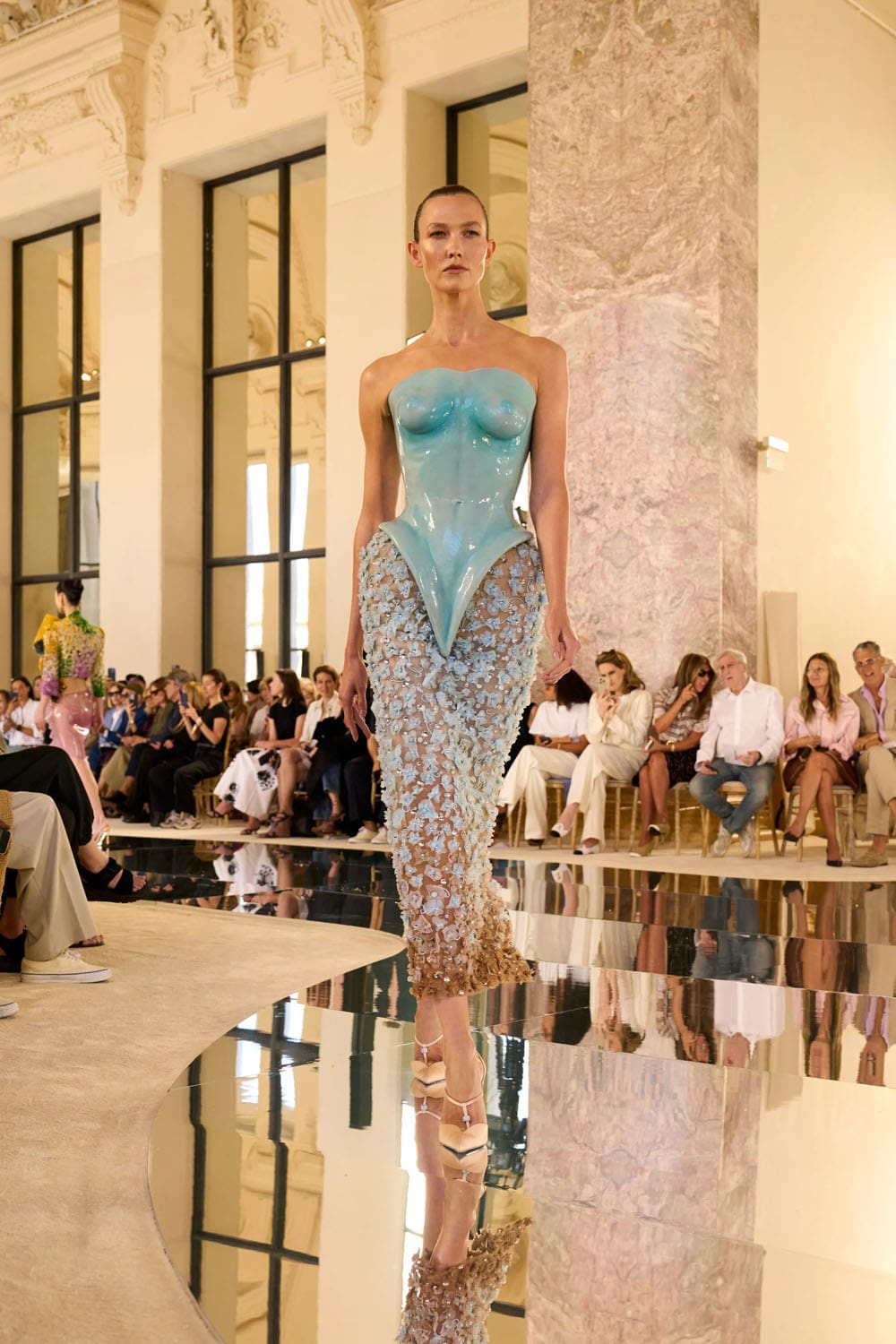
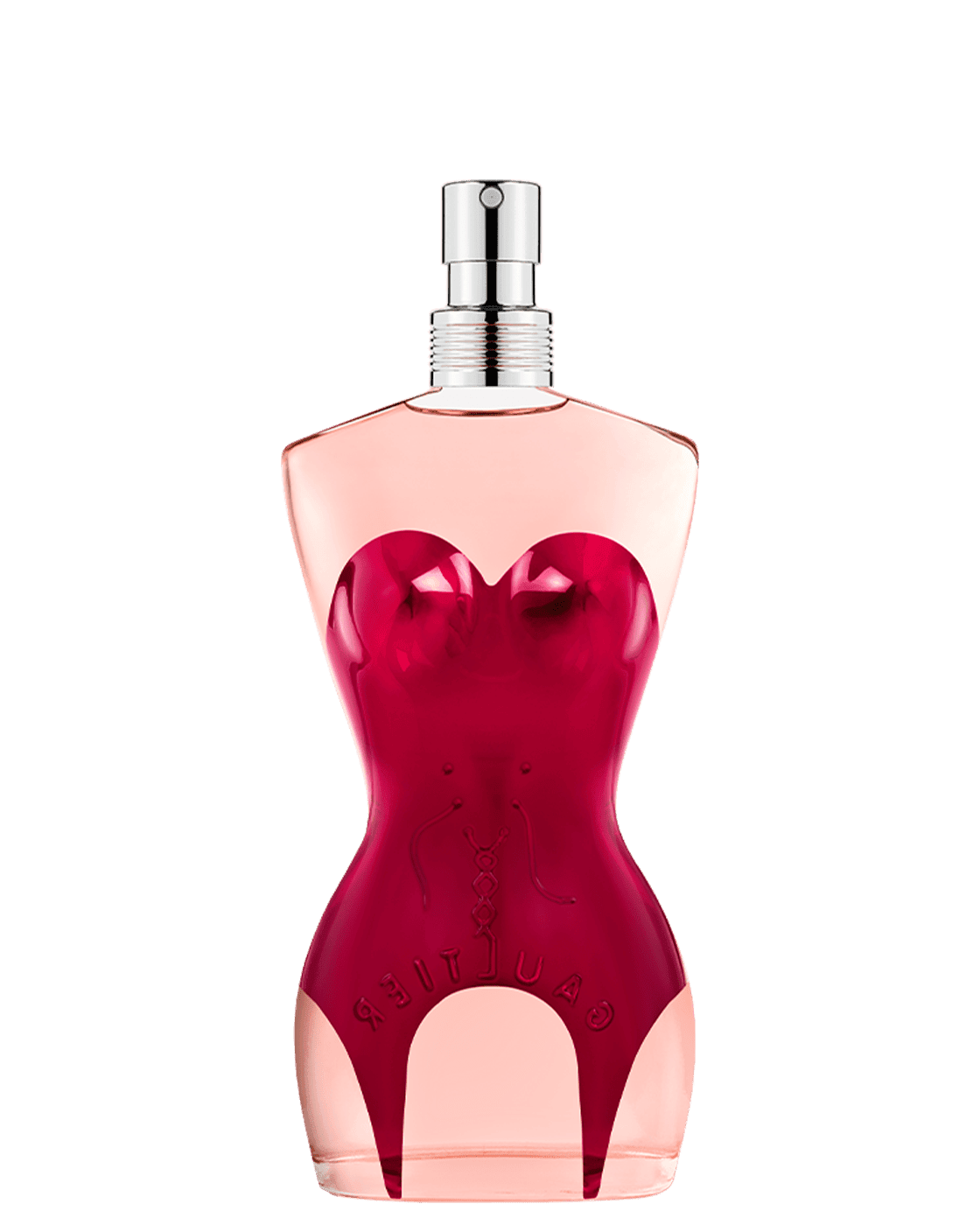
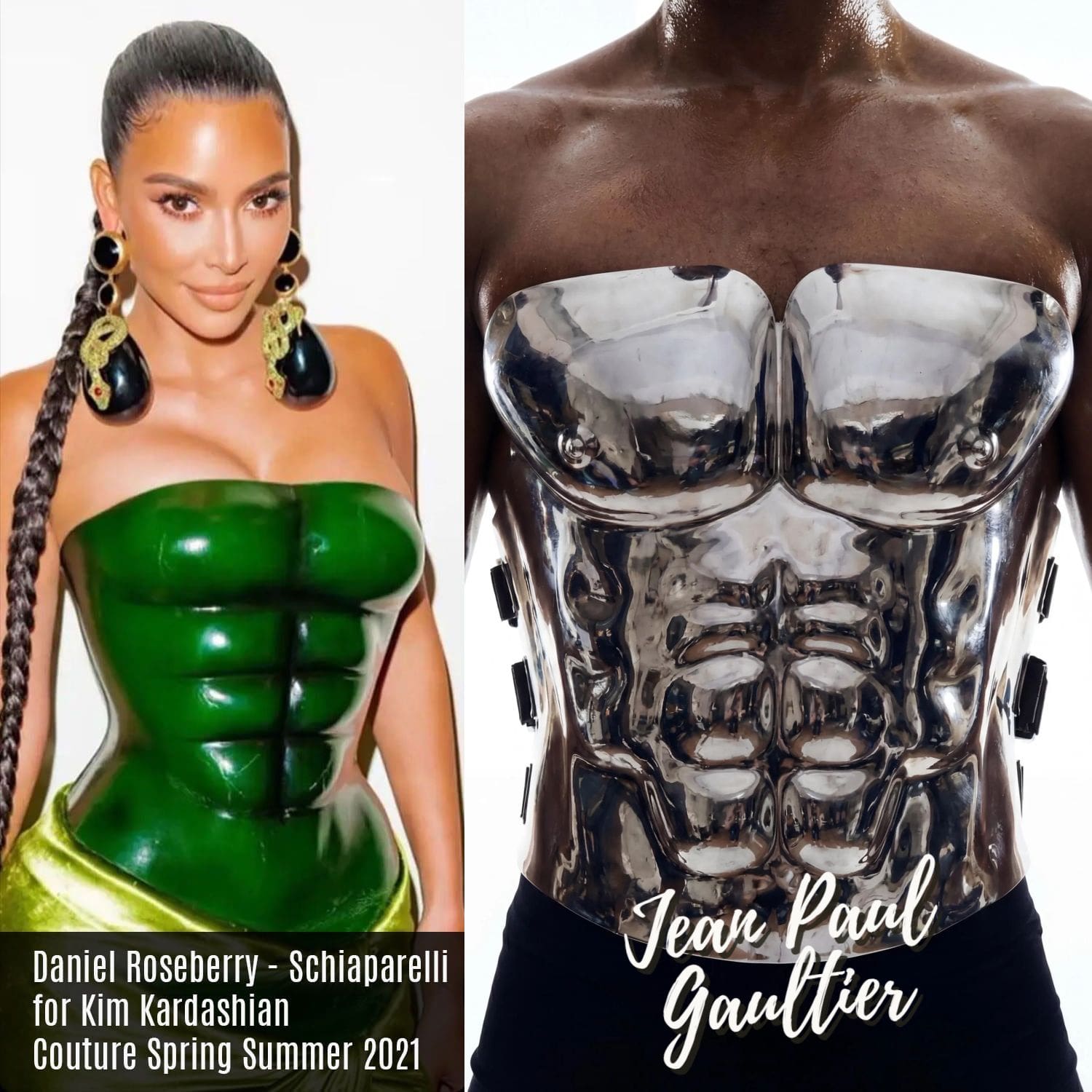
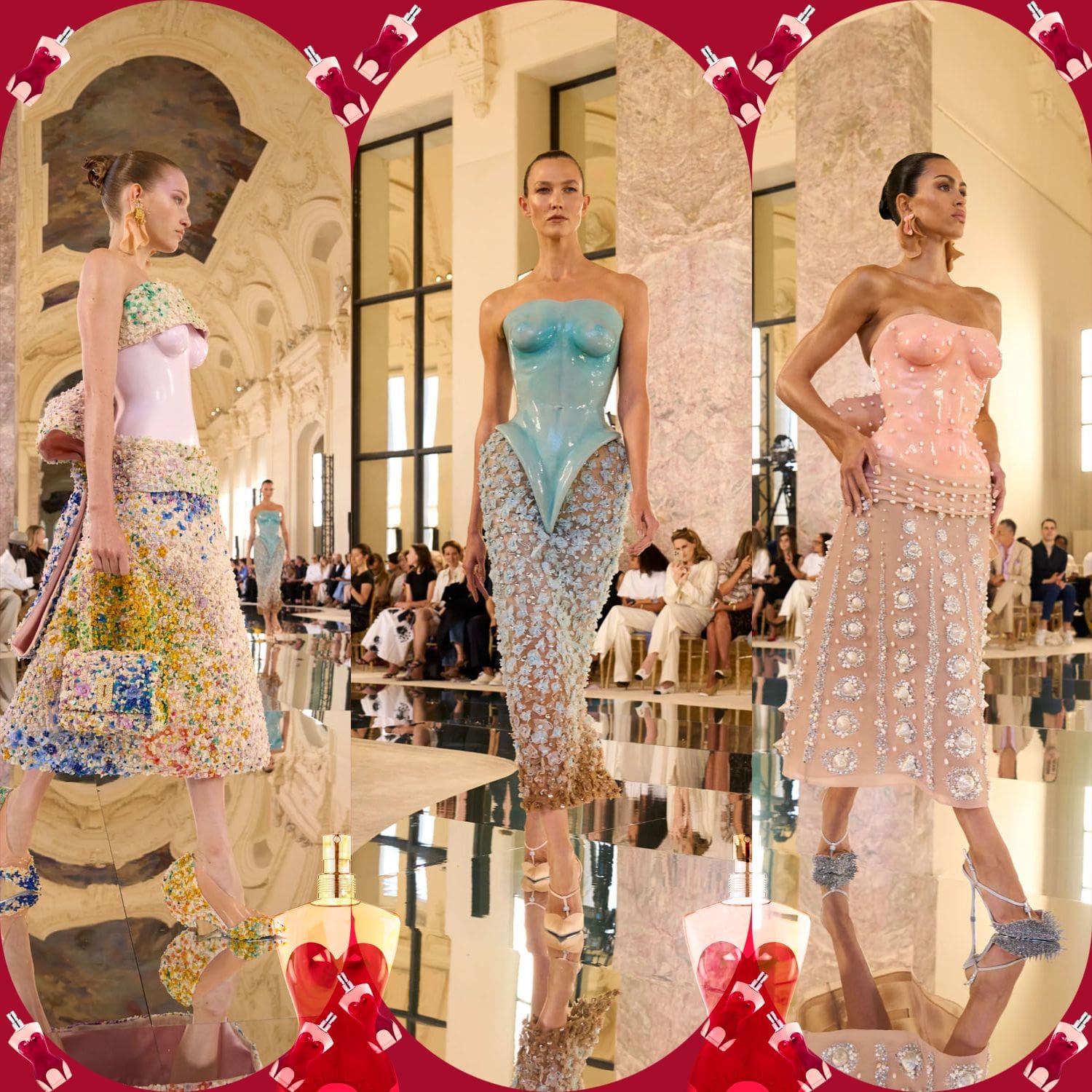
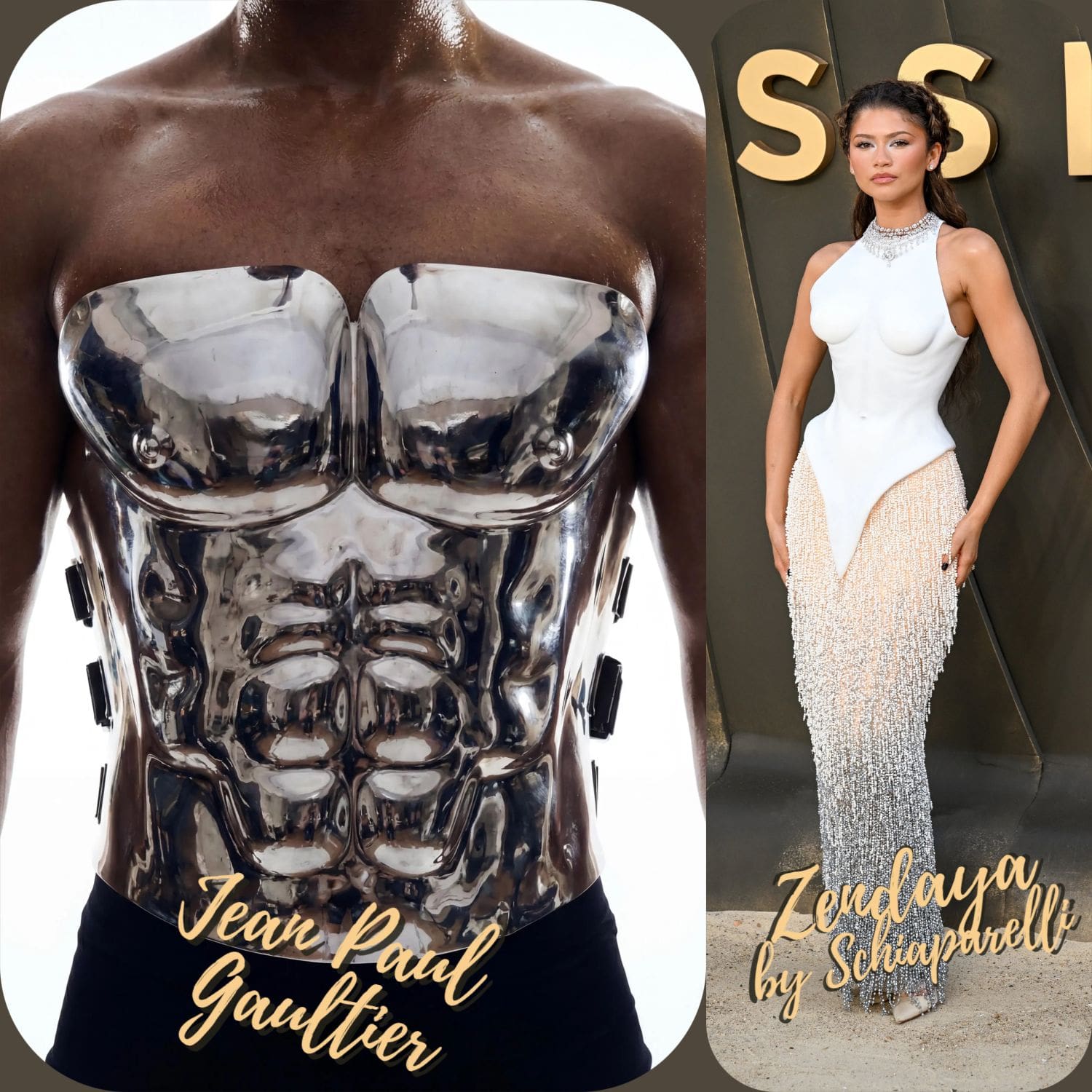
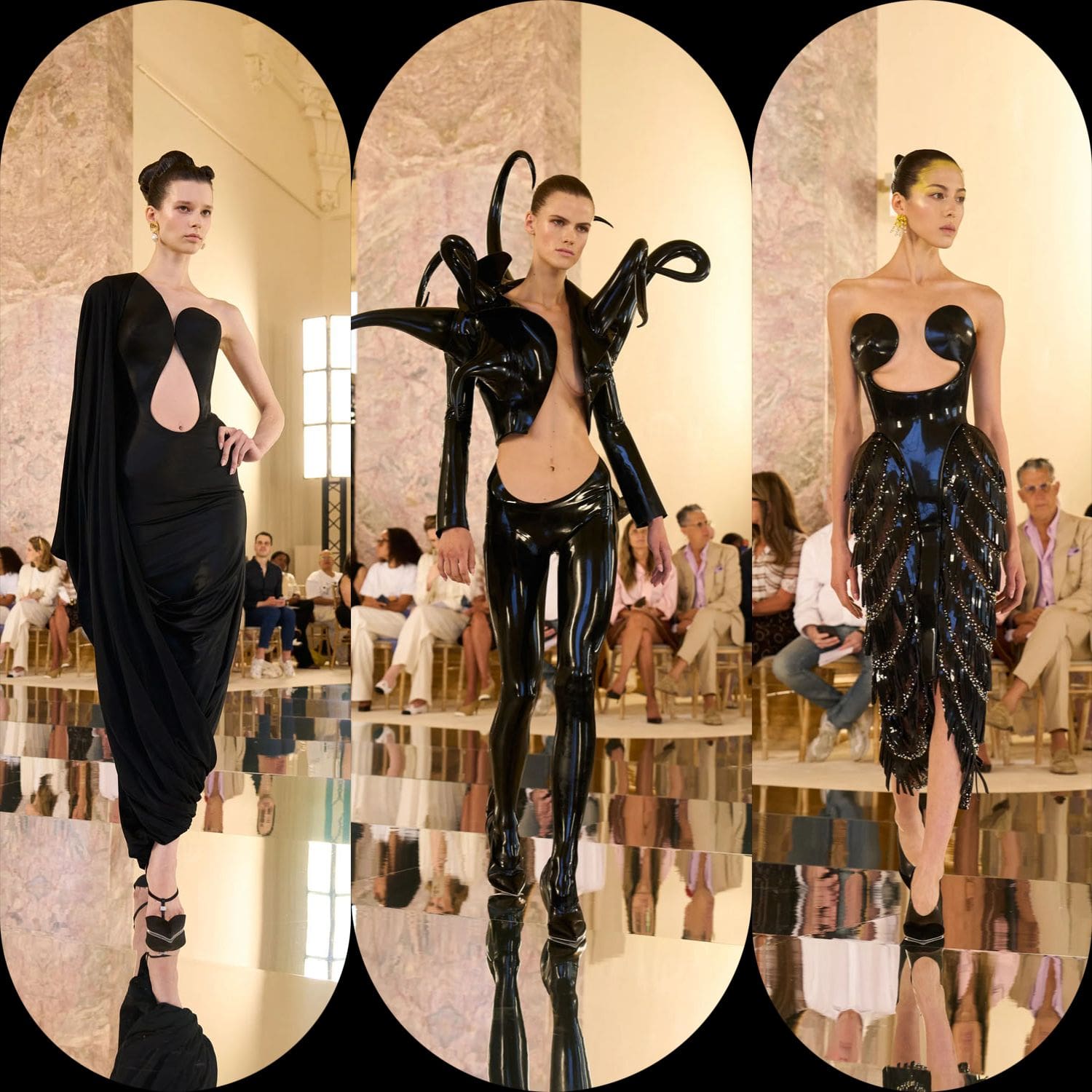
This season, the main stage was entirely hijacked by the sculpted torso. We can only assume they are cast from heavy-duty silicone, given Roseberry’s sudden obsession with a cinema atelier outside Paris that specializes in hyper-realistic lifelike babies. The runway flooded with variations of it: smooth, shiny, skin-like body-molded pieces that look less like Elsa’s whimsical surrealism and more like a high-gloss tribute to Jean Paul Gaultier’s iconic fragrance bottles and legendary metallic chestplates.
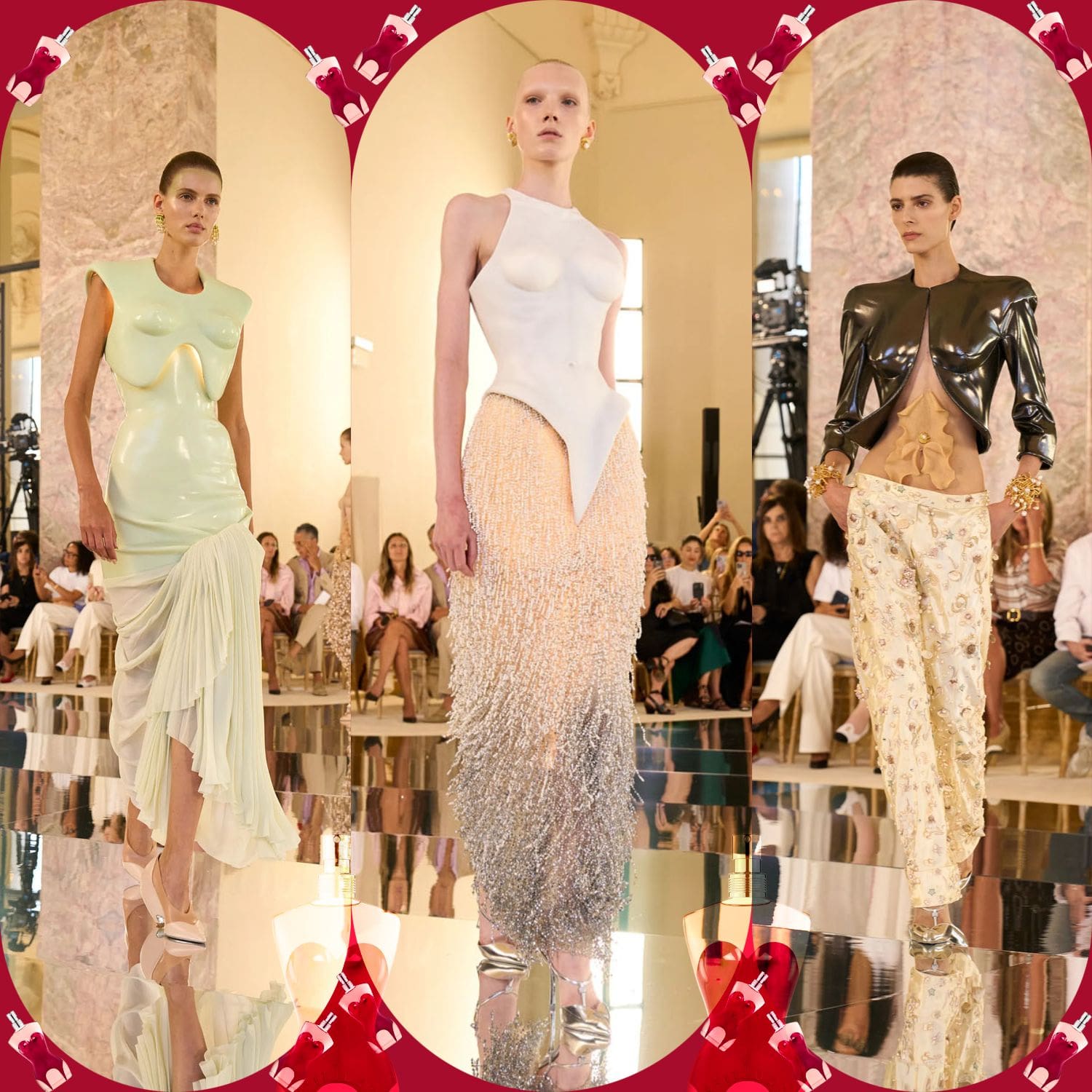
We saw it in milky blue, molded tightly to the body like an alien shell over a skirt of cornflower-blue flowers; we saw it in a pale, glistening pink paired with rows of pearls; and we saw it in a stark, pure white halter silhouette that tapered into an asymmetric point, dripping in a glittering cascade of ombré silver beads.
Sound familiar? It should. Zendaya famously wore that exact white sculpted piece for the Odyssée premiere in London. Honestly, she’d better check out the original. Jean Paul Gaultier is always here to create a miracle—one that is far more outstanding than just a contemporary echo of grace.
Lest we forget, this isn’t the house’s first venture into anatomical mimicry. Remember the 2021 green Hulk-girdle fiasco worn by Kim Kardashian? Or the previous collections that heavily borrowed from Gaultier’s legendary cone bra—the one he created for Madonna that practically defined an era? Next step, we suppose, is launching a line of perfumes in torso-shaped bottles. We’ll wait.
From Lightness to Kink: The Deep-Sea Aquarium
When the models weren’t encased in rubberized human torsos, they were apparently navigating a high-fashion seafood counter. Roseberry claimed he wanted to explore a “creepy fear of what lies in the ocean deeps.”
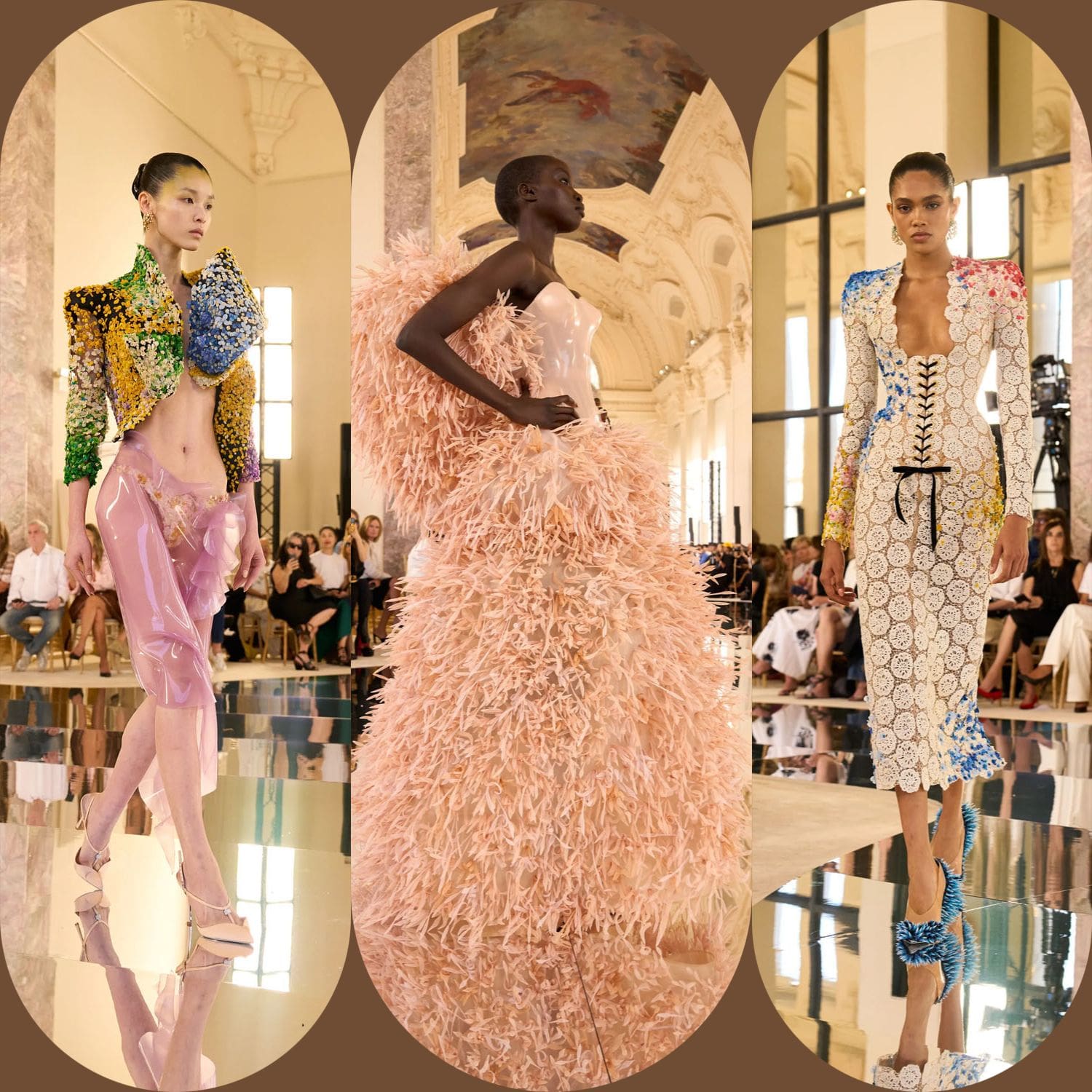
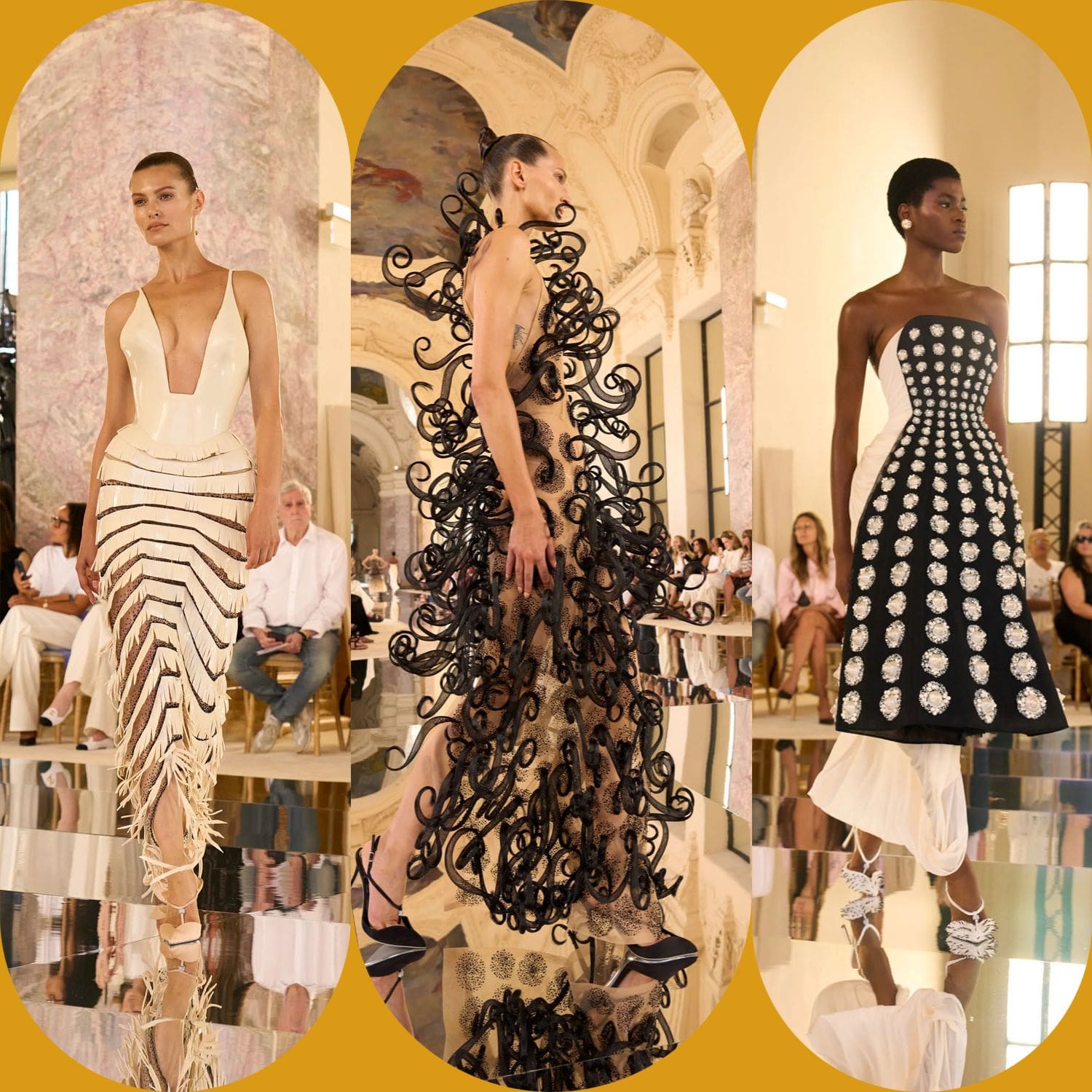
The result? One look transformed a model into a glossy black crustacean, complete with shiny latex pants and kinetic, inflated tendrils scrolling wildly from her shoulders like an angry octopus. Another model walked the mirror-like runway enveloped in a massive, exploding cloud of pink hand-applied feathers—resembling nothing less than a deeply offended sea urchin. There was even a glossy, deep-V latex swimsuit silhouette that transitioned into a tiered, fringed skirt mimicking structured fish scales, and an asymmetrical black gown featuring a giant cutout that revealed a completely bare midriff.
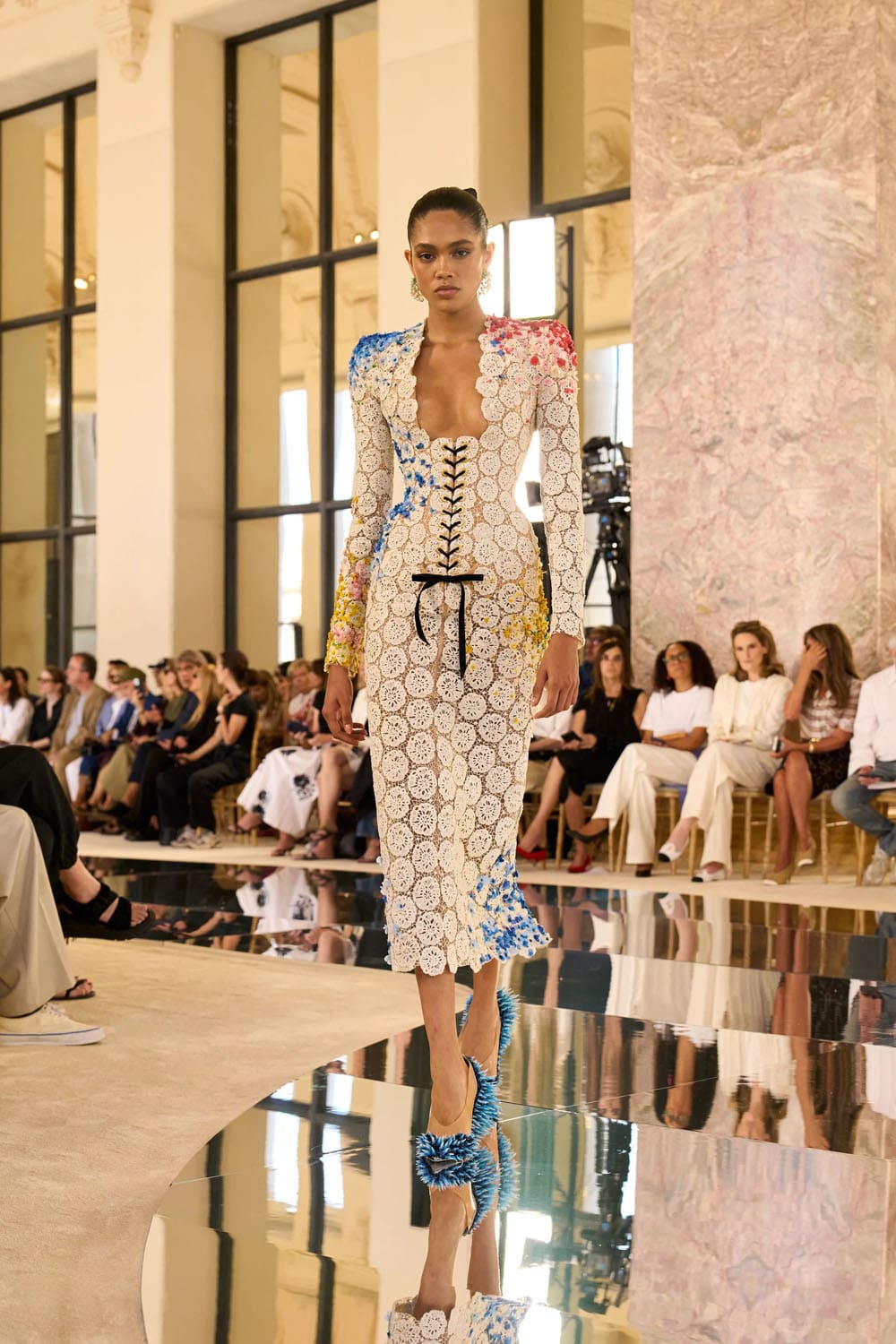
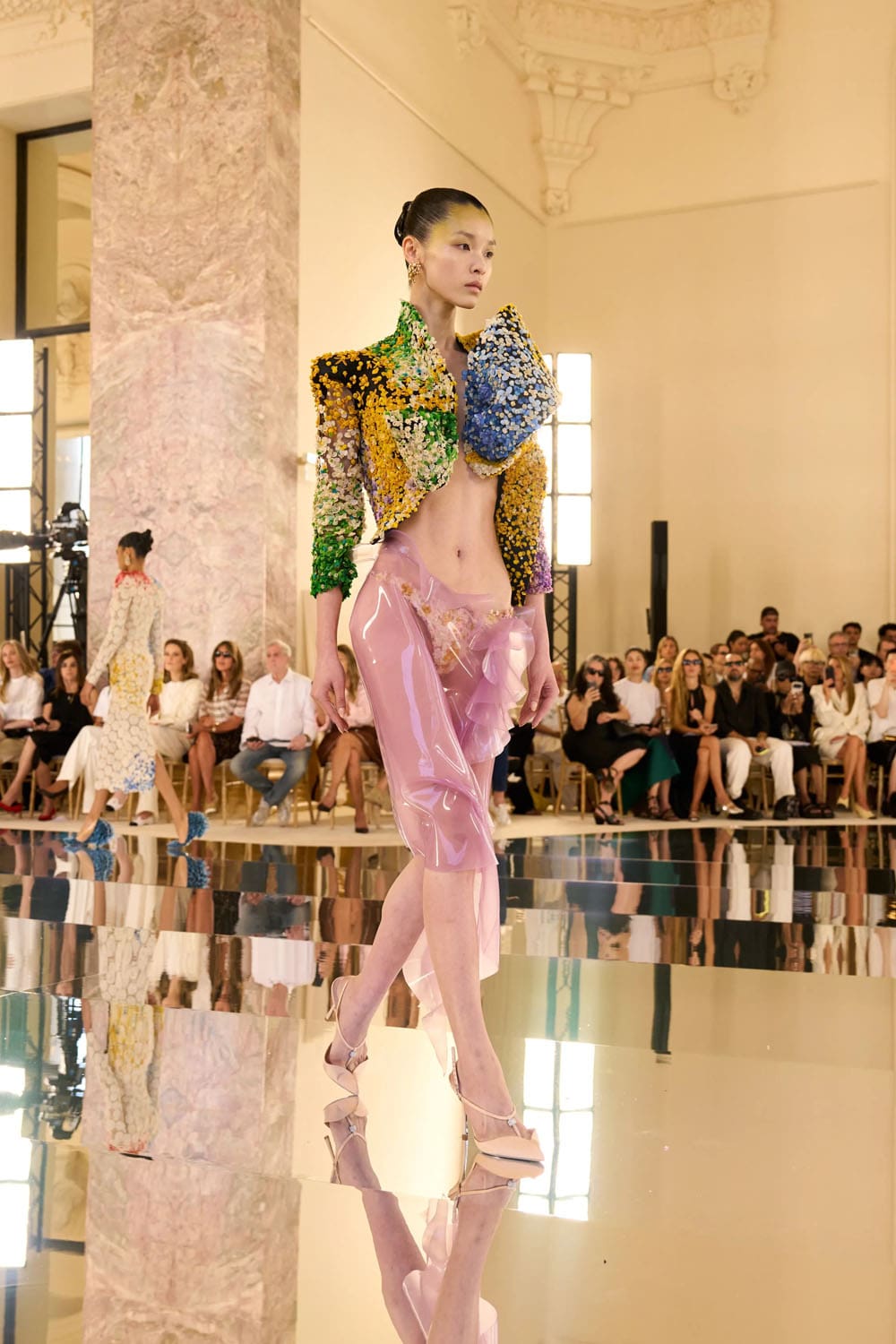
To contrast the synthetic madness of poured silicone satins and baked paint sheets, the atelier threw in hours of traditional labor, like encrusting jackets with real flowers or micro-embroideries of freeze-dried hydrangeas. But when a beautifully tailored floral jacket is paired with a transparent, melted-looking lavender silicone skirt that seems to be sliding off the hips, the “surrealist tension” feels less like Elsa and more like an identity crisis.
The Monologue of a Creative Block: Deconstructing the Drama
Let us look closely at the sheer theatricality of Daniel Roseberry’s self-indulgent confession. In the grand tradition of modern creative directors who mistake a standard artistic block for a Greek tragedy, Daniel treats us to a step-by-step breakdown of his psychological collapse.
He practically whines that because last season’s collection, “The Agony and the Ecstasy,” was a hit, he thought he had cracked the formula. He packed his bags, went to Barcelona, stared at Gaudí’s masterpieces, and expected the couture gods to automatically rain down genius upon his return. But alas, his three-step recipe failed. He entered a “misery-making cycle.” Translation: he panicked because he realized reproducing a commercial template doesn’t yield high art. So, what does a designer do when the well runs dry? They rebrand their anxiety as a philosophical movement and name it The Call of the Void.
Rebranding Silicone as “Surrealism”
Daniel’s main defense mechanism this season is a classic piece of fashion gaslighting. He boldly asks whether beauty resides in traditional, “noble” materials—like silk, satin, and wool—or in the imagination capable of reinventing cheap synthetics.
He swaps out centuries of high-luxury textile heritage for latex, poured sheets of baked paint, and lakes of industrial cinema silicone, and then tells us it’s an act of “total surrender to the unknown.” Let’s be real: pouring liquid plastic onto a table until it resembles a double-faced satin isn’t a surrealist breakthrough; it’s a clever manufacturing hack wrapped in an existential narrative. He claims Elsa Schiaparelli understood this instinctively because her Surrealism was about “revealing unspoken realities.” But Elsa used subversion to challenge societal norms, not to justify why a model is walking down a mirror runway looking like a piece of glazed, white porcelain-effect kitchenware.
When Mastery Means Crashing Into the Echo Chamber
Mastery, Daniel notes in his monologue, is about being brave enough to create in a space of “not knowing.” We actually agree. There is a lot of “not knowing” here—mainly, not knowing why a historic surrealist house is so intent on re-manufacturing the DNA of another living, breathing French legend.
If Elsa Schiaparelli’s greatest legacy is that impossibility can become a creative method, then the current method seems to be testing the limits of how much silicone one can pour over a Gaultier silhouette before anyone notices. It’s a joyful, complicated journey, no doubt. But for now, we’ll leave the diving suits to the professionals and view the abyss from a safe, intellectual distance.
The most amusingly pretentious part of Daniel’s manifesto is his sudden redefinition of “true mastery.” He pompously asks:
“Is it about being brave enough to create in a space of not knowing? Of being able to take flight, and knowing that the net will appear beneath you?”
He even boasted backstage about driving a car straight off a cliff. We appreciate a flair for the dramatic, but let’s look at where he actually landed when he “took flight” without a net: he crashed directly into Jean Paul Gaultier’s archives.
He notes that “codes—as beloved as they are—aren’t meant to be static,” using that as an excuse to push back against the house’s own staples and treat the iconic Schiaparelli jacket as a mere “accessory.” If your version of “venturing into the unknown” and “embracing vulnerability” results in a didactic, literal aquarium of sea urchins, fish scales, and molded torsos that we’ve already seen on perfume counters for decades, then the void isn’t quite as deep as you think it is. It’s just an echo chamber.
So, Daniel tells us to take his hand and jump off into the “bliss of the abyss.” Thanks for the invite, darling, but we’ll keep our feet firmly on the ground, taking notes.
See All Looks Schiaparelli Haute Couture Fall Winter 2026-2027