The Geometry of Desire – Sylvio Giardina’s Living Medievalism at Musée de Cluny. Story by Kate Granger, Editor of RUNWAY MAGAZINE. Photo Courtesy: Sylvio Giardina.
The Geometry of Desire
When fashion attempts to converse with history, it usually trips over its own hems, offering nothing more than lazy, literal pastiche. We have seen enough faux-corsetry and uninspired historical drag to last a lifetime. Yet, inside the sacred, stone-walled quiet of the Musée de Cluny, Sylvio Giardina’s Couture Fall Winter 2026–2027 collection, Mon Seul Désir, achieves something far more perilous and magnificent: it transforms historic heritage into an active, breathing creative mechanism.
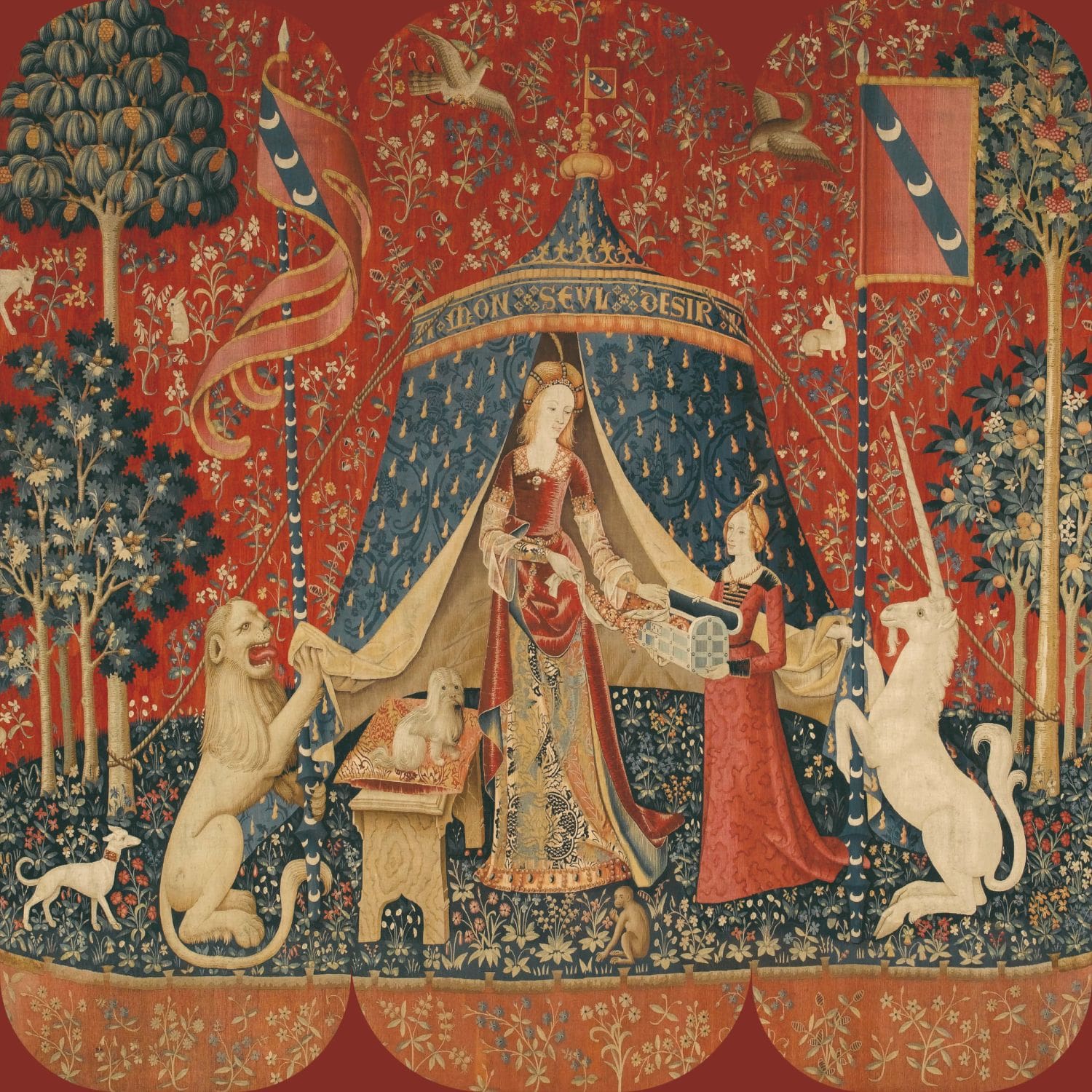
Giardina does not merely look at the legendary 15th-century tapestry cycle La Dame à la licorne; he interrogates its very cellular structure. Rather than indulging in a tedious contemporary reinterpretation of the five senses, his focus shifts entirely to the physics of the weave—the generative power of the thread to construct three-dimensional depth, mass, and illusion from flat surface planes. This is not a collection about medieval style; it is a profound essay on textile tressage and structural volume.
Thread as Architecture: The Sculpture of Lightness
The historic halls of Cluny, filled with ancient stone remnants and sacred iconography, provided a stark, monumental backdrop for garments that function less as clothing and more as kinetic sculptures. Giardina handles traditional couture materials—mikado, duchesse, tulle, and velvet—with the precision of an architect and the malice of a modernist, deliberately contrasting dense weight with sheer transparency.
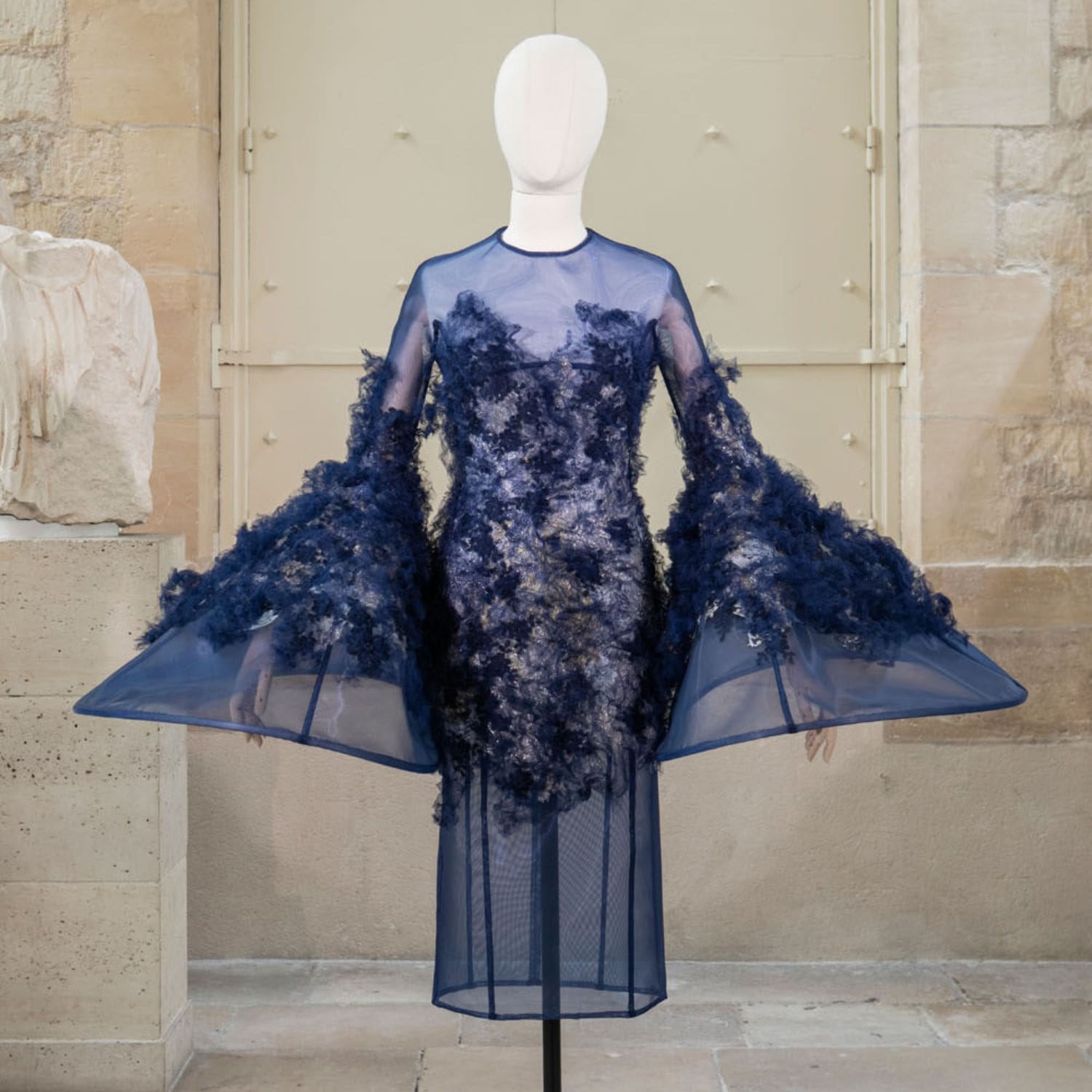
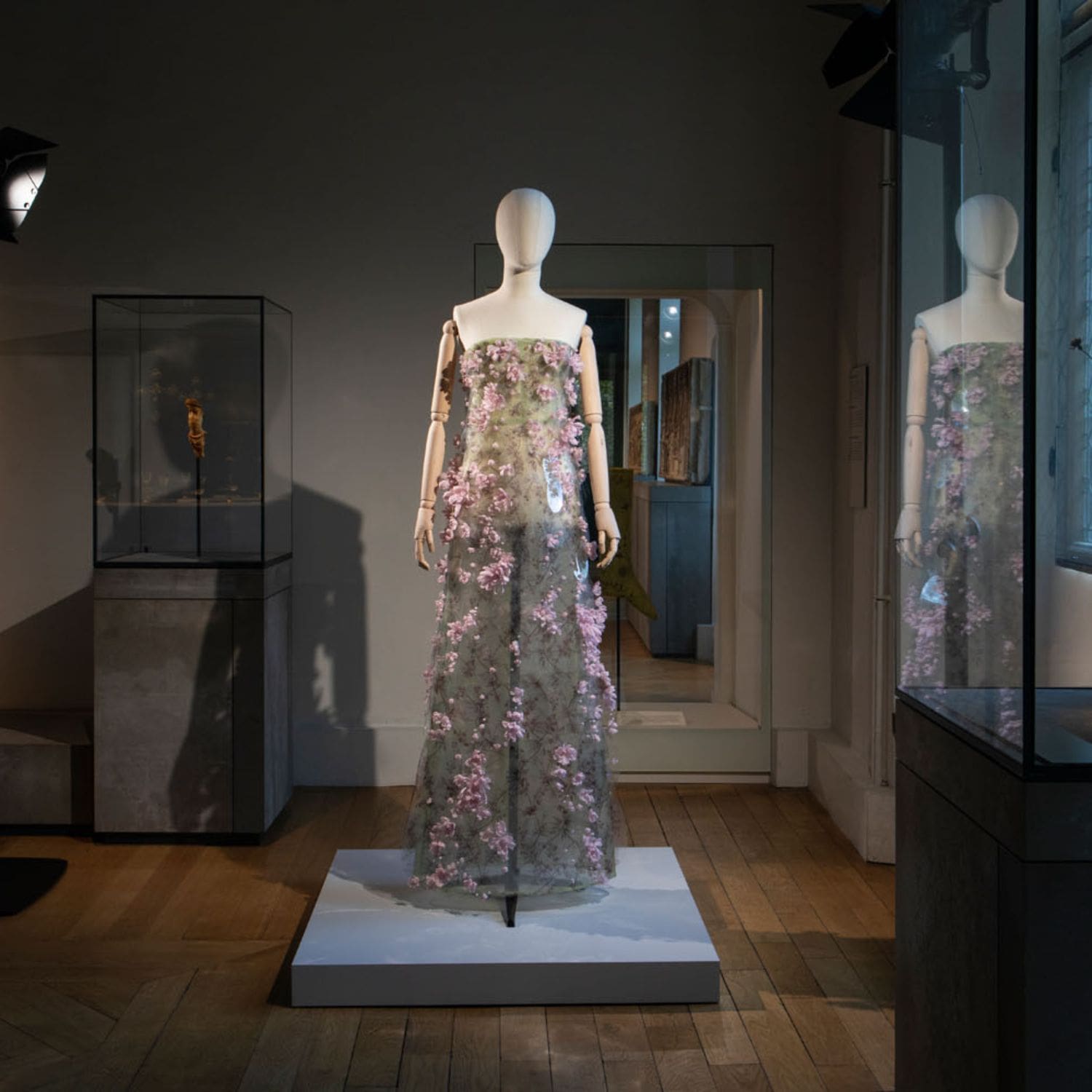
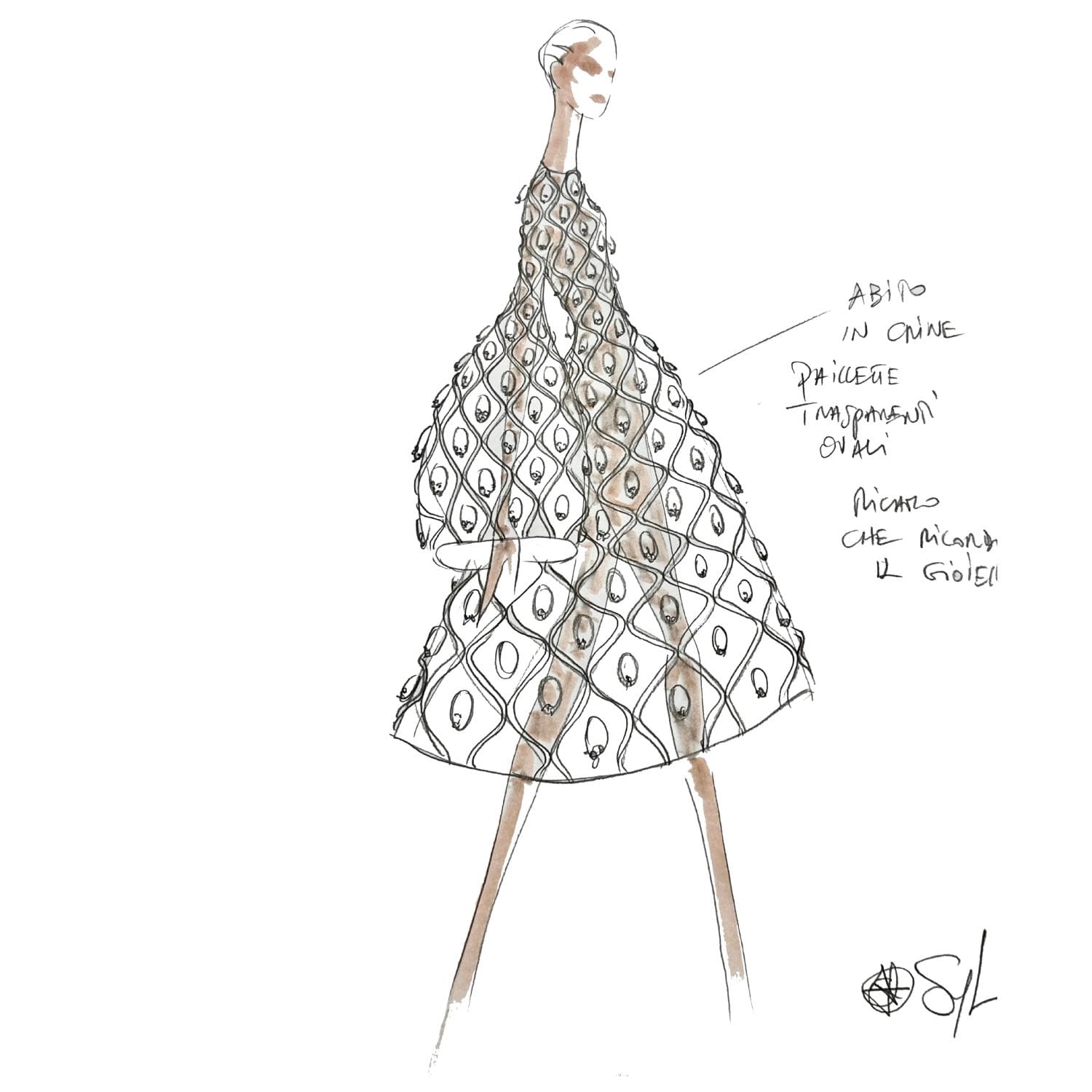
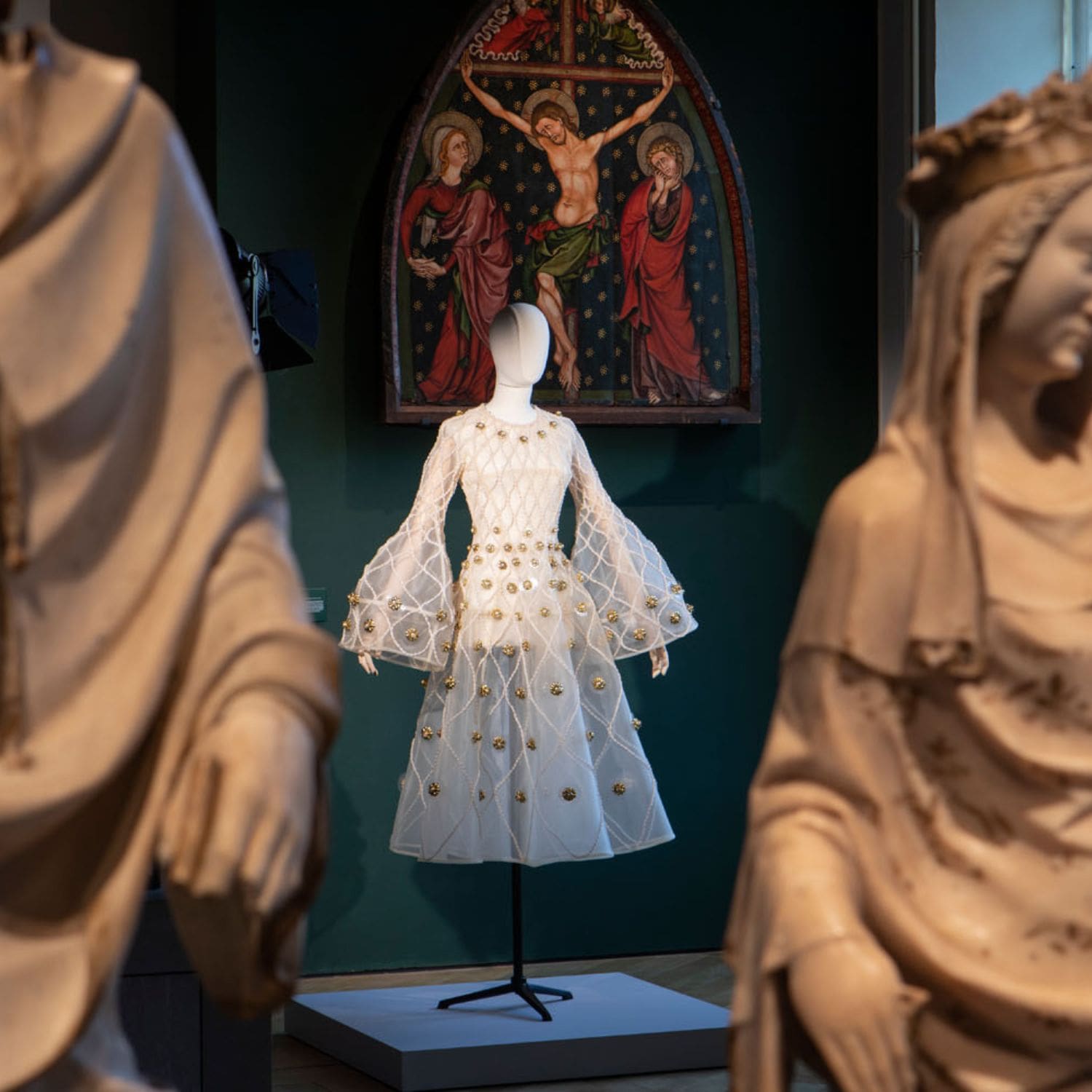
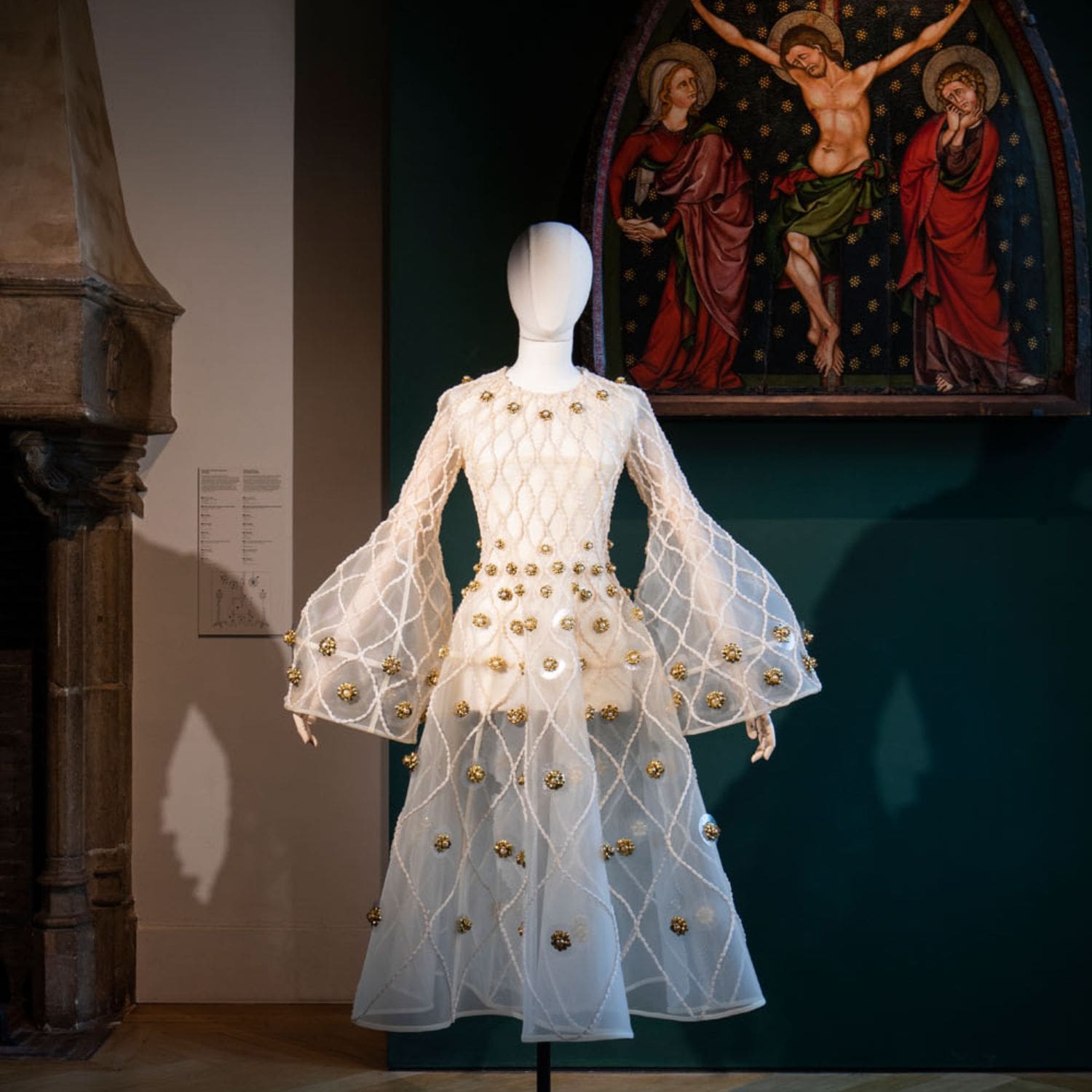
In one instance, the medieval millefleurs technique ceases to be mere decorative pattern and becomes structural grammar. A sheer, structural cream gown floats in the gallery space, its translucent fabric caged by a delicate, diamond-grid lattice. Suspended within this net are golden, jewel-like ornaments, mimicking the floating treasures of a lost century, hanging like gilded fragments captured in a spider’s web. Nearby, a striking, deep midnight-blue dress plays a similar game of substance and air; its structured bodice dissolves into exploding, voluminous bell sleeves crafted from a chaotic, beautifully tactile froth of shredded tulle, mimicking the wild, untamed flora found at the feet of the mythical unicorn.
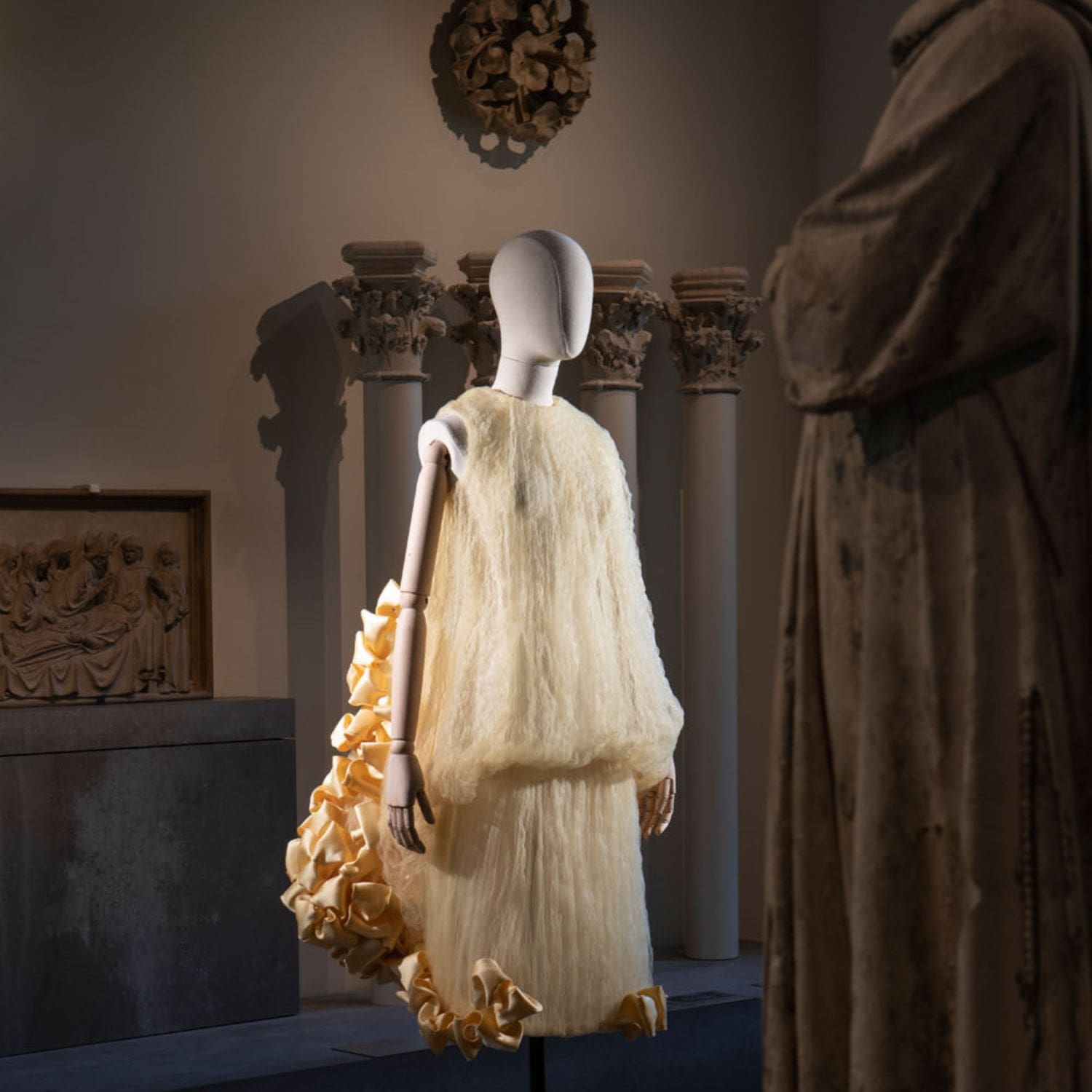
Even when the materials mimic the organic, Giardina’s structural discipline remains razor-sharp. A pale, butter-yellow ensemble challenges the viewer with a dense, mossy, almost fur-like texture that completely envelops the upper torso. It feels deeply primal yet meticulously controlled, cascading down into a skirt hemmed with heavy, sculpted satin scrolls that sit like architectural moldings against the stone floor.
The Crimson Sovereignty: “Mon Seul Désir” Realized
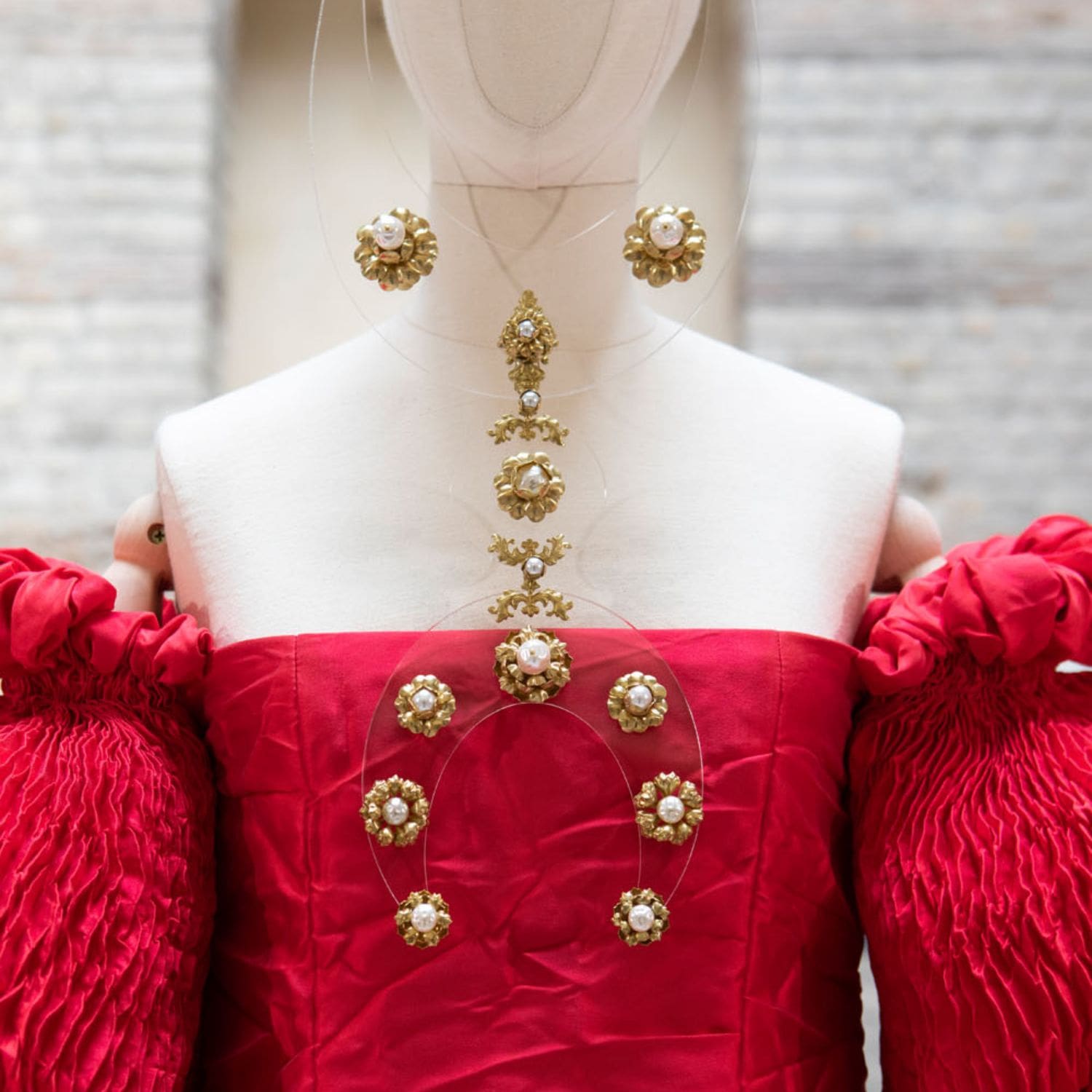
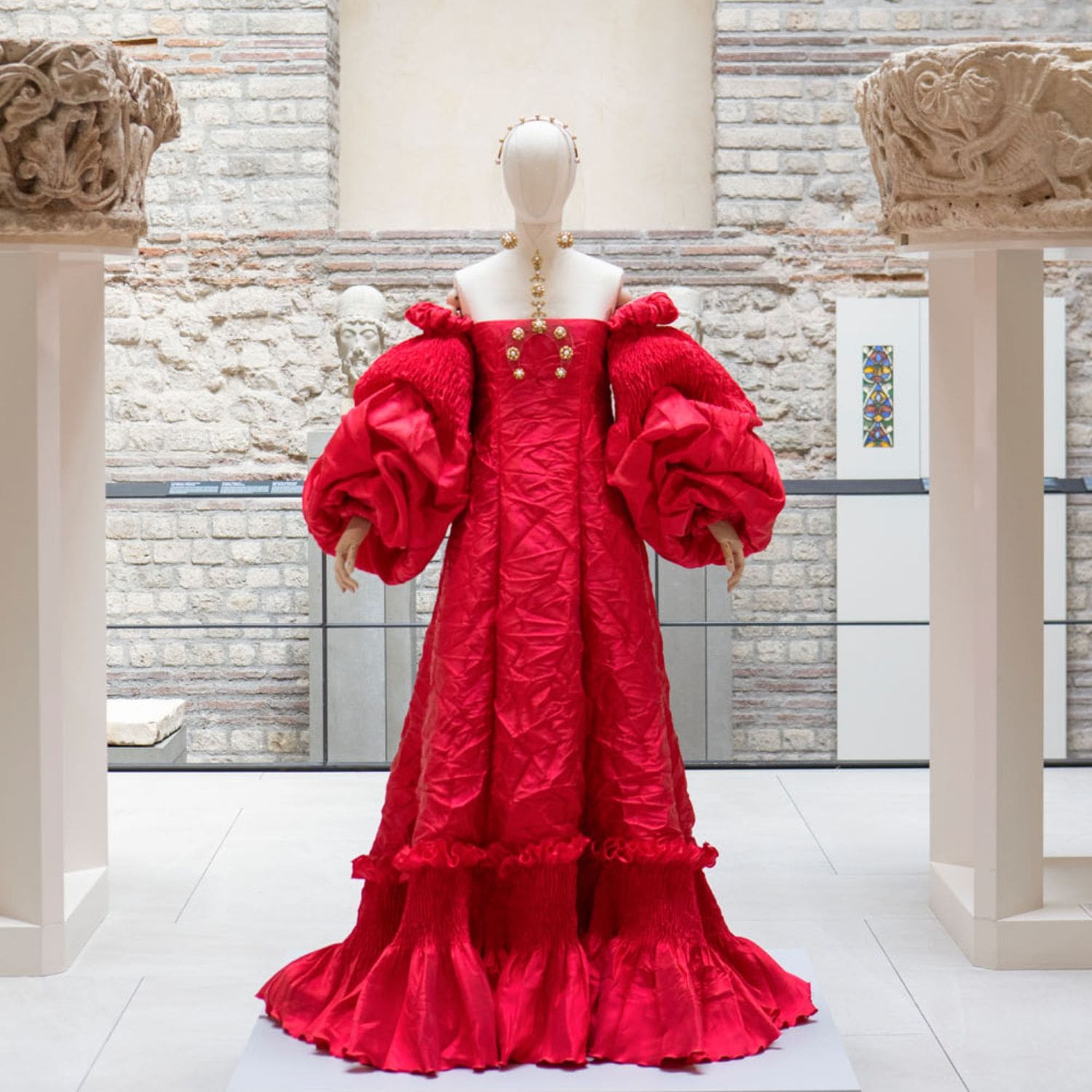
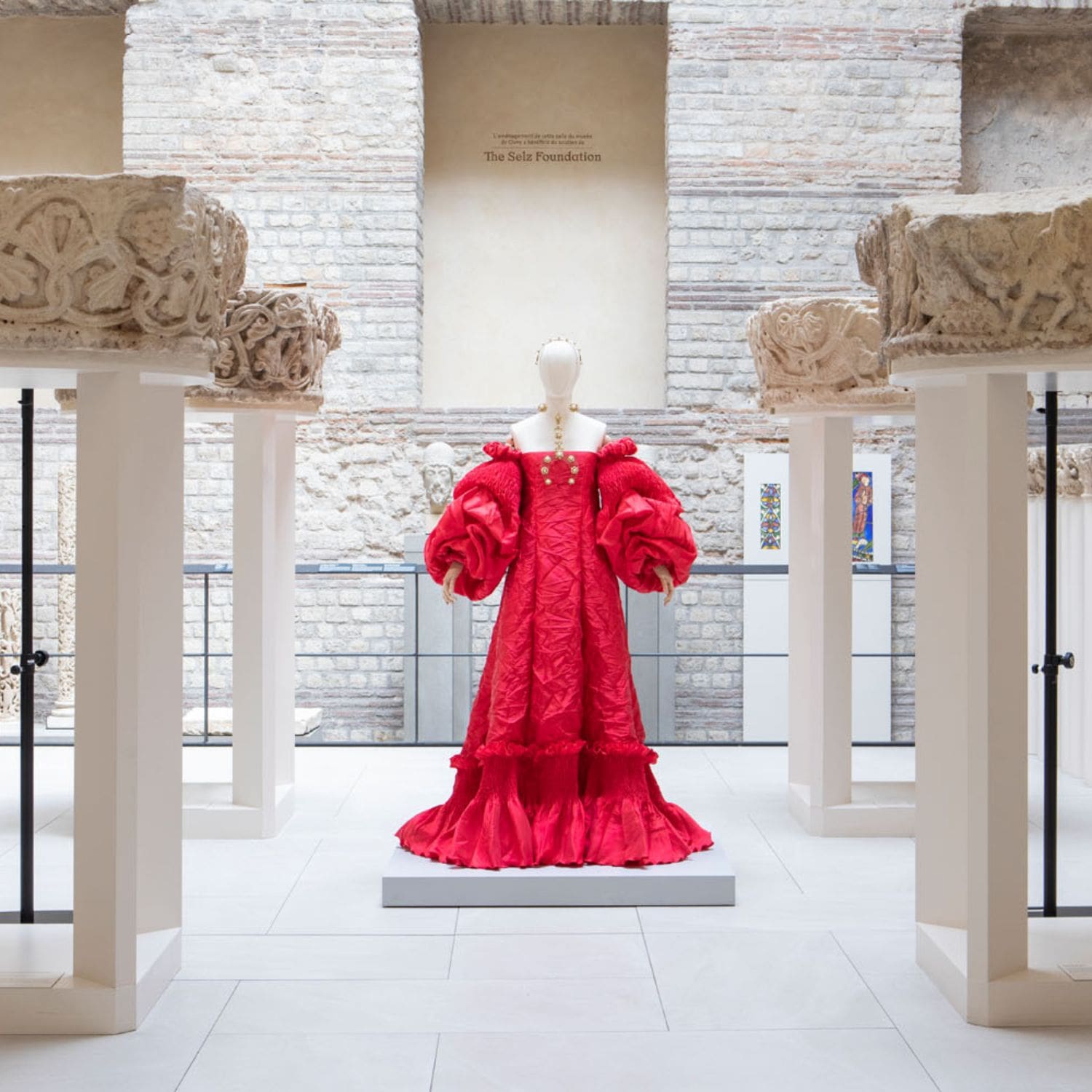
But the absolute zenith of this material narrative—the look that commands the room with an almost aggressive, regal authority—is the grand, monochromatic crimson gown. It is a masterclass in the manipulation of crin and duchesse, a staggering “WOW” that halts the viewer entirely.
The dress anchors itself with an off-the-shoulder neckline, immediately offset by gargantuan, puffed Bishop sleeves that are densely ruched at the top before exploding into massive, swirling vortexes of fabric. The entire surface of the vivid red gown possesses a finely crinkled, paper-like texture, catching the museum’s spotlight in fractured, dramatic facets. It tapers with impeccable precision down the torso, only to expand dramatically at the base into heavy, smocked flounces that spill across the stone floor like pooling blood. Suspended over the bare décolletage is a delicate, architectural gold necklace, integrated directly into the garment’s conceptual framework—a literal translation of medieval jewelry rendered as an avant-garde cage. It is a breathtaking manifestation of the sixth tapestry’s motto: the conscious transition from base desire to absolute awareness.
The Grammar of Ornamentation
Giardina’s intellect shines brightest when he strips away the romanticism of the Middle Ages to expose its graphic bones. The collection thrives on the tension between the fluid and the rigid, the pristine and the subverted.
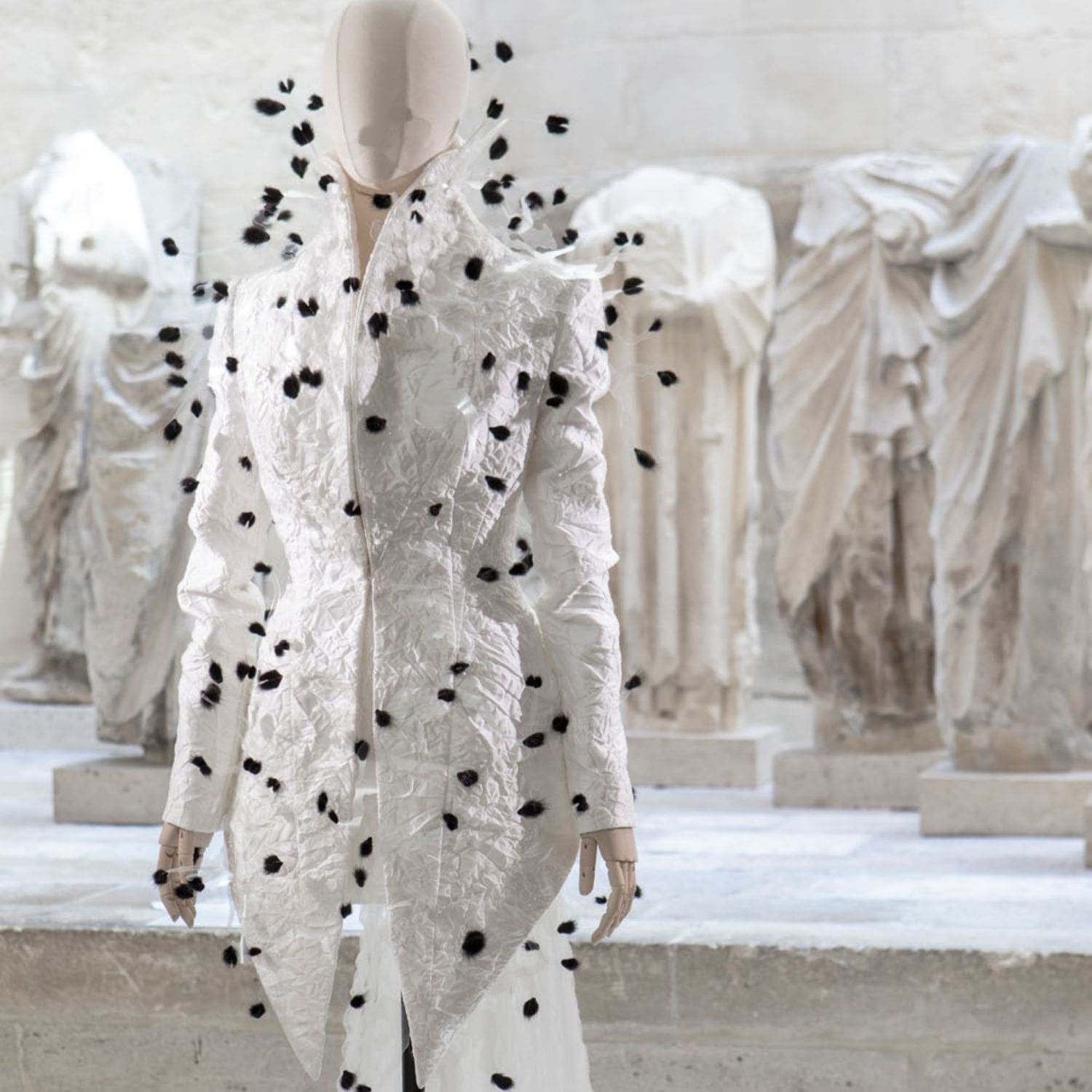
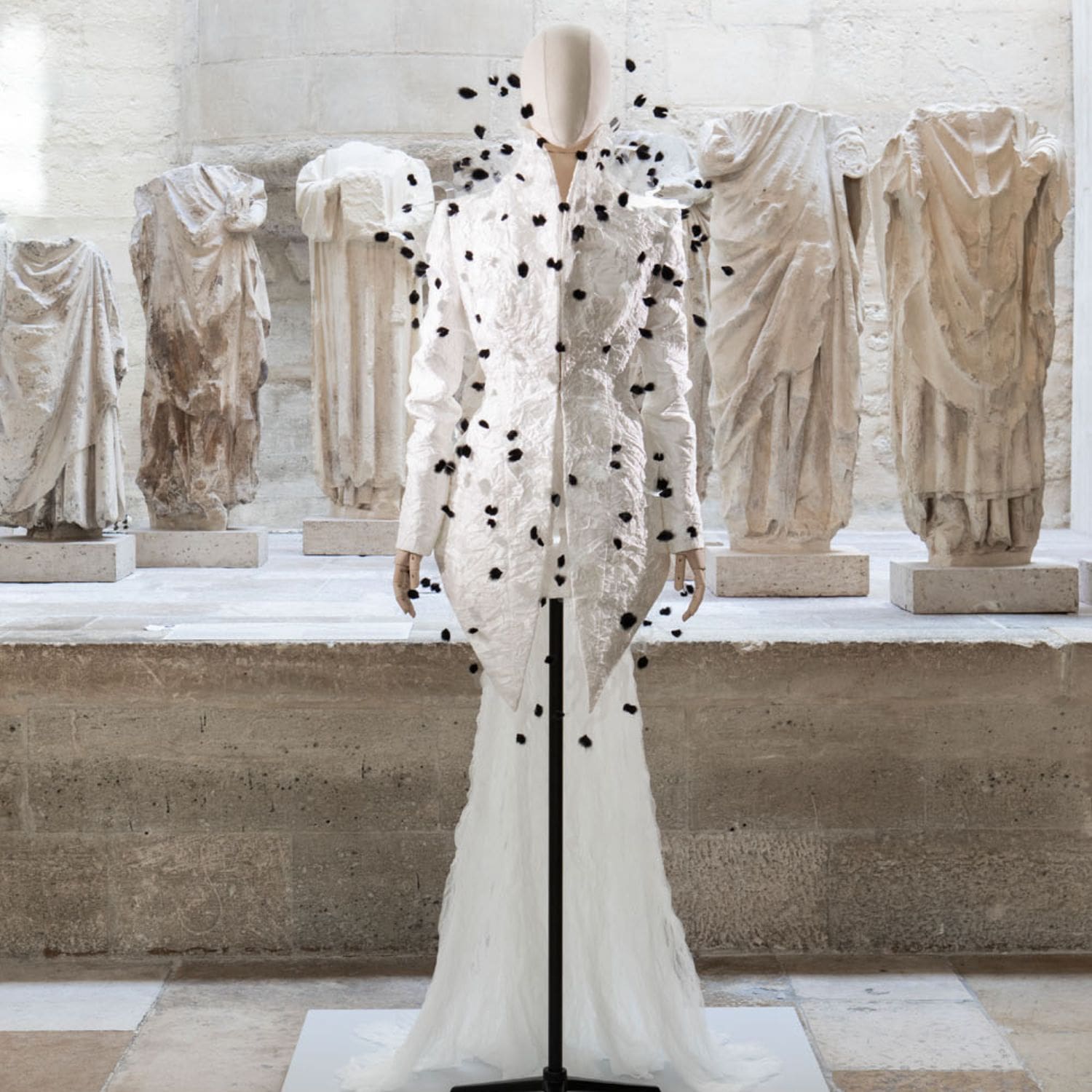
Consider a stark white, sharply tailored coat-dress standing amidst the broken fragments of ancient Gothic statues. The fabric is severely rumpled and crushed, mimicking the texture of ancient parchment, yet its collar rises with intimidating, high-church severity. Sprouting from its seams are hundreds of delicate, floating black tufts, hovering around the silhouette like a swarm of dark, stylized ermine spots or frozen ink drops, bridging the gap between graphic modernity and heraldic symbolism.
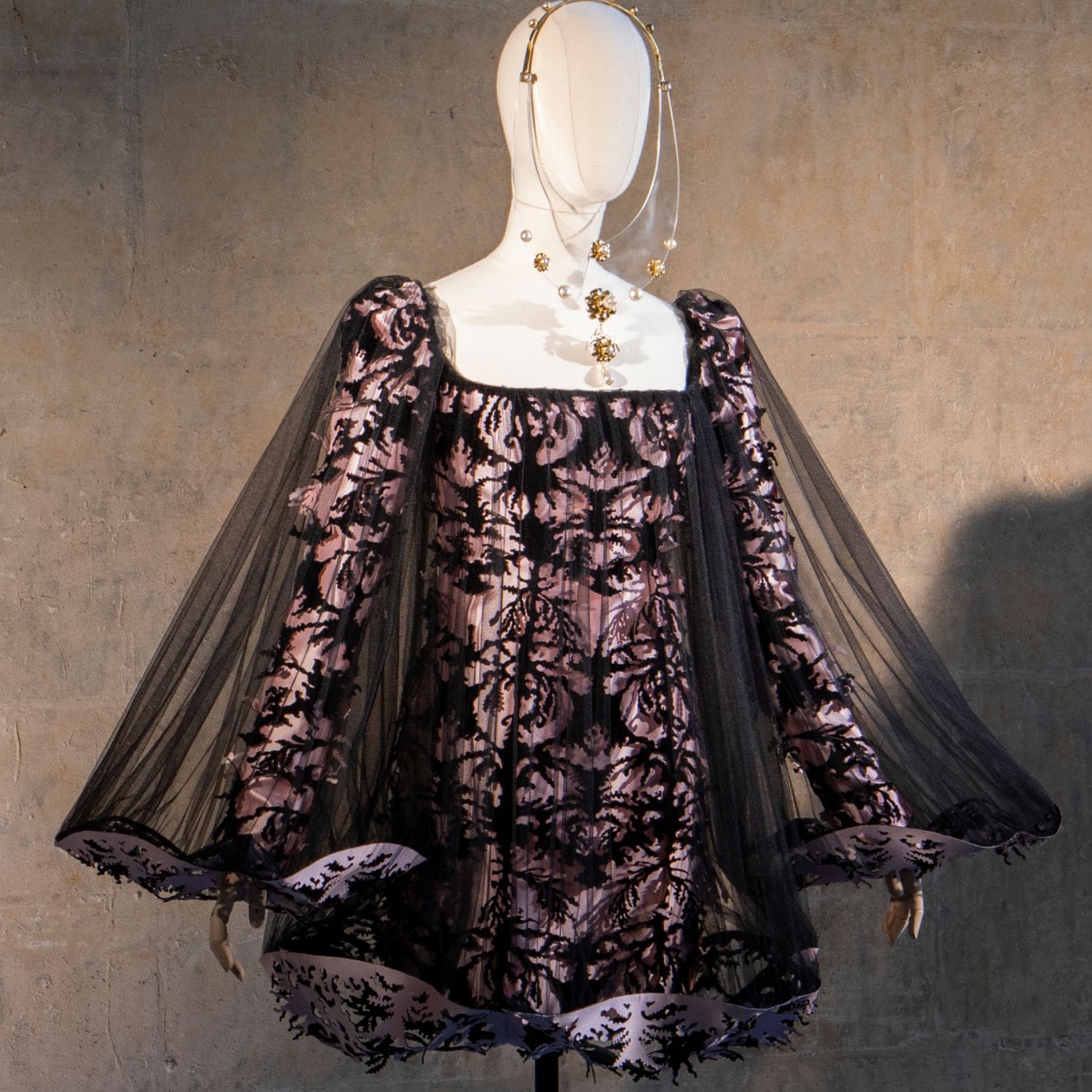
In direct contrast to this monochrome discipline, Giardina introduces an opulent, short balloon-silhouetted dress rendered in a heavy, dramatic black-and-lavender damask. Enveloped in an ethereal overlay of fine black tulle that drapes from the square neckline down to the sweeping sleeves, the look creates an exquisite visual illusion of depth. Suspended above it, a wire-thin golden halo and floating pearl structures hover around the mannequin’s head, transforming the wearer into a secular icon.
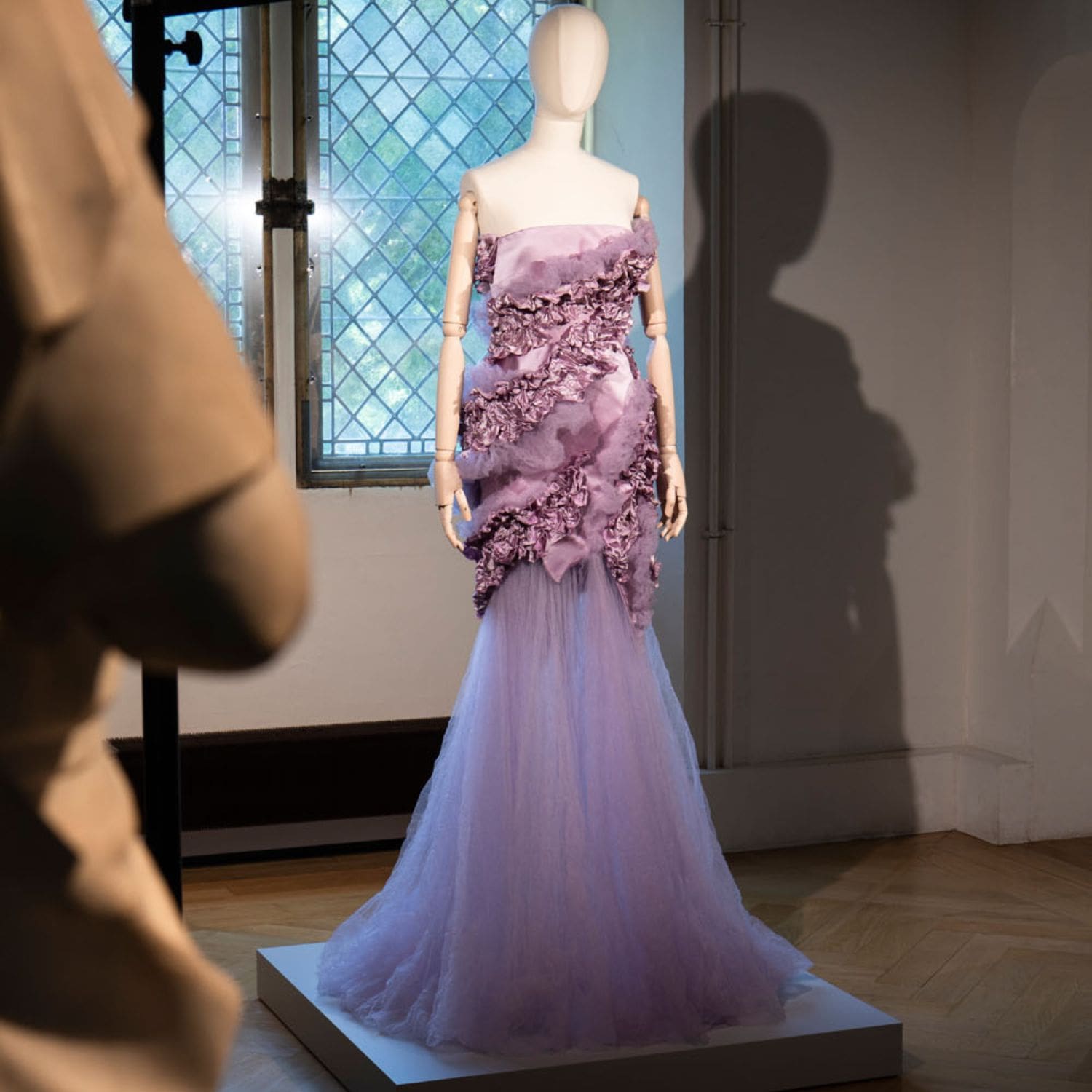
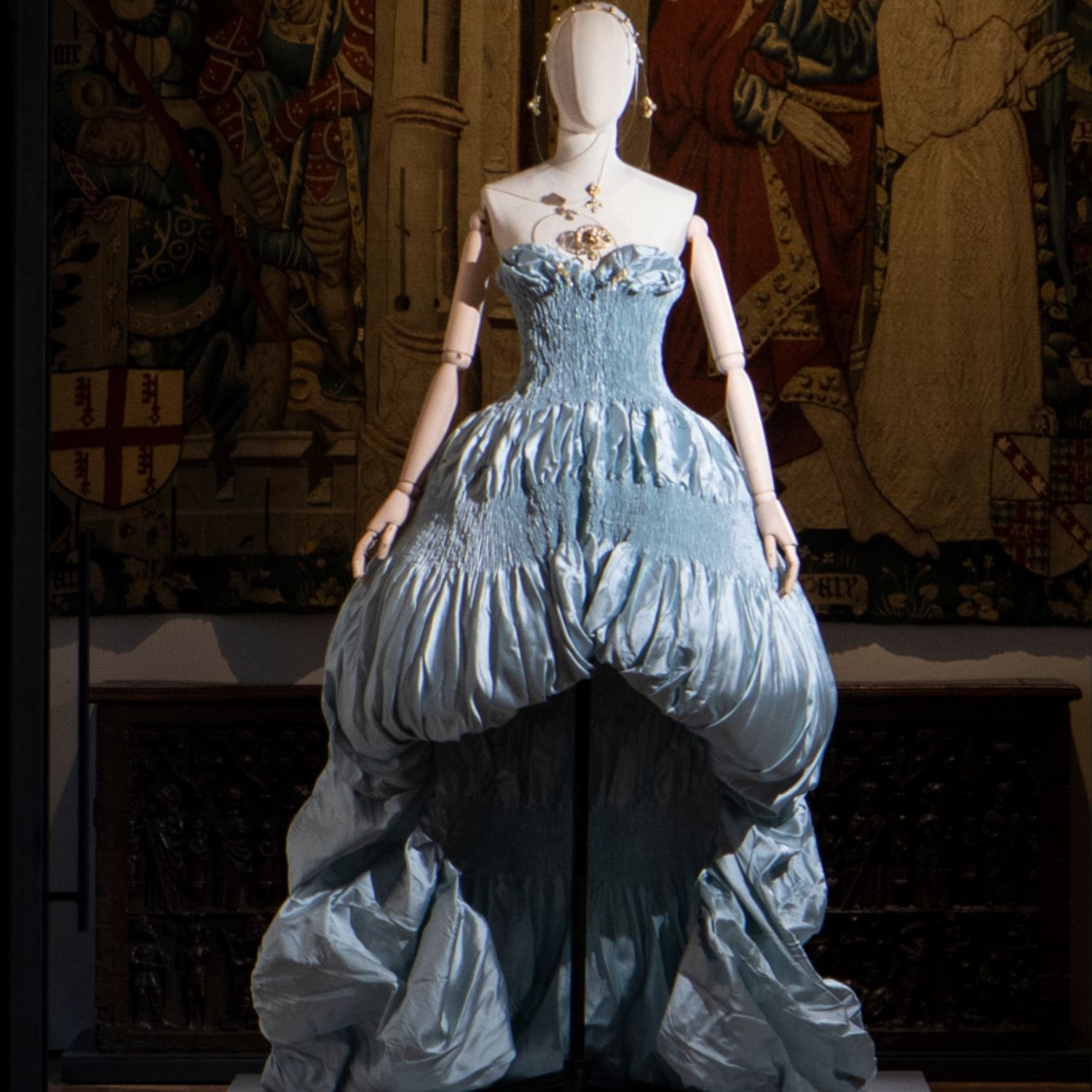
Finally, a spectacular, voluminous gown in powder-blue duchesse satin redefines the classic ballgown silhouette. The strapless bodice is densely smocked, compressing the fabric tightly against the frame before expanding into a massive, gathered, asymmetrical bubble skirt that is hitched up at the front to reveal a structural cascade of fabric trailing behind like a heavy wave.
Through Mon Seul Désir, Sylvio Giardina proves that the museum is never a graveyard of dead ideas. By treating color, texture, and historical geometry as raw, perceptual materials rather than nostalgic artifacts, he has successfully translated the ancient language of the loom into a sharp, contemporary manifesto.