The Winners of Fashion Award 2026 of the Arab World Institute “The Architecture of Memory”. Story by Ana Topi, Celebrity and Lifestyle Editor of RUNWAY MAGAZINE. Photo Courtesy: Arab World Institute.
Fashion awards frequently succumb to corporate ritual, functioning as glossy marketing exercises where established conglomerates applaud their own reflections. On Thursday, October 8, 2026, the Institut du monde arabe in Paris offered a powerful counterpoint. Gathering luminaries across art, culture, and design, the second edition of the Arab World Fashion Award did not merely distribute accolades. It celebrated a generation of designers who refuse to separate garment-making from geographical memory, material ethics, and historical gravity. Supported by a strategic partnership with the Sawiris Foundation ahead of the 2027 edition, this platform provides substantive scaffolding for practitioners emerging from across the Arab world and its diasporas.
What unites these six laureates is an unyielding conviction: clothing achieves lasting significance only when it carries the weight of where it comes from. In a commercial landscape awash with disposable trends and empty seasonal noise, these young creators are treating textiles as living archives.
The Kinetic Monument: Ayham Hassan
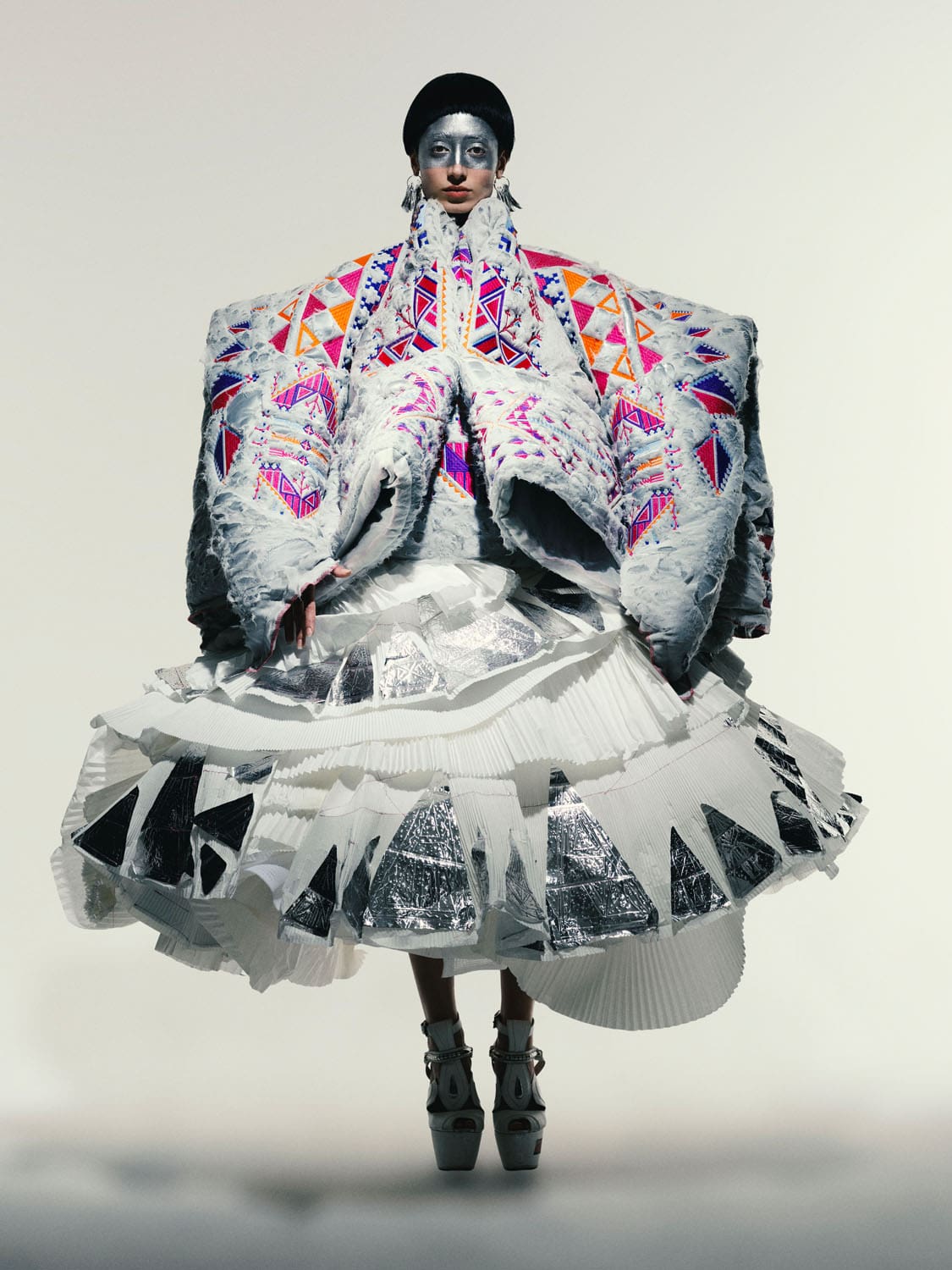
The undisputed triumph of the evening arrived in the Emerging Talent category, awarded to Palestinian designer Ayham Hassan. A graduate of Central Saint Martins whose graduate collection IM-Mortal Magenta previously captured the attention of institutions from the Victoria and Albert Museum to MoMu Antwerp, Hassan approaches garment construction as an act of cultural defiance. His practice does not treat heritage as passive folklore; he converts memory into monumental, three-dimensional sculpture.
Consider his extraordinary architectural silhouette: a sweeping, bell-shaped crinoline composed of razor-sharp white sunburst pleating, fractured diagonally by jagged shards of reflective emergency foil that flash against the eye like mirrors. Above this metallic expanse rises a towering cocooning duvet coat in soft, fleece-textured ash grey, its shoulders squared into an authoritative trapezoid. The coat is entirely hand-embroidered with saturated geometric tatreez needlework in vivid neon orange, magenta, cobalt, and mustard, wrapping the wearer in an imposing ceremonial armor. Topped with a minimalist black coif and silvered face paint, the figure stands at the intersection of traditional West Bank embroidery and avant-garde futurism. It is proof that fashion can articulate grief, resilience, and unshakeable pride through raw structural brilliance.
Bethlehem Proportions and Chouf Needlework
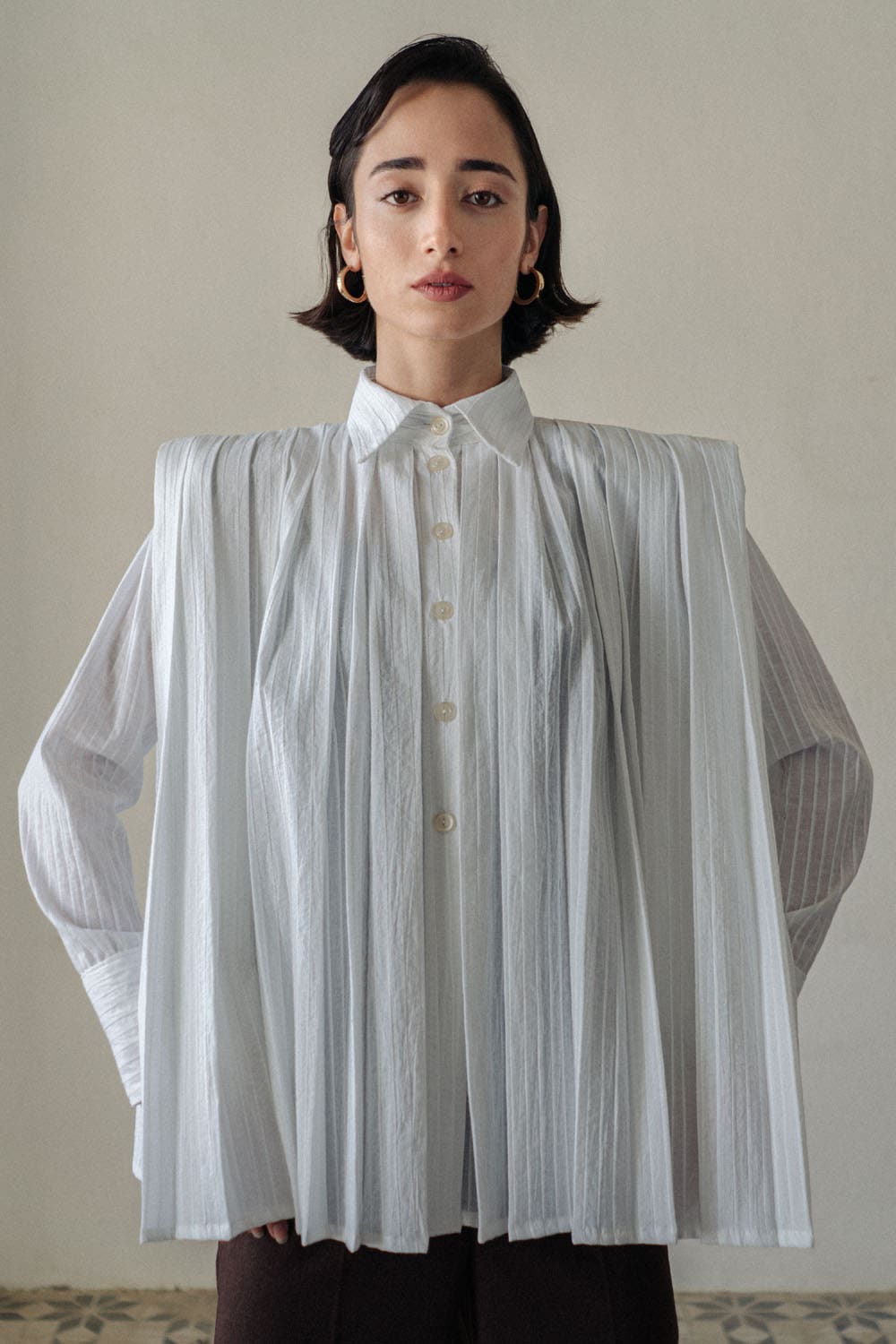
This architectural rigor echoed across Palestine in the Jury’s Honorable Mention, bestowed upon Hind Hilal and her Bethlehem-based studio HINDHILAL. An architect by training, Hilal designs in limited editions, allowing the intrinsic density of natural fibers to dictate form. Her crisp white tunic shirt re-engineers domestic linen into monastic sculpture. Rigid, horizontal shelf-shoulders extend outward past the frame, from which falls a cascade of dense, vertical knife pleats that veil the torso like classical stone fluting. Balanced above straight chocolate trousers and simple gold hoops, it is a silhouette that values mathematical restraint over superficial ornamentation.
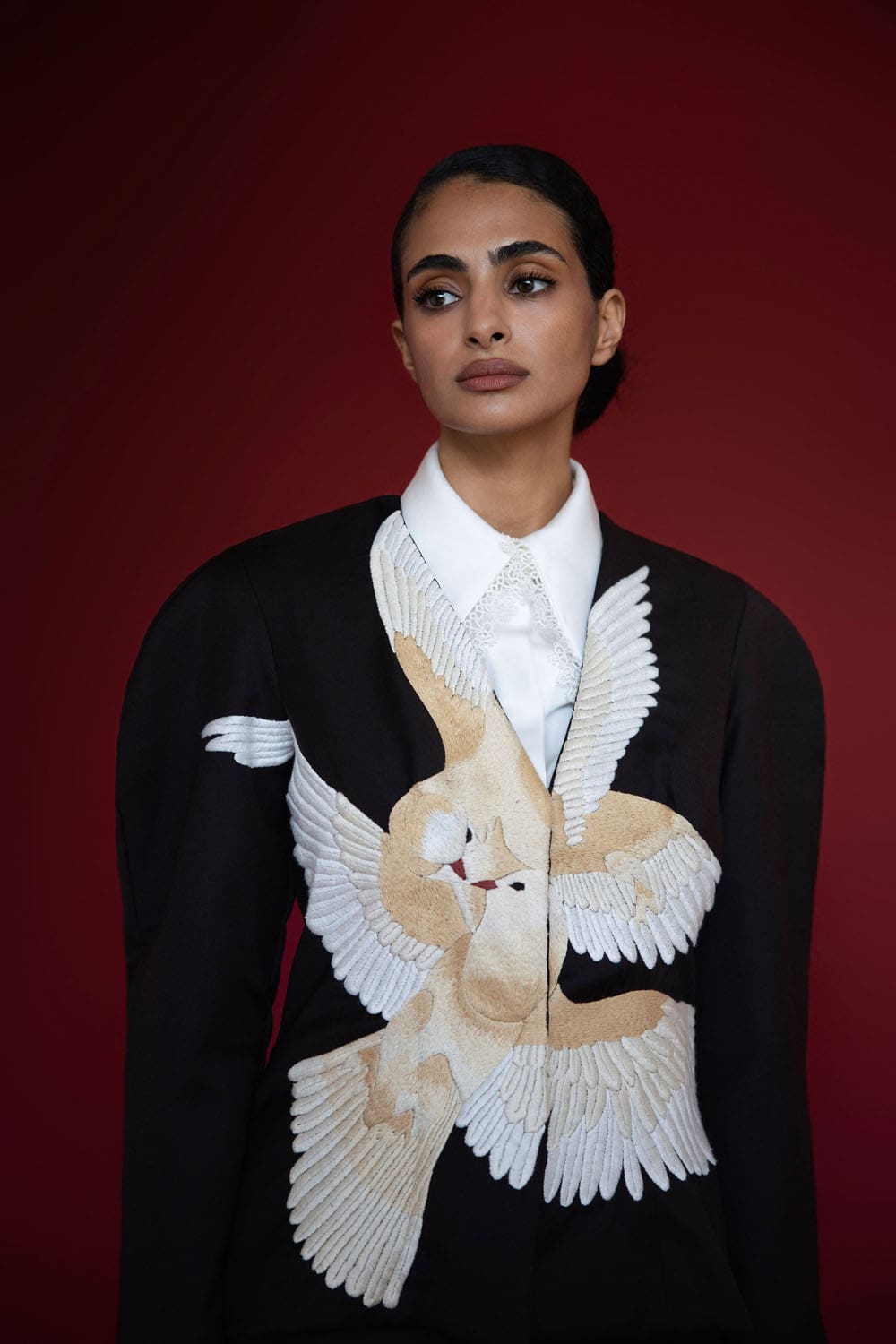
In the Chouf mountains of Lebanon, Salim Azzam—awarded the Talent in Creative Excellence and Craftsmanship—champions a poetic luxury that actively sustains rural female artisans. Azzam views the tension of every hand-drawn stitch as an ethical relationship. His tailored black evening coat presents a masterclass in regional heraldry: cut clean across the collarbone over a crisp white cotton shirt with Guipure lace lapels, the jacket’s front closure is dominated by two massive, hand-embroidered doves intertwined in mid-flight. Worked in dense satin stitches of sand, bone, and snow-white thread, the birds transform tailoring into an heirloom banner of peace and community survival.
The Painterly Casket and the Metamorphic Cloak
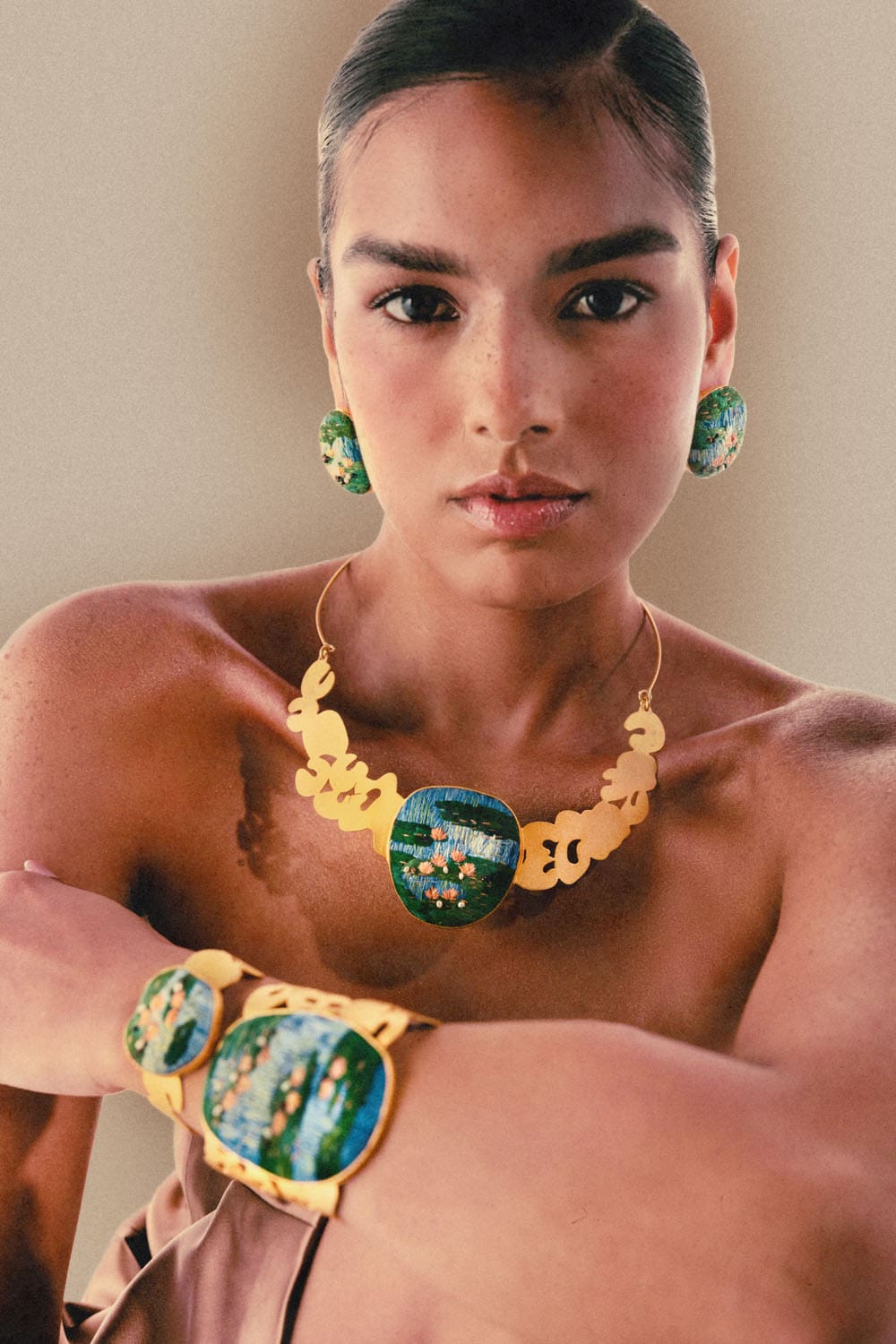
Accessories ceased to be functional afterthoughts in the hands of Egyptian artist and designer Fatma Mostafa, winner of the Talent Accessories prize. Running her contemporary studio at the boundary of sculpture and textile art, Mostafa pioneered a method where needlepoint embroidery and metalwork inhabit the same plane. Her hammered brass pectoral torque cradles a large, bezel-set miniature medallion: not a gem, but an exquisite, hand-embroidered impressionist water lily pond stitched in liquid blues, aquatic greens, and delicate pink blossoms. Paired with matching cuff bracelets and ear clips, the jewels function like wearable Renaissance enamels, transforming ancient Egyptian botanical motifs into tactile, modern amulets.
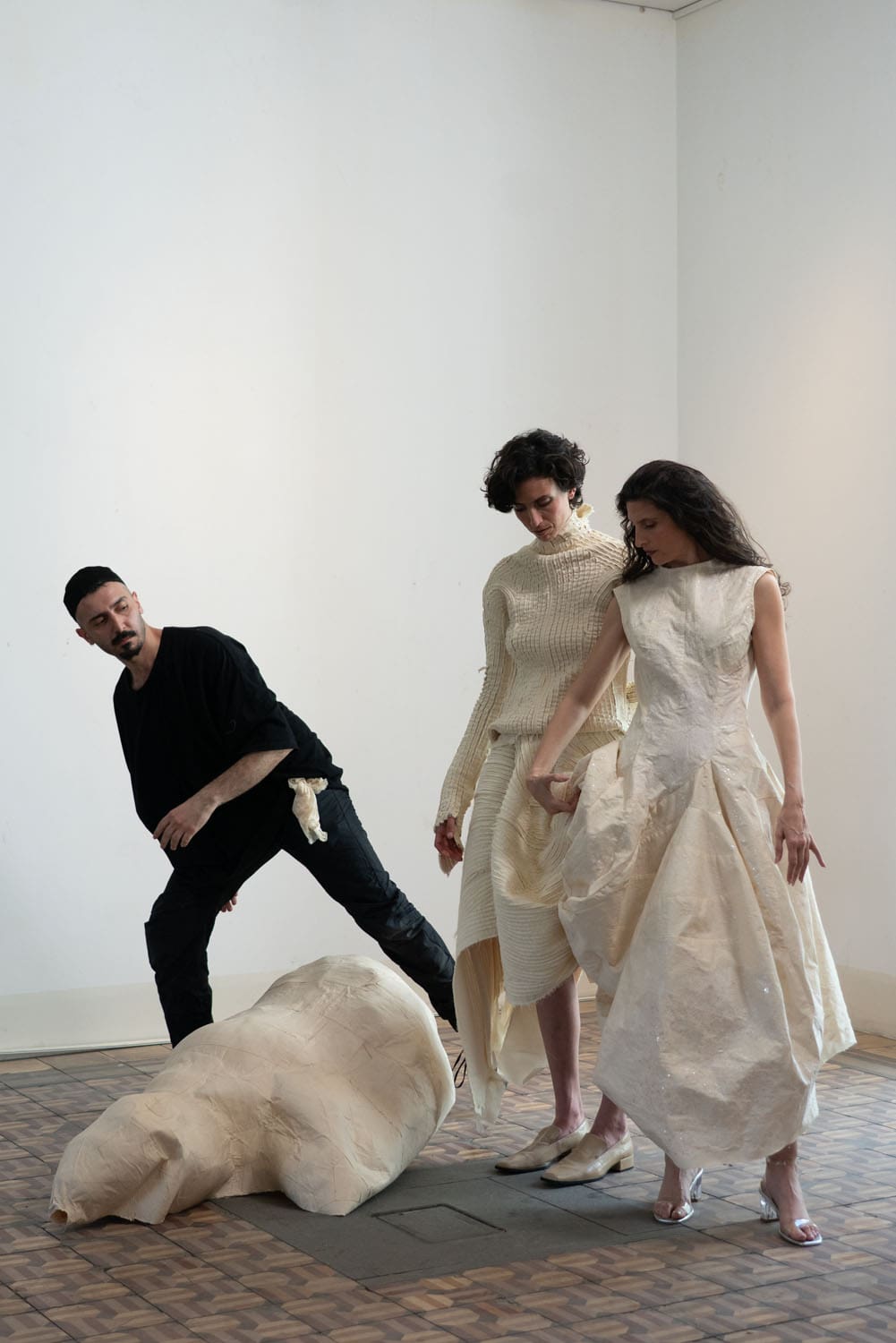
The Jury’s Special Prize honored Lebanese label GOODKILL, founded by creative director Hazem Kais. Rejecting static couture, Kais approaches materials through calculated erosion and metamorphosis. His parchment-toned evening gowns look excavated rather than sewn: one figure wears an ivory silk column dress whose sculpted pannier hips and crinkled paper-crepe bodice seem petrified in time, while another stands wrapped in a ribbed, cocooning knit sheath with an undone funnel neck, accompanied by raw sculpted plaster forms that evoke the passage of human ritual.
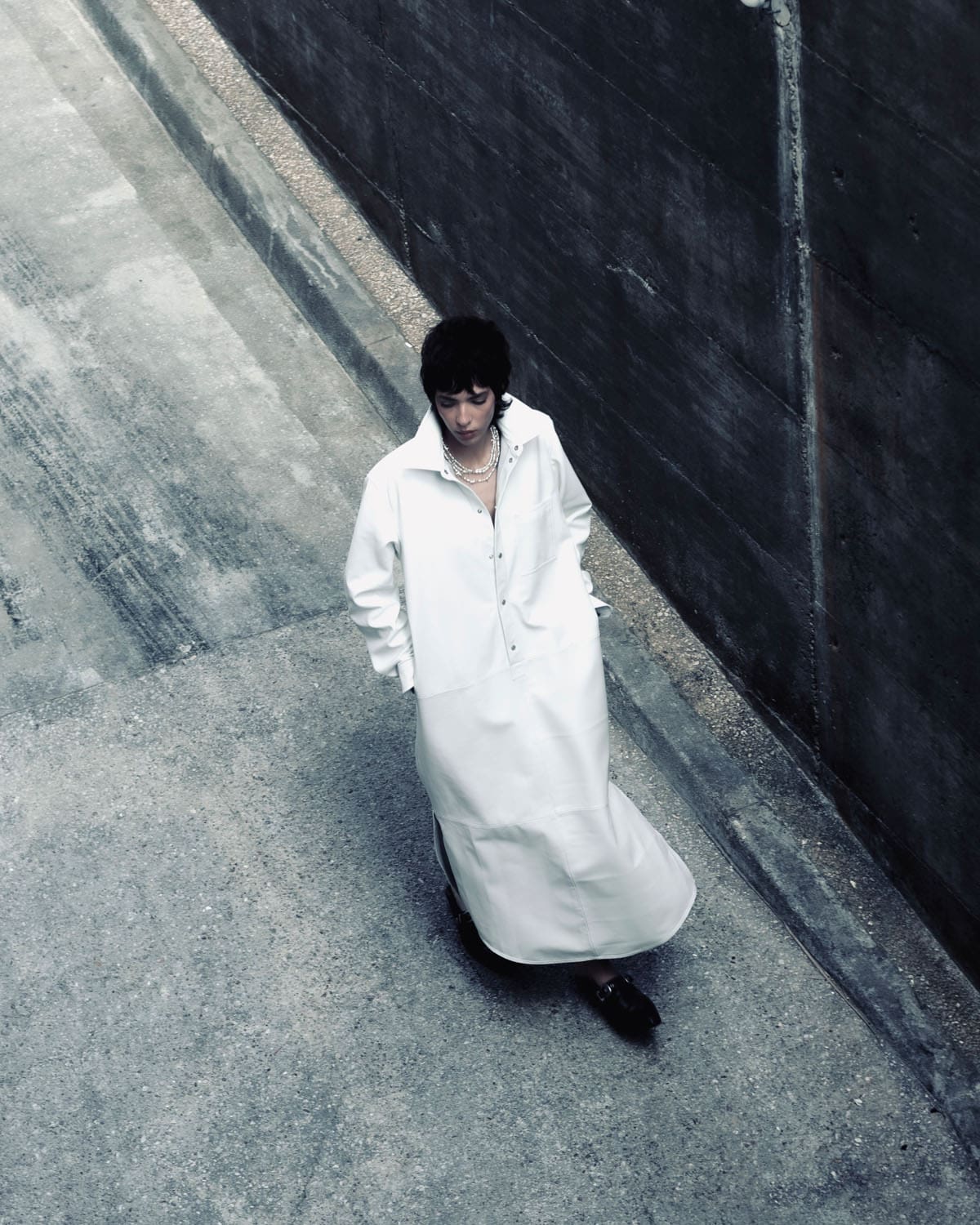
Rounding out the honors, the Creative Entrepreneurship Talent prize recognized Ibrahim Shebani for BORN IN EXILE, bridging Libya and Tunisia. Produced in Tunis with meticulous tailoring, Shebani reinterprets North African garments with clean utilitarian severity. A floor-length poplin shirt-robe cut in chalk white pairs snap-button hardware and a generous storm collar with layered pearl necklaces, worn over black leather monk straps with effortless street poise.
The Arab World Fashion Award demonstrated that the future of fashion will not be written by corporate boardroom spreadsheets or synthetic algorithms. It belongs to hands that know how to hold a needle, minds that honor their ancestral soil, and designers brave enough to construct beauty that endures.