TRADEMARK INFRINGEMENT Walmart’s Unauthorized Commercial Use and Offer for Sale Involving RUNWAY MAGAZINE®.
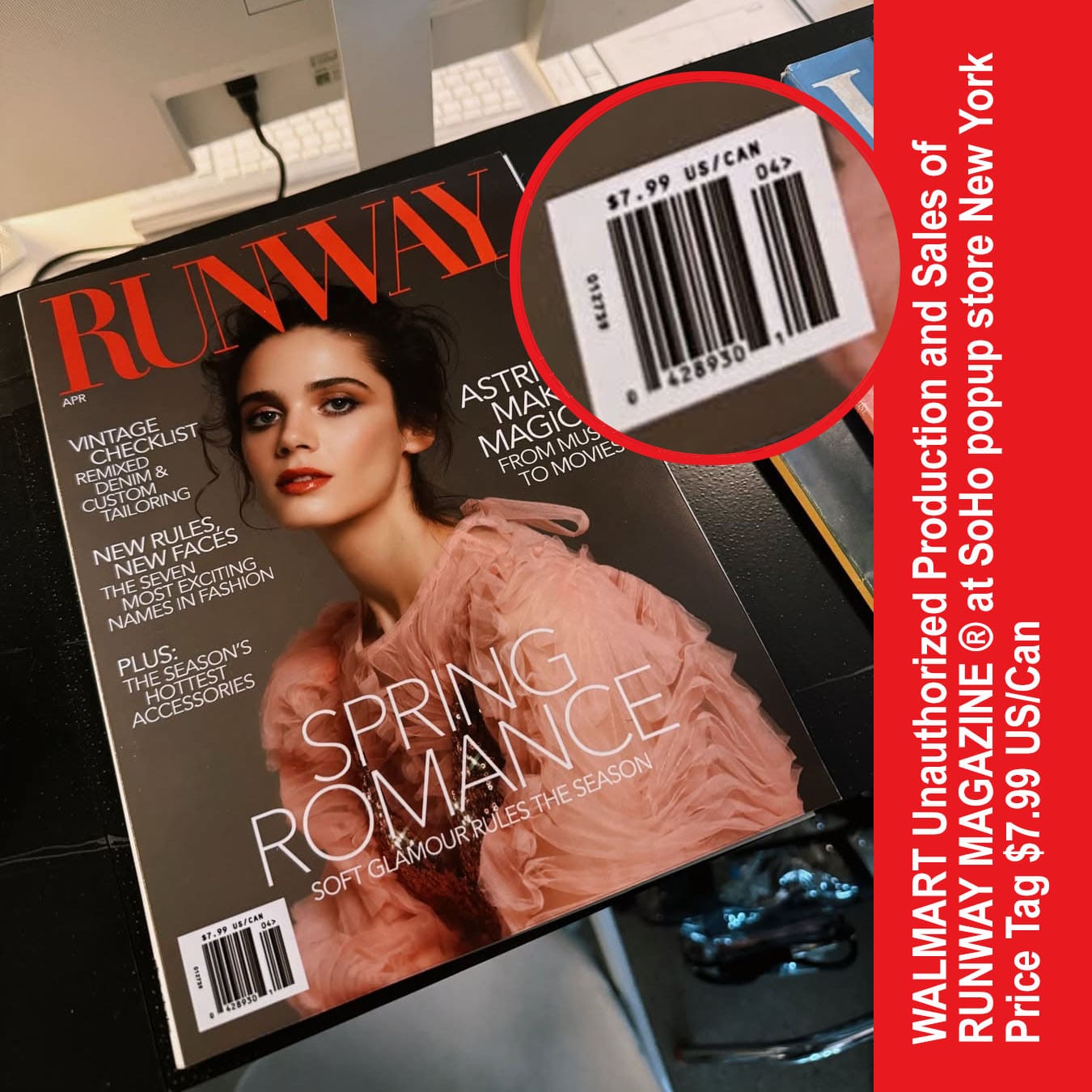
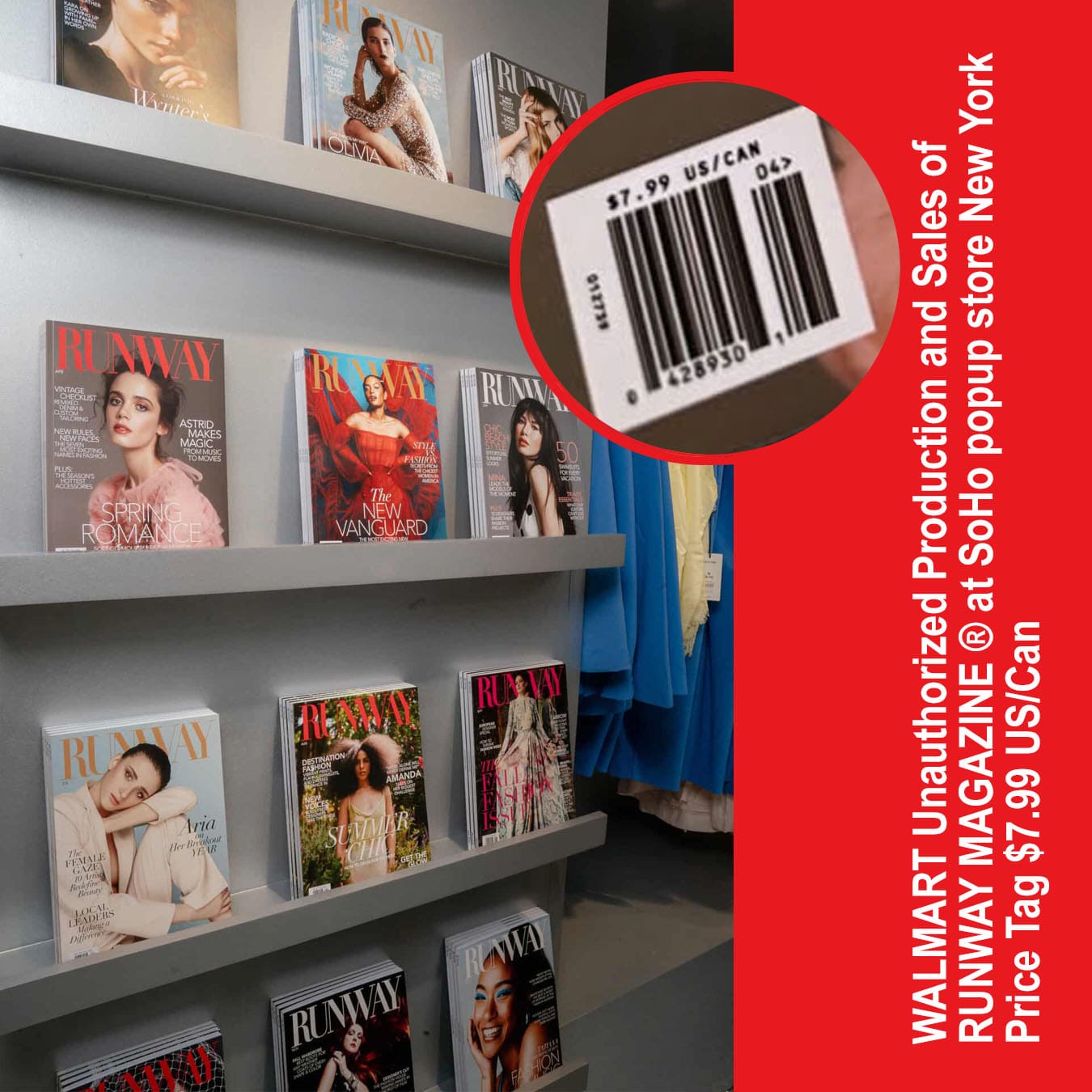
Walmart’s SoHo fashion popup, created in partnership with Scoop – Brandon Maxwell brand for promotional activities surrounding The Devil Wears Prada 2, incorporated fabricated “RUNWAY” magazines into a consumer‑facing retail environment. These items were displayed with price tags, barcodes, and merchandise placement, constituting an unauthorized commercial use and offer for sale involving the RUNWAY MAGAZINE® trade name. In parallel, Walmart deployed digital replicas of the same fabricated magazines inside its Walmart Realm Web3 experience, extending the unauthorized use into a digital commercial environment. These uses were implemented without permission, license, consultation, or authorization from RUNWAY MAGAZINE®.
Unlike other partners whose violations emerged through licensed product lines, Walmart’s misuse of the RUNWAY MAGAZINE® trade name occurred across multiple commercial layers: physical retail, branded installations, and digital interactive environments. The fabricated magazines appeared not only in the SoHo popup but also in promotional imagery circulating online and within Walmart’s own Web3 platform. Although the origin of the fabricated magazines remains unclear, Walmart’s deployment, display, and commercial positioning of these items place the responsibility squarely on Walmart as the commercial actor presenting them to consumers.
The Global “Trade Name” Shield
1. The International Foundation (The Paris Convention) Under Article 8 of the Paris Convention (valid throughout Europe, UK, and the USA), a trade name is protected based on its existence and reputation in trade, regardless of the celebrity status of a fictional counterpart.
2. The United States Protection (The Lanham Act) Under 15 U.S. Code § 1126 (Section 44 of the Lanham Act), the US explicitly codified Article 8 of the Paris Convention. The law states:
“Trade names or commercial names… shall be protected without the obligation of filing or registration whether or not they form parts of marks.”
3. The United Kingdom Protection (Trade Marks Act 1994) In the UK, the “Section 44” equivalent is found in Section 2(2) of the Trade Marks Act 1994. It explicitly protects you even if you haven’t finished your registration:
“No proceedings lie to prevent or recover damages for the infringement of an unregistered trade mark as such; but nothing in this Act affects the law relating to passing off.”
The Retail Activation and Promotional Context
Walmart, through its Scoop brand and designer Brandon Maxwell, participated in promotional activities surrounding The Devil Wears Prada 2 by operating a branded fashion popup in SoHo, New York. Within this retail activation, Walmart displayed multiple fabricated “RUNWAY” magazines alongside priced apparel and accessories. These items carried price tags, barcodes, and merchandise placement, creating the clear impression of commercial availability within a consumer‑facing retail environment.
Unlike licensed film merchandise, these fabricated magazines were not part of any authorized product line, nor were they produced under any legitimate agreement involving RUNWAY MAGAZINE®. Their presence in a Walmart‑operated retail space—positioned among priced goods and integrated into the store’s visual merchandising—constitutes an unauthorized commercial use of the RUNWAY MAGAZINE® trade name.
The underlying legal issue is straightforward: Walmart has no intellectual property rights, licensing authority, or commercial basis to reproduce, display, or offer for sale any materials bearing the RUNWAY MAGAZINE® trade name. The brand identity used in these fabricated magazines does not originate from Disney, Scoop, Brandon Maxwell, or any affiliated partner. No entity involved in the popup possesses the legal capacity to deploy the RUNWAY MAGAZINE® trade name in real‑world commercial environments.
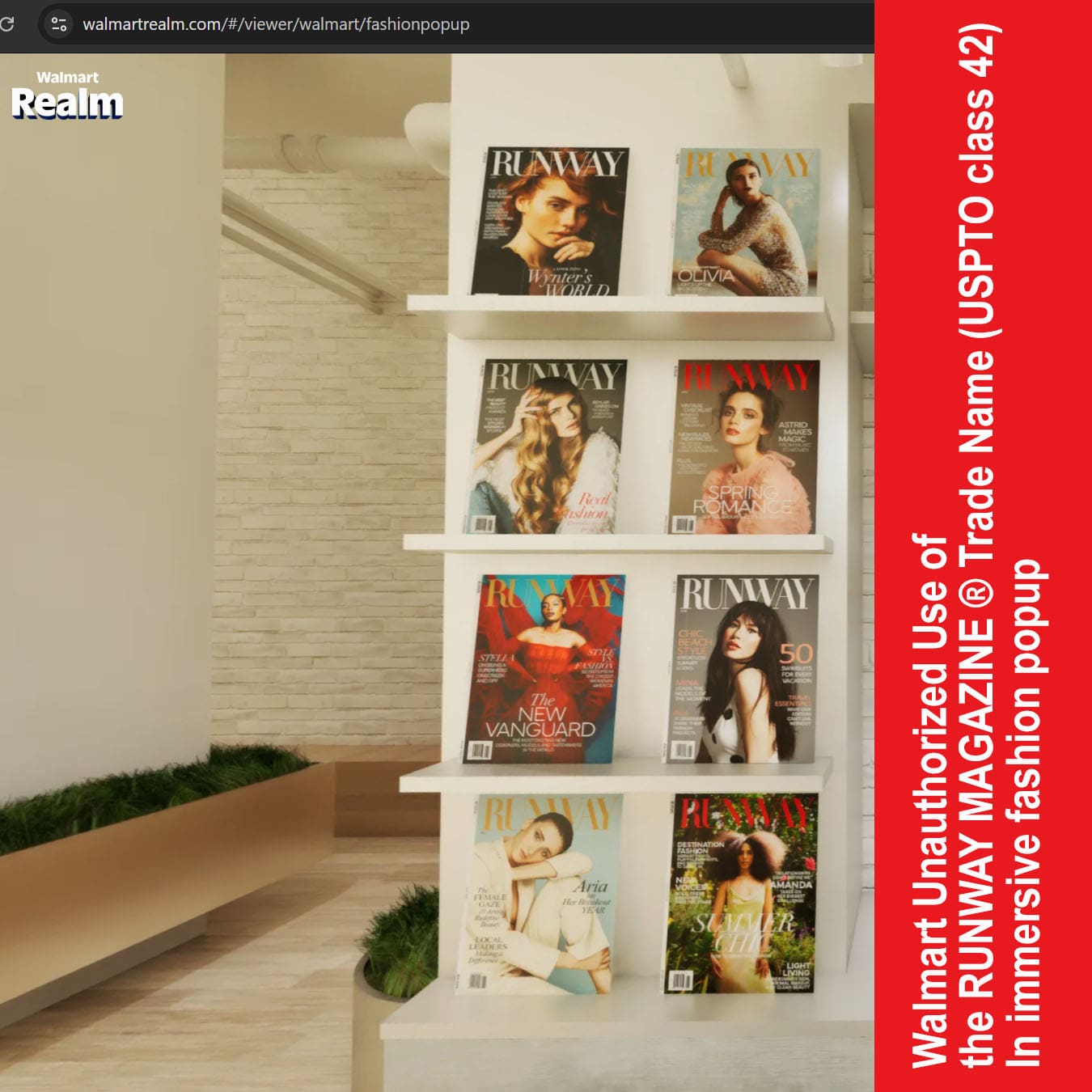
Compounding this misuse, Walmart extended the same fabricated magazines into its Walmart Realm Web3 experience, where digital replicas remain publicly accessible. This digital deployment further amplifies the unauthorized use, placing the RUNWAY MAGAZINE® trade name into a branded interactive environment without permission or consultation.
The Trademark Violation
The fabricated magazines displayed in Walmart’s SoHo popup do not use the fictional cinematic branding created for The Devil Wears Prada for internal narrative purposes. Instead, Walmart presented the RUNWAY MAGAZINE® trade name in a commercial retail environment, positioned among priced merchandise and accompanied by visible price tags and barcodes. This constitutes an unauthorized commercial use and offer for sale involving the RUNWAY MAGAZINE® trade name.
The same fabricated magazines were also deployed in Walmart’s Walmart Realm Web3 experience, where digital replicas remain publicly accessible. This extends the unauthorized use into a digital commercial environment, reinforcing the false impression of affiliation, endorsement, or licensing.
Walmart has no trademark rights, licensing authority, or legal basis to reproduce, display, or commercially position the RUNWAY MAGAZINE® trade name in any physical or digital context. The use of the trade name in these environments constitutes trademark infringement under U.S. and international trademark law.
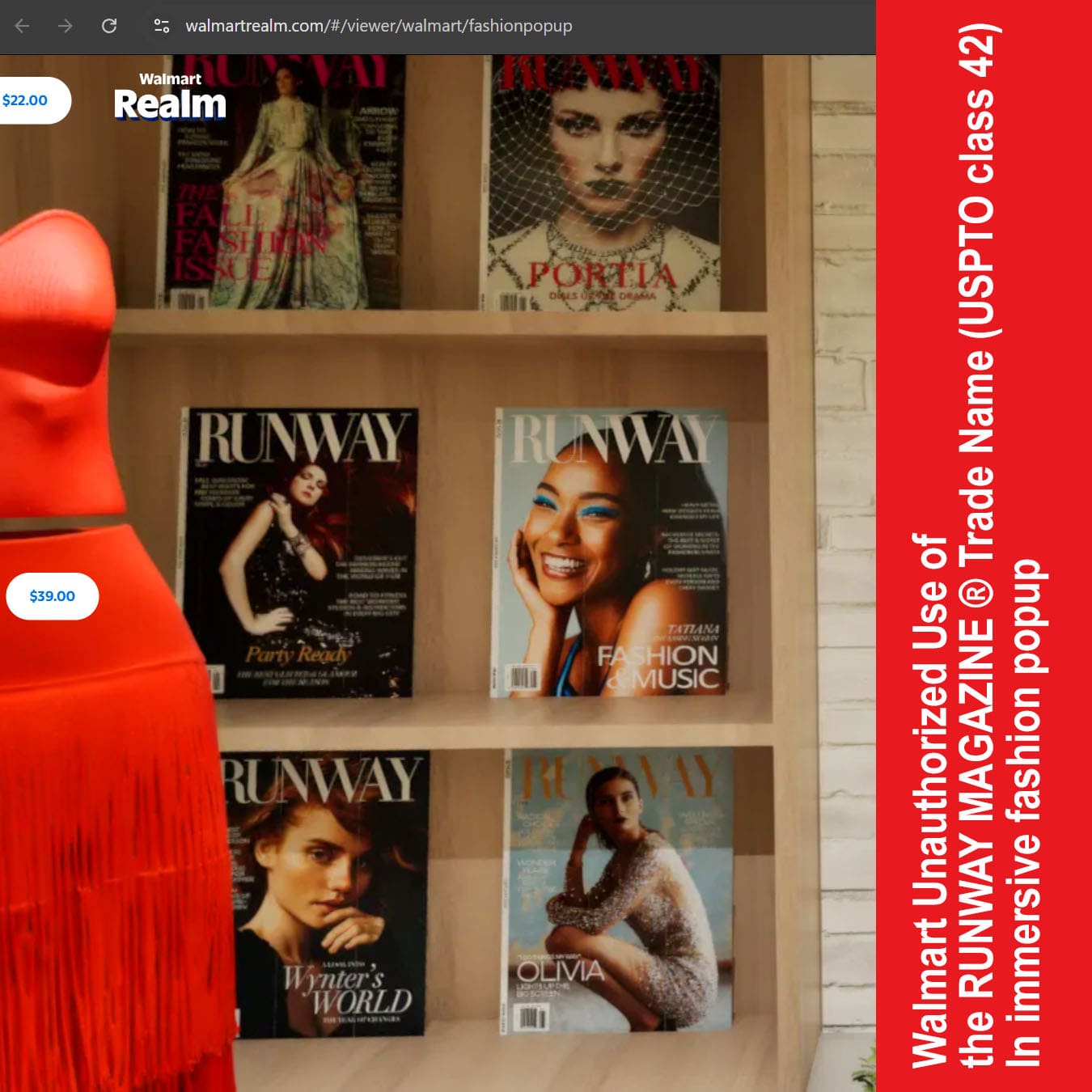
Real Identity vs. Corporate Misrepresentation – The Visual Proof – Walmart TRADEMARK INFRINGEMENT
To understand the scope of Walmart’s trademark violation, one only needs to examine the fabricated “RUNWAY” magazines displayed inside the SoHo popup alongside priced merchandise. These items were not part of any film collectible or freebie, nor were they limited to cinematic narrative use. Instead, Walmart placed them directly into a consumer‑facing retail environment, complete with price tags, barcodes, and merchandise‑level presentation.
A legitimate promotional partner referencing The Devil Wears Prada would rely exclusively on the fictional movie prop branding, used only within the cinematic universe and never authorized for real‑world commerce. Walmart did not do this. The fabricated magazines deployed in the popup and in Walmart Realm present the RUNWAY MAGAZINE® trade name as if it were a legitimate, marketable product associated with Walmart’s fashion activation.
The issue is not the movie prop logo itself — it is Walmart’s commercial deployment of materials bearing the RUNWAY MAGAZINE® trade name in a context that implies availability, affiliation, and endorsement. By positioning these fabricated magazines with price tag among priced goods and replicating them in a branded Web3 environment, Walmart created a false commercial association with an active, global media brand whose identity they have no right to use.
This is not a thematic homage to a film. It is the unauthorized commercial use of a protected trade name inside both physical and digital retail ecosystems.
Key Technical Differences
The Authentic RUNWAY MAGAZINE® Trade Name
- Origin: A globally recognized media brand with registered trademark protections.
- Identity: Represents a real editorial institution, not a fictional cinematic construct.
- Legal Status: Protected under international trademark law, trade name protections, and the Paris Convention.
Walmart’s Infringing Use
- Origin: Fabricated magazines with price tag deployed inside a Walmart‑operated retail popup store and replicated digitally in Walmart Realm.
- Design: Uses the RUNWAY MAGAZINE® trade name in a manner that mimics real editorial branding with price, positioned among priced merchandise.
- Legal Status: An unauthorized commercial use and offer for sale involving a protected trade name, constituting trademark infringement.
Walmart TRADEMARK INFRINGEMENT and the Consequences of Commercial Misrepresentation
The record now reflects a clear and documented misuse of the RUNWAY MAGAZINE® trade name inside Walmart’s SoHo popup and within the Walmart Realm digital environment. By placing fabricated “RUNWAY” magazines with a price tags among priced merchandise and replicating them in a branded Web3 space, Walmart introduced a false commercial association with a real, protected media brand. This is not a cinematic reference; it is a misrepresentation deployed inside retail and digital ecosystems operated under Walmart’s corporate banner.
RUNWAY MAGAZINE® does not permit its identity to be used as retail décor, digital content, or offered for sales for corporate activations. Walmart’s presentation of fabricated “RUNWAY” materials—whether physical or digital—creates consumer confusion and violates the protections afforded to our trade name under international trademark law.
We require the immediate removal of all fabricated “RUNWAY” materials from Walmart’s physical and digital environments, along with a formal clarification that no affiliation or licensing relationship exists. This matter is now part of the public record, and ongoing monitoring will continue across all commercial channels.
FINAL DEMAND: IMMEDIATE CEASE AND DESIST
Notice is hereby publicly served to Walmart Inc. to IMMEDIATELY CEASE AND DESIST from any further use, display, replication, or commercial positioning of the RUNWAY MAGAZINE® trade name. Any continued deployment of fabricated “RUNWAY” materials—whether in retail activations, digital platforms, or offer for sale—will trigger escalated trademark enforcement actions across all applicable jurisdictions.
Public CEASE AND DESIST NOTICE AVAILABLE HERE
Disclaimer: Disney DOES NOT OWN trademarks for RUNWAY / RUNWAY MAGAZINE, DOES NOT HAVE COMMERCIAL USE for Devil Wears Prada 2 characters and fictional universe props until 2026, First Amendment related to author’s rights and covers only fictional narratives.
RUNWAY MAGAZINE® printed editions exist since 1995, operates under the internationally recognized protections for Freedom of Expression, Media Freedom, and the Safety of Journalists as affirmed in Article 11 of the Déclaration des droits de l’homme et du citoyen (1789), Article 19 of the Universal Declaration of Human Rights (1948), Article 10 of the European Convention on Human Rights (1950), the Loi du 29 juillet 1881 sur la liberté de la presse, U.S. constitutional protections for editorial commentary and satire, UNESCO’s standards for the independence of the press, and the protections against abusive litigation (SLAPP) afforded by the EU Anti-SLAPP Directive (2024/1069).
Any effort to restrict, suppress, or unduly pressure a media outlet in the exercise of its journalistic functions stands in tension with these binding standards and the public‑interest role of the press.
Eleonora de Gray, Editor-in-Chief of RUNWAY MAGAZINE:
International Association of Journalists ID W73133, and the American Association of Journalists ID C553-3.
RUNWAY MAGAZINE® operates under the French activity code Édition de revues et périodiques (5814Z) and is governed by the Journalistes (1480) collective agreement.
